Ellis Maggie, Astell Arlene
School of Psychology and Neuroscience, University of St Andrews, St. Andrews, United Kingdom.
ScHARR, University of Sheffield, Sheffield, United Kingdom.
PLoS One. 2017 Aug 1;12(8):e0180395. doi: 10.1371/journal.pone.0180395. eCollection 2017.
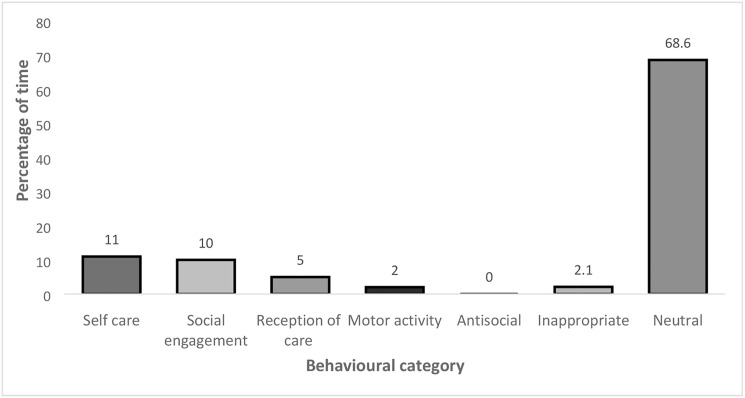
Loss of verbal language production makes people with dementia appear unreachable. We previously presented a case study applying nonverbal communication techniques with a lady with dementia who could no longer speak, which we termed Adaptive Interaction. The current small-n study examines the applicability of Adaptive Interaction as a general tool for uncovering the communication repertoires of non-verbal individuals living with dementia. Communicative responses of 30 interaction sessions were coded and analysed in two conditions: Standard (Baseline) and Adaptive Interaction (Intervention). All participants retained the ability to interact plus a unique communication repertoire comprising a variety of nonverbal components, spanning eye gaze, emotion expression, and movement. In comparison to Baseline sessions, Intervention sessions were characterised by more smiling, looking at ME and imitation behaviour from the people with dementia. These findings allude to the potential of Adaptive Interaction as the basis for interacting with people living with dementia who can no longer speak.
语言表达能力的丧失使痴呆症患者显得难以接近。我们之前展示了一个案例研究,对一位无法再说话的痴呆症女士应用了非语言沟通技巧,我们将其称为适应性互动。当前的小样本研究考察了适应性互动作为一种通用工具的适用性,以揭示痴呆症非言语患者的沟通方式。在两种情况下对30次互动会话的沟通反应进行了编码和分析:标准(基线)和适应性互动(干预)。所有参与者都保留了互动能力以及独特的沟通方式,包括各种非言语成分,如目光接触、情感表达和动作。与基线会话相比,干预会话的特点是痴呆症患者有更多微笑、看向“我”和模仿行为。这些发现暗示了适应性互动作为与无法再说话的痴呆症患者互动基础的潜力。