Vuillemin Aurèle, Horn Fabian, Alawi Mashal, Henny Cynthia, Wagner Dirk, Crowe Sean A, Kallmeyer Jens
GFZ German Research Centre for Geosciences, Section 5.3: GeomicrobiologyPotsdam, Germany.
Research Center for Limnology, Indonesian Institute of SciencesCibinong-Bogor, Indonesia.
Front Microbiol. 2017 Jul 27;8:1440. doi: 10.3389/fmicb.2017.01440. eCollection 2017.
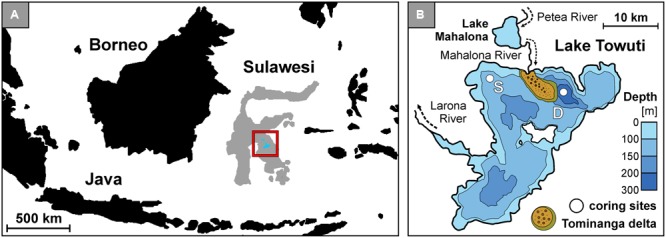
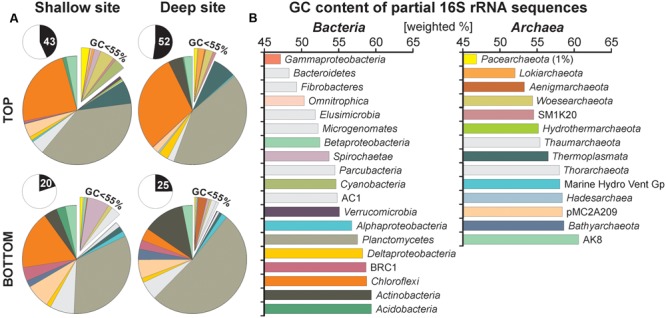
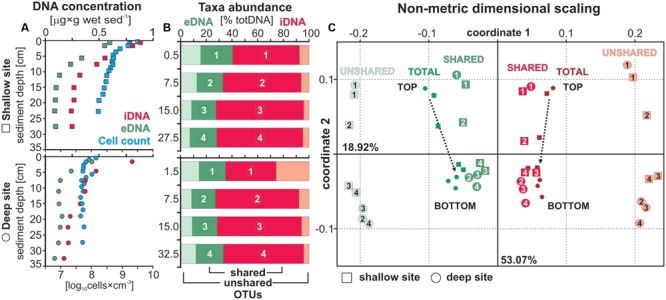
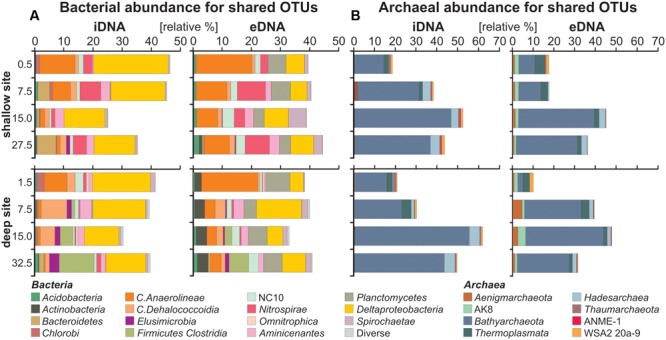
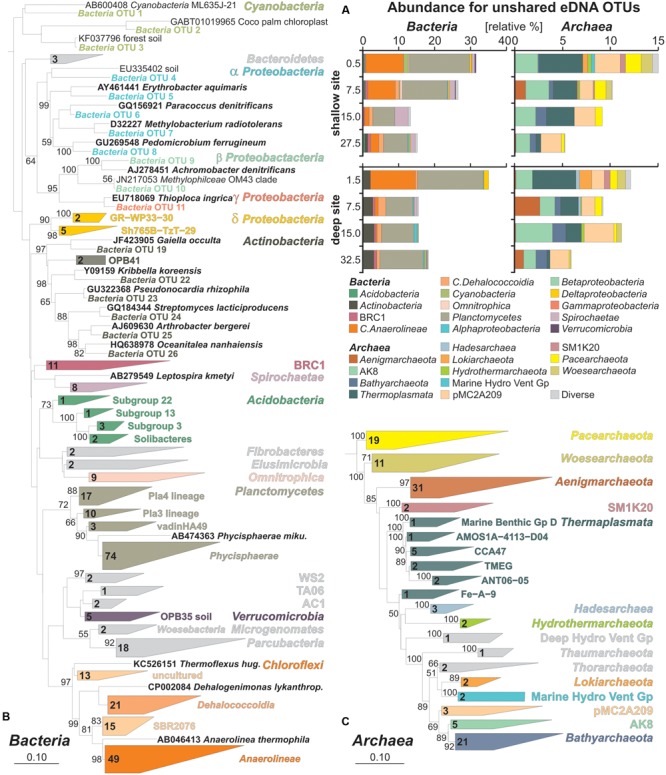
Extracellular DNA is ubiquitous in soil and sediment and constitutes a dominant fraction of environmental DNA in aquatic systems. In theory, extracellular DNA is composed of genomic elements persisting at different degrees of preservation produced by processes occurring on land, in the water column and sediment. Extracellular DNA can be taken up as a nutrient source, excreted or degraded by microorganisms, or adsorbed onto mineral matrices, thus potentially preserving information from past environments. To test whether extracellular DNA records lacustrine conditions, we sequentially extracted extracellular and intracellular DNA from anoxic sediments of ferruginous Lake Towuti, Indonesia. We applied 16S rRNA gene Illumina sequencing on both fractions to discriminate exogenous from endogenous sources of extracellular DNA in the sediment. Environmental sequences exclusively found as extracellular DNA in the sediment originated from multiple sources. For instance, , and derived from soils in the catchment. Limited primary productivity in the water column resulted in few sequences of in the oxic photic zone, whereas stratification of the water body mainly led to secondary production by aerobic and anaerobic heterotrophs. and , the main degraders of sinking organic matter and planktonic sequences at the water-sediment interface, were preferentially preserved during the initial phase of burial. To trace endogenous sources of extracellular DNA, we used relative abundances of taxa in the intracellular DNA to define which microbial populations grow, decline or persist at low density with sediment depth. Cell lysis became an important additional source of extracellular DNA, gradually covering previous genetic assemblages as other microbial genera became more abundant with depth. The use of extracellular DNA as nutrient by active microorganisms led to selective removal of sequences with lowest GC contents. We conclude that extracellular DNA preserved in shallow lacustrine sediments reflects the initial environmental context, but is gradually modified and thereby shifts from its stratigraphic context. Discrimination of exogenous and endogenous sources of extracellular DNA allows simultaneously addressing in-lake and post-depositional processes. In deeper sediments, the accumulation of resting stages and sequences from cell lysis would require stringent extraction and specific primers if ancient DNA is targeted.
细胞外DNA在土壤和沉积物中普遍存在,并且在水生系统中构成环境DNA的主要部分。理论上,细胞外DNA由在陆地、水柱和沉积物中发生的过程产生的、以不同保存程度存在的基因组元件组成。细胞外DNA可以作为营养源被微生物摄取、排泄或降解,或者吸附到矿物基质上,从而有可能保存过去环境的信息。为了测试细胞外DNA是否记录了湖泊状况,我们从印度尼西亚铁质的托武蒂湖的缺氧沉积物中依次提取了细胞外DNA和细胞内DNA。我们对这两个部分都应用了16S rRNA基因的Illumina测序,以区分沉积物中细胞外DNA的外源和内源来源。仅在沉积物中作为细胞外DNA发现的环境序列来自多个来源。例如, 、 和 源自集水区的土壤。水柱中有限的初级生产力导致有氧光合层中 的序列很少,而水体分层主要导致需氧和厌氧异养生物的次级生产。 和 是水体 - 沉积物界面下沉有机物和浮游生物序列的主要降解者,在埋藏初期被优先保存。为了追踪细胞外DNA的内源来源,我们使用细胞内DNA中分类单元的相对丰度来确定哪些微生物种群随着沉积物深度的增加而生长、减少或低密度持续存在。细胞裂解成为细胞外DNA的一个重要额外来源,随着其他微生物属随着深度增加而变得更加丰富,逐渐覆盖了先前的遗传组合。活跃微生物将细胞外DNA用作营养物质导致GC含量最低的序列被选择性去除。我们得出结论,保存在浅湖相沉积物中的细胞外DNA反映了初始环境背景,但会逐渐被改变,从而偏离其地层背景。区分细胞外DNA的外源和内源来源可以同时研究湖泊内和沉积后的过程。在更深的沉积物中,如果目标是古代DNA,静止期的积累和细胞裂解产生的序列将需要严格的提取和特异性引物。