Pediatric Endocrine Unit, Massachusetts General Hospital for Children and Harvard Medical School, Boston, MA, USA; Neuroendocrine Unit, Massachusetts General Hospital and Harvard Medical School, Boston, MA, USA.
Neuroendocrine Unit, Massachusetts General Hospital and Harvard Medical School, Boston, MA, USA.
Psychoneuroendocrinology. 2017 Nov;85:28-34. doi: 10.1016/j.psyneuen.2017.07.486. Epub 2017 Jul 24.
The hypothalamic hormone oxytocin (OXT) plays an important role in a range of physiological processes and social-emotional functioning in both sexes. In women, physiological stimuli, such as suckling and parturition, result in pulsatile release of OXT into the peripheral circulation via the posterior pituitary gland. However, data regarding OXT secretory patterns in men during a state of rest are limited. Further, the relationship between secretory dynamics of OXT and emotional measures has never been evaluated. We hypothesized a pulsatile pattern of OXT secretion in men, and explored the relationship between OXT secretory patterns and social-emotional functioning.
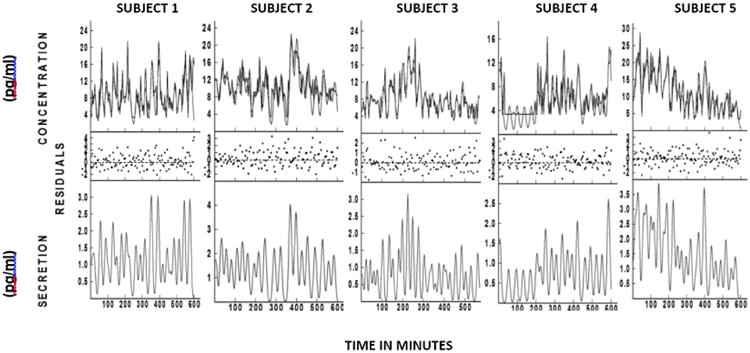
Deconvolution analysis was performed on serum OXT levels obtained every 5min over a period of 10h in 5 healthy normal weight men. Area under the curve (AUC), average OXT values, and pulse characteristics [pulse number, inter-pulse interval, pulse height and mass (area under each pulse)] were calculated. State Adult Attachment Measure (SAAM) assessed types of human attachment. Interpersonal Support Evaluation List (ISEL) assessed perception of social support. Toronto Alexithymia Scale (TAS-20) measured the ability to express and identify one's own emotions.
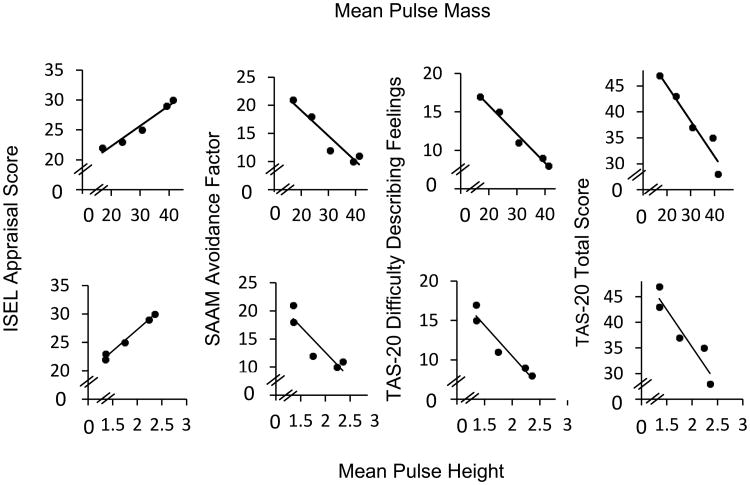
Mean age was 22.8±1.2years, and BMI was 21.7±0.4kg/m (mean±SEM). Assuming a basal secretion of zero and a half life of five to seven minutes, we demonstrated the following: OXT AUC: 5421±1331pg/ml, mean OXT level: 9.1pg/ml, mean pulse number: 22±3/10hr, mean pulse height: 1.81±0.48pg/ml, mean pulse mass: 30.34±10.29pg/ml and mean inter-pulse interval: 27±4min. The SAAM Avoidant scale correlated negatively with mean OXT pulse height (r=-0.90, p=0.04) and pulse mass (r=-0.95, p=0.01). The ISEL Belonging score correlated positively with OXT AUC (r=0.89, p=0.04) and average OXT (r=0.93, p=0.02). ISEL Appraisal score also had a positive association with mean OXT pulse height (r=0.99, p=0.0006) and pulse mass (r=0.98, p=0.003). Finally, ISEL total score had a significant correlation with average OXT values (r=0.90, p=0.04). While none of the subjects had a score in the alexithymia range, TAS-20 Difficulty describing feelings score had an inverse correlation with OXT pulse height (r=-0.96, p=0.01) and pulse mass (r=-0.99, p=0.001). TAS-20 total score also had an inverse correlation with OXT pulse height (r=-0.94, p=0.02) and pulse mass (r=-0.96, p=0.009).
We demonstrate a pulsatile pattern of peripheral OXT secretion in healthy men at rest. Subjects with lower OXT pulse height and pulse mass had a more avoidant style of attachment, felt less supported, and expressed greater difficulty in describing their feelings. Our findings support the concept that OXT is a key mediator of social-emotional functioning. Future studies to determine causality are warranted.
探究健康男性静息状态下外周 oxytocin(OXT)的分泌模式及其与社会情感功能的关系。
采用 5 名健康正常体重男性的血清 OXT 水平,每 5 分钟采集 1 次,共采集 10 小时。采用解析法计算 OXT 曲线下面积(AUC)、平均 OXT 值、脉冲特征[脉冲数、脉冲间隔、脉冲高度和脉冲质量(每个脉冲下的面积)]。成人依恋量表(SAAM)评估人类依恋类型。人际支持评估量表(ISEL)评估社会支持的感知。多伦多述情障碍量表(TAS-20)评估表达和识别自身情绪的能力。
参与者平均年龄为 22.8±1.2 岁,BMI 为 21.7±0.4kg/m(均值±SEM)。假设基础分泌为零,半衰期为 5-7 分钟,我们发现:OXT AUC:5421±1331pg/ml,平均 OXT 水平:9.1pg/ml,平均脉冲数:22±3/10 小时,平均脉冲高度:1.81±0.48pg/ml,平均脉冲质量:30.34±10.29pg/ml,平均脉冲间隔:27±4 分钟。SAAM 回避量表与平均 OXT 脉冲高度(r=-0.90,p=0.04)和脉冲质量(r=-0.95,p=0.01)呈负相关。ISEL 归属感评分与 OXT AUC(r=0.89,p=0.04)和平均 OXT(r=0.93,p=0.02)呈正相关。ISEL 评价评分与平均 OXT 脉冲高度(r=0.99,p=0.0006)和脉冲质量(r=0.98,p=0.003)也呈正相关。最后,ISEL 总分与平均 OXT 值呈显著相关(r=0.90,p=0.04)。尽管没有受试者的得分处于述情障碍范围内,但 TAS-20 描述困难评分与 OXT 脉冲高度(r=-0.96,p=0.01)和脉冲质量(r=-0.99,p=0.001)呈负相关。TAS-20 总分与 OXT 脉冲高度(r=-0.94,p=0.02)和脉冲质量(r=-0.96,p=0.009)也呈负相关。
我们在健康男性静息状态下证明了外周 OXT 分泌的脉冲模式。OXT 脉冲高度和脉冲质量较低的受试者表现出更回避的依恋风格,感到支持较少,表达自身情绪的难度较大。我们的研究结果支持了 OXT 是社会情感功能的关键调节因子这一概念。需要进一步的研究来确定因果关系。