Parsons Dave, Cordier Reinie, Vaz Sharmila, Lee Hoe C
School of Occupational Therapy and Social Work, Curtin University, Perth, Australia.
J Med Internet Res. 2017 Aug 14;19(8):e198. doi: 10.2196/jmir.6651.
Parent training programs for families living outside of urban areas can be used to improve the social behavior and communication skills in children with autism spectrum disorder (ASD). However, no review has been conducted to investigate these programs.
The aim of this study was to (1) systematically review the existing evidence presented by studies on parent-mediated intervention training, delivered remotely for parents having children with ASD and living outside of urban areas; (2) provide an overview of current parent training interventions used with this population; (3) and provide an overview of the method of delivery of the parent training interventions used with this population.
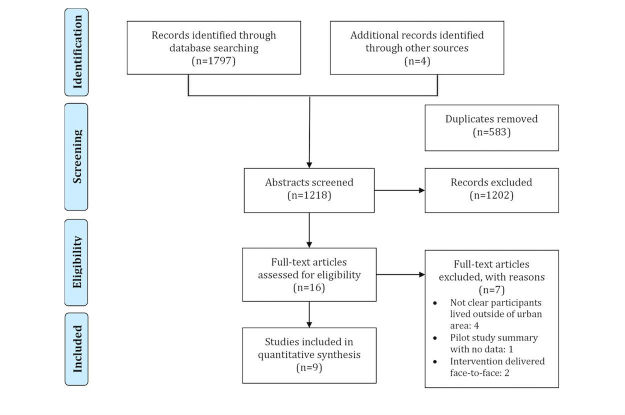
Guided by the preferred reporting items for systematic reviews and meta-analyses (PRISMA) statement, we conducted a comprehensive review across 5 electronic databases (CINAHL, Embase, ERIC, PsycINFO, and Pubmed) on July 4, 2016, searching for studies investigating parent-mediated intervention training for families living outside of urban centers who have a child diagnosed with ASD. Two independent researchers reviewed the articles for inclusion, and assessment of methodological quality was based on the Kmet appraisal checklist.
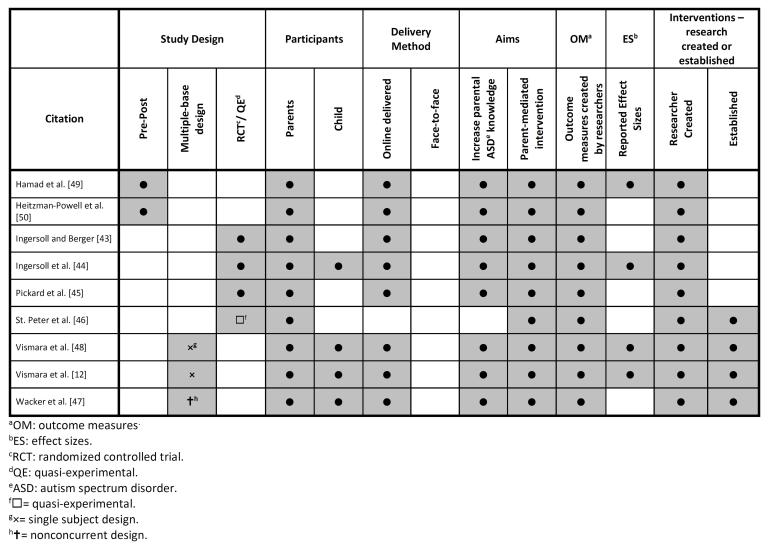
Seven studies met the eligibility criteria, including 2 prepost cohort studies, 3 multiple baseline studies, and 2 randomized controlled trials (RCTs). Interventions included mostly self-guided websites: with and without therapist assistance (n=6), with training videos, written training manuals, and videoconferencing. Post intervention, studies reported significant improvements (P<.05) in parent knowledge (n=4), parent intervention fidelity (n=6), and improvements in children's social behavior and communication skills (n=3). A high risk of bias existed within all of the studies because of a range of factors including small sample sizes, limited use of standardized outcome measures, and a lack of control groups to negate confounding factors.
There is preliminary evidence that parent-mediated intervention training delivered remotely may improve parent knowledge, increase parent intervention fidelity, and improve the social behavior and communication skills for children with ASD. A low number of RCTs, difficulty in defining the locality of the population, and a paucity of standardized measures limit the generalization of the findings to the target population. Future studies should investigate the appropriateness and feasibility of the interventions, include RCTs to control for bias, and utilize standard outcome measures.
针对居住在城市以外地区家庭的家长培训项目,可用于改善自闭症谱系障碍(ASD)儿童的社交行为和沟通技巧。然而,尚未有综述对这些项目进行调查。
本研究的目的是:(1)系统回顾关于为居住在城市以外地区且子女患有ASD的家长远程提供的家长介导干预训练研究中所呈现的现有证据;(2)概述目前针对该人群使用的家长培训干预措施;(3)概述针对该人群使用的家长培训干预措施的实施方法。
以系统评价和荟萃分析的首选报告项目(PRISMA)声明为指导,我们于2016年7月4日在5个电子数据库(CINAHL、Embase、ERIC、PsycINFO和Pubmed)中进行了全面检索,寻找调查为居住在城市中心以外地区且子女被诊断患有ASD的家庭提供家长介导干预训练的研究。两名独立研究人员对文章进行纳入审查,方法学质量评估基于Kmet评估清单。
七项研究符合纳入标准,包括2项前后队列研究、3项多重基线研究和2项随机对照试验(RCT)。干预措施主要包括自助式网站:有或没有治疗师协助(n = 6),配有培训视频、书面培训手册和视频会议。干预后,研究报告家长知识(n = 4)、家长干预保真度(n = 6)有显著改善(P <.05),儿童社交行为和沟通技巧也有改善(n = 3)。由于一系列因素,包括样本量小、标准化结局测量使用有限以及缺乏对照组以消除混杂因素,所有研究中均存在较高的偏倚风险。
有初步证据表明,远程提供的家长介导干预训练可能会提高家长知识、增加家长干预保真度,并改善ASD儿童的社交行为和沟通技巧。RCT数量少、难以界定人群所在地以及标准化测量方法匮乏,限制了研究结果向目标人群的推广。未来的研究应调查干预措施的适宜性和可行性,纳入RCT以控制偏倚,并使用标准化结局测量方法。