Hull Michael V, Neddo Jonathan, Jagim Andrew R, Oliver Jonathan M, Greenwood Mike, Jones Margaret T
Center for Sports Performance, George Mason University, Fairfax, VA USA.
Division of Health & Human Performance, George Mason University, 10890 George Mason Circle, MS 4E5, Manassas, VA 20110-2203 USA.
J Int Soc Sports Nutr. 2017 Aug 10;14:29. doi: 10.1186/s12970-017-0187-6. eCollection 2017.
The purpose was to survey dietary habits (DH) and nutrient timing (NT) practices of baseball student-athletes (mean ± 20.7 ± 1.4 yr.) from three NCAA Division I institutions, and examine the effect of a sports dietitian (SD) in regard to nutrition practices.
Descriptive statistics and Pearson analyses were run. Responses on 10 DH and 5 NT items differed ( ≤ 0.10) between athletes who sought dietary planning from a SD ( = 36) versus those who consulted a strength and conditioning coach (SCC, = 42).
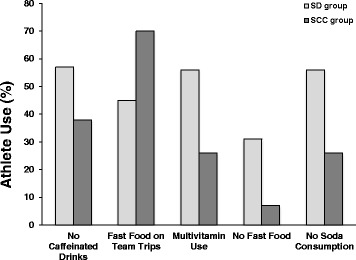
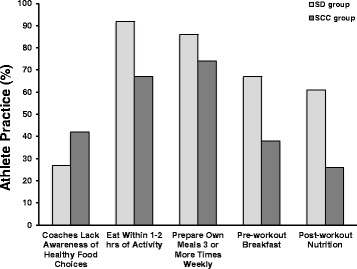
In regard to DH items, the SD group found it easier to eat before activity (92% vs. 71%, = 0.03), did not consume fast food (31% vs. 14%, = 0.02), caffeinated beverages (57% vs. 46%, = 0.02), or soda (56% vs. 37%, = 0.10), prepared their own meals more often (86% vs. 73%, = 0.07), and took daily multi-vitamins (56% vs. 32%, = 0.02). The SCC group ate more at burger locations (21% vs. 6%, = 0.02). In regard to NT items, the SD group ate breakfast before training/lifting sessions (67% vs. 37%, = 0.02), and had post-workout nutrition options provided (61% vs. 27%, = 0.01). The SCC group reported pre-competition meals of fast food (58% vs. 45%, = 0.01), and sport coaches who were less aware of healthy food options (39% vs. 65%, = 0.05).
The SD is as a valuable asset to an intercollegiate athletics program. In the current study, athletes from the SD group consumed less high calorie/low nutrient dense items, ate before exercise, and consumed healthier options post-exercise. The presence of a SD was linked to provision of healthier food options during team trips. The evidence-based eating strategies and dietary plan provided by a SD may lead to improved performance and recovery.
本研究旨在调查来自美国大学体育协会(NCAA)一级联盟三所院校的棒球学生运动员(平均年龄±20.7±1.4岁)的饮食习惯(DH)和营养摄入时间(NT)情况,并研究运动营养师(SD)对营养实践的影响。
进行描述性统计和Pearson分析。在寻求运动营养师制定饮食计划的运动员(n = 36)和咨询力量与体能教练(SCC,n = 42)的运动员之间,对10项饮食习惯和5项营养摄入时间项目的回答存在差异(p≤0.10)。
在饮食习惯方面,运动营养师组的运动员发现在活动前更容易进食(92%对71%,p = 0.03),不吃快餐(31%对14%,p = 0.02)、含咖啡因饮料(57%对46%,p = 0.02)或汽水(56%对37%,p = 0.10),更常自己准备饭菜(86%对73%,p = 0.07),并且每天服用多种维生素(56%对32%,p = 0.02)。力量与体能教练组的运动员在汉堡店就餐的更多(21%对6%,p = 0.02)。在营养摄入时间方面,运动营养师组的运动员在训练/举重前吃早餐(67%对37%,p = 0.02),并且有运动后营养补充选择(61%对27%,p = 0.01)。力量与体能教练组的运动员报告在比赛前吃快餐(58%对45%,p = 0.01),并且体育教练对健康食物选择的了解较少(39%对65%)。
运动营养师是大学体育项目的宝贵资产。在本研究中,运动营养师组的运动员摄入的高热量/低营养密度食物较少,在运动前进食,并且在运动后选择更健康的食物。运动营养师的存在与团队旅行期间提供更健康的食物选择有关。运动营养师提供的循证饮食策略和饮食计划可能会提高运动表现和促进恢复。