College of Chemistry and Materials Science, Anhui Normal University, Wuhu, China.
Department of Chemistry, Hong Kong Baptist University, Kowloon Tong, Hong Kong, China.
Sci Rep. 2017 Aug 21;7(1):8980. doi: 10.1038/s41598-017-09478-6.
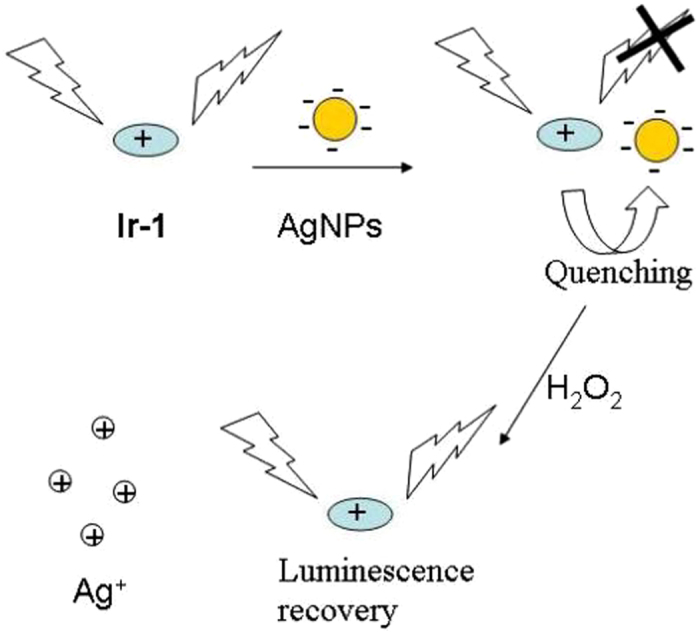
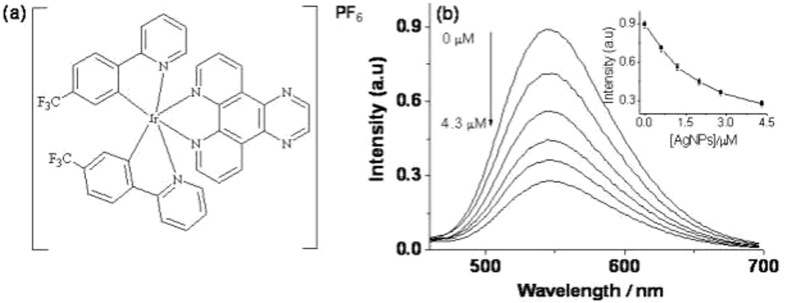
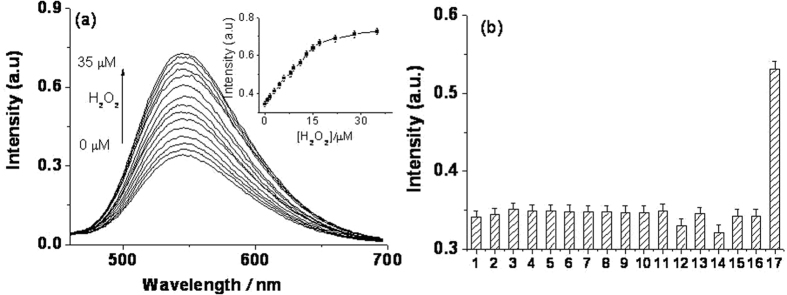
A sensitive turn-on luminescent sensor for HO based on the silver nanoparticle (AgNP)-mediated quenching of an luminescent Ir(III) complex (Ir-1) has been designed. In the absence of HO, the luminescence intensity of Ir-1 can be quenched by AgNPs via non-radiative energy transfer. However, HO can oxidize AgNPs to soluble Ag cations, which restores the luminescence of Ir-1. The sensing platform displayed a sensitive response to HO in the range of 0-17 μM, with a detection limit of 0.3 μM. Importantly, the probe was successfully applied to monitor intracellular HO in living cells, and it also showed high selectivity for HO over other interfering substances.
设计了一种基于银纳米粒子(AgNP)介导的发光铱(III)配合物(Ir-1)荧光猝灭的灵敏的 HO 型荧光传感器。在不存在 HO 的情况下,Ir-1 的发光强度可以通过 AgNPs 进行非辐射能量转移而猝灭。然而,HO 可以将 AgNPs 氧化为可溶性 Ag 阳离子,从而恢复 Ir-1 的发光。该传感平台对 HO 的响应范围为 0-17 μM,检测限为 0.3 μM。重要的是,该探针成功地应用于活细胞内 HO 的监测,并且对 HO 具有高选择性,优于其他干扰物质。