Joshi Chaitanya Pradeep, D'Lima Cynthia Bernardo, Samat Urmila Chandrashekhar, Karde Prerna Ashok, Patil Agraja Ganpat, Dani Nitin Hemchandra
Department of Periodontics, MGV's KBH Dental College and Hospital, Nashik, India.
Tissue Bank, Tata Memorial Hospital and Research Centre, Mumbai, India.
Contemp Clin Dent. 2017 Apr-Jun;8(2):211-217. doi: 10.4103/ccd.ccd_147_17.
For the first time in India, allografts from human extracted teeth were prepared. A randomized, prospective, clinicoradiographical, histological study was conducted to evaluate their efficacy in comparison with freeze-dried bone allograft (FDBA) in alveolar ridge preservation.
Graft preparation: with written consent, teeth were collected from three donors (full mouth extraction cases). Once donors' serums were tested negative for HIV, HBV, HCV, and Venereal disease research laboratory (VDRL), mineralized whole tooth allograft (WTA) and dentin allograft (DA) were prepared using the standard protocol of Tissue Bank at Tata Memorial Hospital, Mumbai, India.
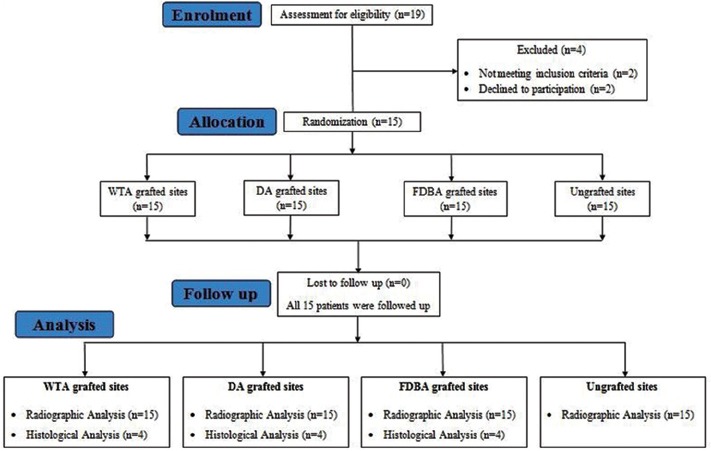
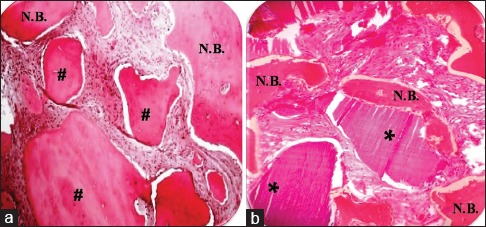
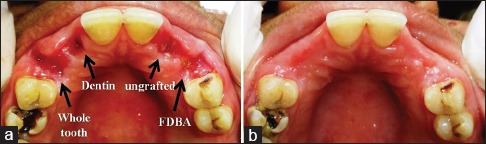
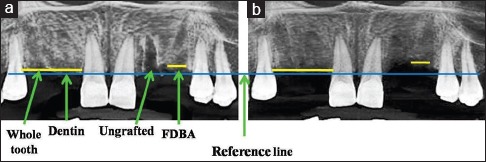
In this randomized controlled trial, 15 patients undergoing extraction of at least four teeth were selected. In each patient after atraumatic extractions, one socket was grafted with WTA, second with DA, third with FDBA, and fourth was left ungrafted (control site). All the sites were covered with chorion membrane. To estimate three-dimensional alveolar crest changes, cone beam computed tomography scans were taken immediately after grafting and 4 months postoperatively. Bone biopsies using 3 mm trephine bur were obtained from four patients at the time of implant placement and evaluated histologically.
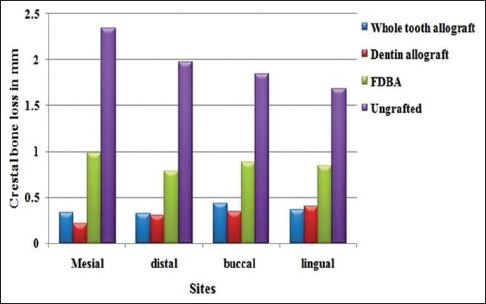
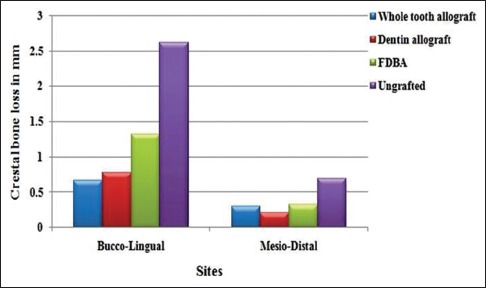
Clinically uneventful healing was observed at all sites. Compared to other sites, WTA and DA consistently showed superior results demonstrating least reduction in alveolar crest height and width which was statistically significant ( < 0.05). Between WTA and DA sites, there was no statistically significant difference. Histological analysis also confirmed more new bone formation at WTA and DA sites.
Rather than disposing extracted human teeth as a biomedical waste (common practice), they can be collected from suitable systemically healthy donors. With the help of tissue bank, they can be processed into an allograft, serving as an excellent alternative to conventional allografts.
在印度首次制备了来自人类拔除牙齿的同种异体移植物。进行了一项随机、前瞻性、临床影像学、组织学研究,以评估其与冻干骨同种异体移植物(FDBA)相比在牙槽嵴保存中的疗效。
移植物制备:在获得书面同意后,从三名捐赠者(全口拔牙病例)收集牙齿。一旦捐赠者血清的HIV、HBV、HCV和性病研究实验室(VDRL)检测呈阴性,使用印度孟买塔塔纪念医院组织库的标准方案制备矿化全牙同种异体移植物(WTA)和牙本质同种异体移植物(DA)。
在这项随机对照试验中,选择了15名至少拔除四颗牙齿的患者。在每位患者进行无创拔牙后,一个牙槽窝植入WTA,第二个植入DA,第三个植入FDBA,第四个不植入(对照部位)。所有部位均覆盖绒毛膜。为了评估三维牙槽嵴变化,在植入后立即和术后4个月进行锥形束计算机断层扫描。在植入种植体时,从四名患者处获取3毫米环钻活检组织,并进行组织学评估。
所有部位均观察到临床愈合顺利。与其他部位相比,WTA和DA始终显示出更好的结果,牙槽嵴高度和宽度的减少最少,具有统计学意义(<0.05)。在WTA和DA部位之间,没有统计学上的显著差异。组织学分析也证实WTA和DA部位有更多的新骨形成。
与其将拔除的人类牙齿作为生物医学废物处理(常见做法),不如从系统健康的合适捐赠者处收集。在组织库的帮助下,它们可以被加工成同种异体移植物,作为传统同种异体移植物的极佳替代品。