Indrio Flavia, Martini Silvia, Francavilla Ruggiero, Corvaglia Luigi, Cristofori Fernanda, Mastrolia Salvatore Andrea, Neu Josef, Rautava Samuli, Russo Spena Giovanna, Raimondi Francesco, Loverro Giuseppe
Department of Pediatrics, Aldo Moro University, Bari, Italy.
Neonatology and Neonatal Intensive Care Unit, St. Orsola-Malpighi Hospital, Department of Medical and Surgical Sciences, University of Bologna, Bologna, Italy.
Front Pediatr. 2017 Aug 22;5:178. doi: 10.3389/fped.2017.00178. eCollection 2017.
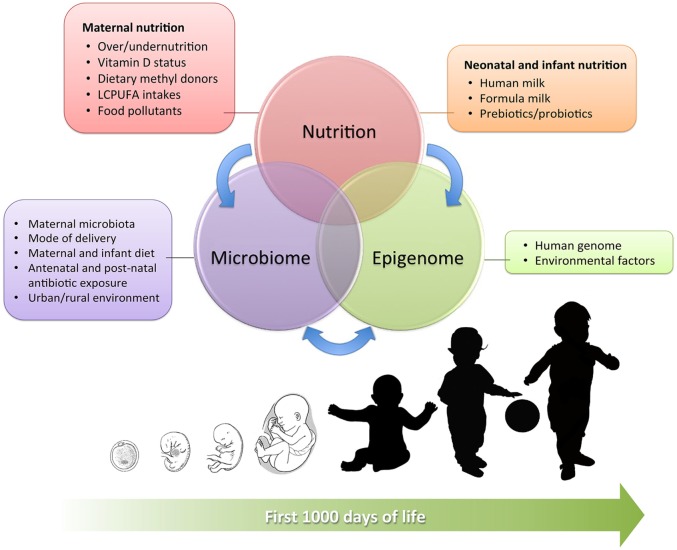
Epigenetic modifications are among the most important mechanisms by which environmental factors can influence early cellular differentiation and create new phenotypic traits during pregnancy and within the neonatal period without altering the deoxyribonucleic acid sequence. A number of antenatal and postnatal factors, such as maternal and neonatal nutrition, pollutant exposure, and the composition of microbiota, contribute to the establishment of epigenetic changes that can not only modulate the individual adaptation to the environment but also have an influence on lifelong health and disease by modifying inflammatory molecular pathways and the immune response. Postnatal intestinal colonization, in turn determined by maternal flora, mode of delivery, early skin-to-skin contact and neonatal diet, leads to specific epigenetic signatures that can affect the barrier properties of gut mucosa and their protective role against later insults, thus potentially predisposing to the development of late-onset inflammatory diseases. The aim of this review is to outline the epigenetic mechanisms of programming and development acting within early-life stages and to examine in detail the role of maternal and neonatal nutrition, microbiota composition, and other environmental factors in determining epigenetic changes and their short- and long-term effects.
表观遗传修饰是环境因素影响早期细胞分化并在孕期和新生儿期创造新表型特征的最重要机制之一,且不会改变脱氧核糖核酸序列。许多产前和产后因素,如母婴营养、污染物暴露和微生物群组成,都有助于表观遗传变化的形成,这些变化不仅可以调节个体对环境的适应能力,还能通过改变炎症分子途径和免疫反应影响一生的健康和疾病。产后肠道定植又由母体菌群、分娩方式、早期皮肤接触和新生儿饮食决定,会导致特定的表观遗传特征,这些特征会影响肠道黏膜的屏障特性及其对后期损伤的保护作用,从而可能引发迟发性炎症性疾病。本综述的目的是概述生命早期阶段的编程和发育的表观遗传机制,并详细探讨母婴营养、微生物群组成和其他环境因素在决定表观遗传变化及其短期和长期影响方面的作用。