Pasman Wilrike J, Boessen Ruud, Donner Yoni, Clabbers Nard, Boorsma André
TNO, Department of Microbiology and Systems Biology, Zeist, Netherlands.
TNO, Department of Risk Analysis for Products In Development, Zeist, Netherlands.
JMIR Res Protoc. 2017 Sep 7;6(9):e169. doi: 10.2196/resprot.6727.
There is an increasing interest among nutritional researchers to perform lifestyle and nutritional intervention studies in a home setting instead of testing subjects in a clinical unit. The term used in other disciplines is 'ecological validity' stressing a realistic situation. This becomes more and more feasible because devices and self-tests that enable such studies are more commonly available. Here, we present such a study in which we reproduced the effect of caffeine on attention and alertness in an at-home setting.
The study was aimed to reproduce the effect of caffeine on attention and alertness using a Web-based study environment of subjects, at home, performing different Web-based cognition tests.
The study was designed as a randomized, placebo-controlled, double-blind, crossover study. Subjects were provided with coffee sachets (2 with and 2 without caffeine). They were also provided with a written instruction of the test days. Healthy volunteers consumed a cup of coffee after an overnight fast. Each intervention was repeated once. Before and 1 hour after coffee consumption subjects performed Web-based cognitive performance tests at home, which measured alertness and attention, established by 3 computerized tests provided by QuantifiedMind. Each test was performed for 5 minutes.
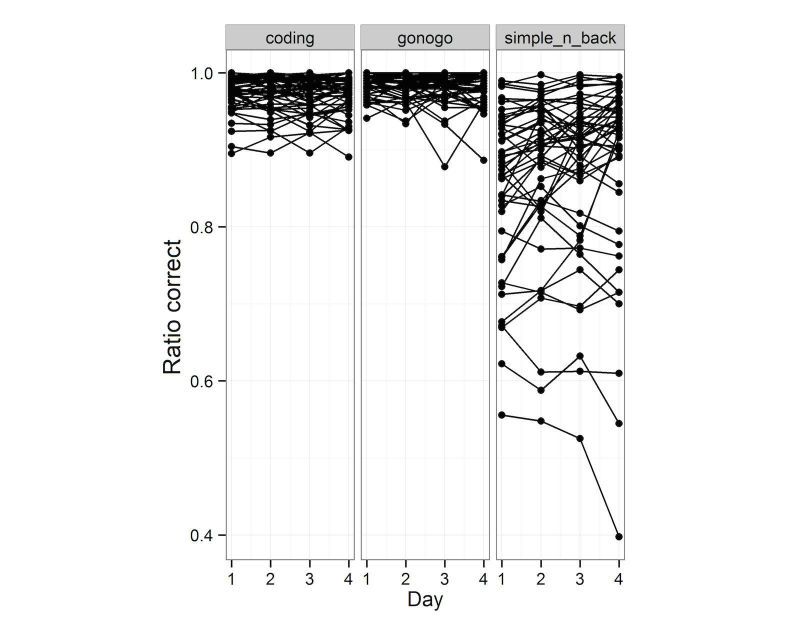
Web-based recruitment was fast and efficient. Within 2 weeks, 102 subjects applied, of whom 70 were eligible. Of the 66 subjects who started the study, 53 completed all 4 test sessions (80%), indicating that they were able to perform the do it yourself tests, at home, correctly. The Go-No Go cognition test performed at home showed the same significant improvement in reaction time with caffeine as found in controlled studies in a metabolic ward (P=.02). For coding and N-back the second block was performed approximately 10% faster. No effect was seen on correctness.
The study showed that the effects of caffeine consumption on a cognition test in an at-home setting revealed similar results as in a controlled setting. The Go-No Go test applied showed improved results after caffeine intake, similar as seen in clinical trials. This type of study is a fast, reliable, economical, and easy way to demonstrate effectiveness of a supplement and is rapidly becoming a viable alternative for the classical randomized control trial to evaluate life style and nutritional interventions.
Clinicaltrials.gov NCT02061982; https://clinicaltrials.gov/ct2/show/NCT02061982 (Archived by WebCite at https://clinicaltrials.gov/ct2/show/NCT02061982).

营养研究人员越来越有兴趣在家庭环境中开展生活方式和营养干预研究,而非在临床机构对受试者进行测试。其他学科中使用的术语是“生态效度”,强调真实情境。由于使此类研究成为可能的设备和自我测试越来越普遍,这变得越来越可行。在此,我们展示了一项在家庭环境中重现咖啡因对注意力和警觉性影响的研究。
本研究旨在通过让受试者在家中使用基于网络的研究环境进行不同的基于网络的认知测试,来重现咖啡因对注意力和警觉性的影响。
本研究设计为随机、安慰剂对照、双盲、交叉研究。为受试者提供咖啡包(2个含咖啡因,2个不含咖啡因)。还为他们提供了测试日的书面说明。健康志愿者在禁食过夜后饮用一杯咖啡。每种干预重复一次。在饮用咖啡前及饮用后1小时,受试者在家中进行基于网络的认知表现测试,该测试通过QuantifiedMind提供的3项计算机化测试来测量警觉性和注意力。每项测试进行5分钟。
基于网络的招募快速且高效。在2周内,有102名受试者申请,其中70名符合条件。在开始研究的66名受试者中,53名完成了所有4次测试环节(80%),这表明他们能够在家中正确地进行自我测试。在家中进行的“停止信号”认知测试显示,与在代谢病房进行的对照研究中发现的一样,咖啡因使反应时间有显著改善(P = 0.02)。对于编码和n-back测试,第二个模块的完成速度快了约10%;在正确性方面未发现影响。
该研究表明,在家庭环境中饮用咖啡因对认知测试的影响与在对照环境中相似;所应用的“停止信号”测试显示,摄入咖啡因后结果有所改善,与临床试验中的情况相似。这类研究是一种快速、可靠、经济且简便的方式来证明补充剂的有效性,并且正迅速成为评估生活方式和营养干预的经典随机对照试验的可行替代方法。
Clinicaltrials.gov NCT02061982;https://clinicaltrials.gov/ct2/show/NCT02061982(由WebCite存档于https://clinicaltrials.gov/ct2/show/NCT02061982)