Weaver S C, Scott T W, Lorenz L H, Lerdthusnee K, Romoser W S
Department of Pathology, Lenox Hill Hospital, New York, New York 10021.
J Virol. 1988 Jun;62(6):2083-90. doi: 10.1128/JVI.62.6.2083-2090.1988.
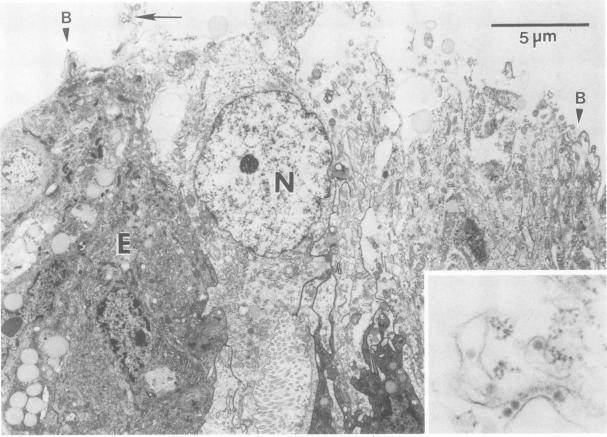
Arthropod-borne viruses were not previously believed to cause discernible pathologic changes in their natural mosquito vectors. We report cytopathologic lesions in the midgut of the mosquito, Culiseta melanura, 2 to 5 days after oral infection with eastern equine encephalomyelitis virus. Sloughing of densely staining, heavily infected epithelial cells into the midgut lumen was observed by light and transmission electron microscopy, along with degeneration of cells within the epithelium. Pathological changes in midgut epithelial cells sometimes included loss of brush border and basal lamina integrity. Disruption of the midgut basal lamina could result in bypassing of barriers to virus dissemination within the mosquito and allow rapid transmission to occur. Alternatively, luminal sloughing of heavily infected midgut epithelial cells may serve to modulate mosquito infections. These findings challenge previous beliefs regarding the benign nature of arbovirus-invertebrate host relationships.
以前人们认为节肢动物传播的病毒不会在其天然蚊子宿主中引起明显的病理变化。我们报告,在库蚊感染东部马脑炎病毒2至5天后,其肠道中出现了细胞病理损伤。通过光学显微镜和透射电子显微镜观察到,大量被感染的上皮细胞脱落至中肠管腔,同时上皮细胞发生变性。中肠上皮细胞的病理变化有时包括刷状缘丧失和基膜完整性受损。中肠基膜的破坏可能导致病毒在蚊子体内传播的屏障被绕过,从而使其能够快速传播。另外,大量被感染的中肠上皮细胞向管腔脱落可能有助于调节蚊子的感染情况。这些发现挑战了以前关于虫媒病毒与无脊椎动物宿主关系为良性的观点。