Department of Decoded Neurofeedback, ATR Brain Information Communication Research Laboratory Group, Advanced Telecommunications Research Institute International, Kyoto, Japan; Medical Institute of Developmental Disabilities Research, Showa University, Tokyo, Japan; Department of Language Sciences, Graduate School of Humanities, and Research Center for Language, Brain and Genetics, Tokyo Metropolitan University, Tokyo, Japan; Department of Molecular Imaging and Theranostics, National Institute of Radiological Sciences, National Institutes for Quantum and Radiological Science and Technology, Chiba, Japan; Department of Youth Mental Health, Graduate School of Medicine, The University of Tokyo, Tokyo, Japan; Department of Psychiatry and Neurosciences, Graduate School of Biomedical Sciences, Hiroshima University, Hiroshima, Japan; Department of Psychiatry, Kyoto University Graduate School of Medicine, Kyoto, Japan.
Int J Neuropsychopharmacol. 2017 Oct 1;20(10):769-781. doi: 10.1093/ijnp/pyx059.
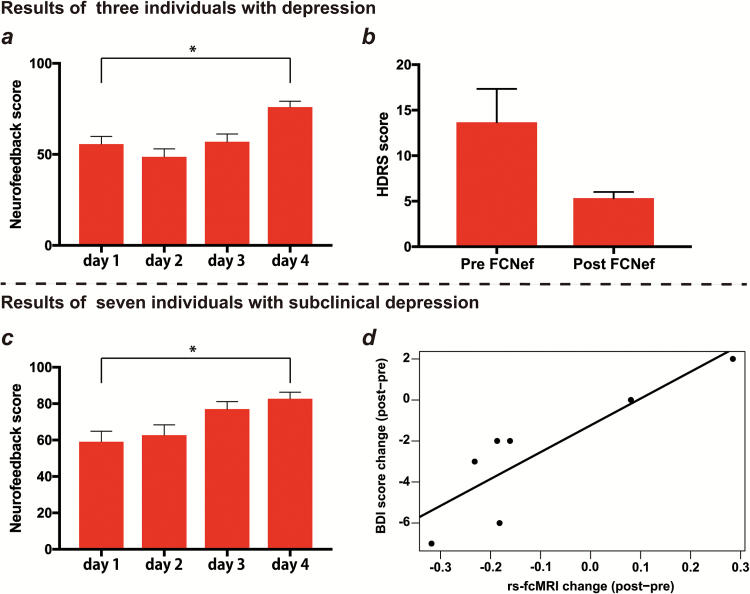
Psychiatric research has been hampered by an explanatory gap between psychiatric symptoms and their neural underpinnings, which has resulted in poor treatment outcomes. This situation has prompted us to shift from symptom-based diagnosis to data-driven diagnosis, aiming to redefine psychiatric disorders as disorders of neural circuitry. Promising candidates for data-driven diagnosis include resting-state functional connectivity MRI (rs-fcMRI)-based biomarkers. Although biomarkers have been developed with the aim of diagnosing patients and predicting the efficacy of therapy, the focus has shifted to the identification of biomarkers that represent therapeutic targets, which would allow for more personalized treatment approaches. This type of biomarker (i.e., "theranostic biomarker") is expected to elucidate the disease mechanism of psychiatric conditions and to offer an individualized neural circuit-based therapeutic target based on the neural cause of a condition. To this end, researchers have developed rs-fcMRI-based biomarkers and investigated a causal relationship between potential biomarkers and disease-specific behavior using functional MRI (fMRI)-based neurofeedback on functional connectivity. In this review, we introduce a recent approach for creating a theranostic biomarker, which consists mainly of 2 parts: (1) developing an rs-fcMRI-based biomarker that can predict diagnosis and/or symptoms with high accuracy, and (2) the introduction of a proof-of-concept study investigating the relationship between normalizing the biomarker and symptom changes using fMRI-based neurofeedback. In parallel with the introduction of recent studies, we review rs-fcMRI-based biomarker and fMRI-based neurofeedback, focusing on the technological improvements and limitations associated with clinical use.
精神科研究受到精神科症状与其神经基础之间解释差距的阻碍,这导致了治疗效果不佳。这种情况促使我们从基于症状的诊断转向数据驱动的诊断,旨在将精神障碍重新定义为神经回路障碍。有希望用于数据驱动诊断的候选者包括基于静息状态功能连接磁共振成像(rs-fcMRI)的生物标志物。尽管生物标志物的开发旨在诊断患者和预测治疗效果,但重点已转移到识别代表治疗靶点的生物标志物,这将允许更个性化的治疗方法。这种类型的生物标志物(即“治疗诊断生物标志物”)有望阐明精神疾病的发病机制,并根据疾病的神经原因提供基于个体化神经回路的治疗靶点。为此,研究人员已经开发了基于 rs-fcMRI 的生物标志物,并使用基于功能磁共振成像(fMRI)的神经反馈研究了潜在生物标志物与特定疾病行为之间的因果关系。在这篇综述中,我们介绍了一种创建治疗诊断生物标志物的新方法,该方法主要包括 2 部分:(1)开发一种能够以高精度预测诊断和/或症状的基于 rs-fcMRI 的生物标志物,(2)引入一项概念验证研究,调查使用 fMRI 基于神经反馈的正常化生物标志物与症状变化之间的关系。在介绍最近的研究的同时,我们回顾了基于 rs-fcMRI 的生物标志物和基于 fMRI 的神经反馈,重点介绍了与临床应用相关的技术改进和局限性。