Mukherjee Shuvankar
Department of Community Medicine, Calcutta National Medical College, West Bengal, India.
Indian J Dermatol. 2017 Sep-Oct;62(5):459-467. doi: 10.4103/ijd.IJD_379_17.
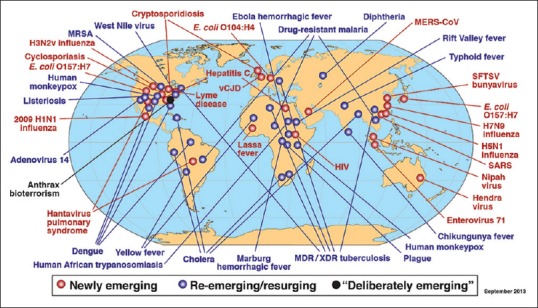
Over the past 30 years, at least 30 new infectious diseases have emerged to threaten the health of millions of people across the globe. The major challenge to combat these infections is that for many of them, there is no specific treatment or cure or vaccine. There is limited scope of preventing or controlling them. The contributory factors include urbanization and destruction of natural habitats, climate change and changing ecosystems, changes in population of reservoir hosts or intermediate insect vectors and microbial genetic mutation, international trade and commerce, change in human demographics and behavior, lack of public health services and infrastructure, and antibiotic resistance. It is clear by now that the problem of emerging infectious disease (EID) is not restricted to any single country, and a strong and sustainable international collaboration will be needed in their prevention and control. India along with other countries in the South-East Asian region will continue to bear the brunt of the burden of EIDs in years to come.
在过去30年里,至少有30种新的传染病出现,威胁着全球数百万人的健康。抗击这些感染的主要挑战在于,其中许多传染病没有特定的治疗方法、治愈手段或疫苗。预防或控制它们的范围有限。促成因素包括城市化和自然栖息地的破坏、气候变化和生态系统变化、储存宿主或中间昆虫媒介数量的变化以及微生物基因突变、国际贸易和商业、人口结构和人类行为的变化、公共卫生服务和基础设施的缺乏以及抗生素耐药性。现在很明显,新发传染病问题并不局限于任何一个国家,在其预防和控制方面需要强有力且可持续的国际合作。印度与东南亚地区的其他国家在未来几年将继续首当其冲地承受新发传染病的负担。