Department of Clinical Pharmacy, Dongguan Third People's Hospital, Affiliated Dongguan Shilong People's Hospital of Southern Medical University, Dongguan, Guangdong, China.
Department of Gynaecology and Obstetric, Dongguan Third People's Hospital, Affiliated Dongguan Shilong People's Hospital of Southern Medical University, Dongguan, Guangdong, China.
Nutr J. 2017 Oct 6;16(1):67. doi: 10.1186/s12937-017-0290-1.
The potential glucose-lowering effects of pomegranate have been reported in animal and observational studies, but intervention studies in humans have generated mixed results. In this paper, we aimed to conduct a systematic review and meta-analysis of randomized controlled trials (RCTs) to evaluate the precise effects of pomegranate supplementation on measures of glucose control, insulin levels and insulin sensitivity in humans.
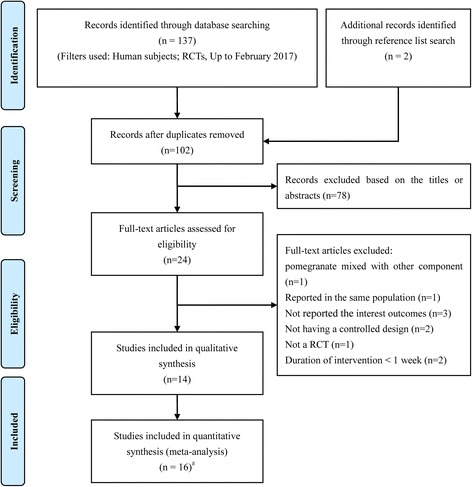
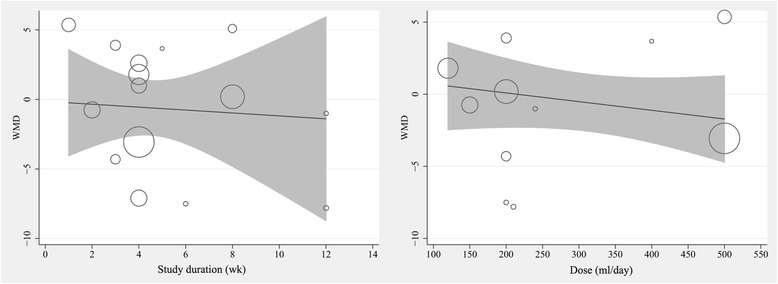
Comprehensive electronic searches were conducted in PubMed, Embase, and the Cochrane Library. Studies included were RCTs that evaluated the changes in diabetes biomarkers among adults (≥18 years) following pomegranate interventions. The predefined outcomes included fasting blood glucose (FBG), fasting blood insulin (FBI), glycated haemoglobin (HbA1c), and homeostatic model assessment of insulin resistance (HOMA-IR). Endpoints were calculated as weighted mean differences (WMDs) with 95% confidence intervals (CIs) by using a random-effects model. Publication bias, subgroup analyses, sensitivity analysis and random-effects meta-regression were also performed to explore the influence of covariates on the net changes in fasting glucose and insulin concentrations.
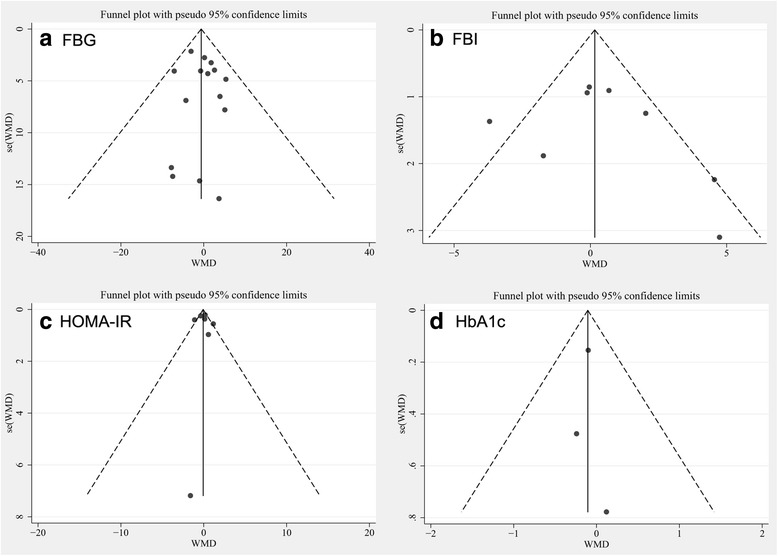
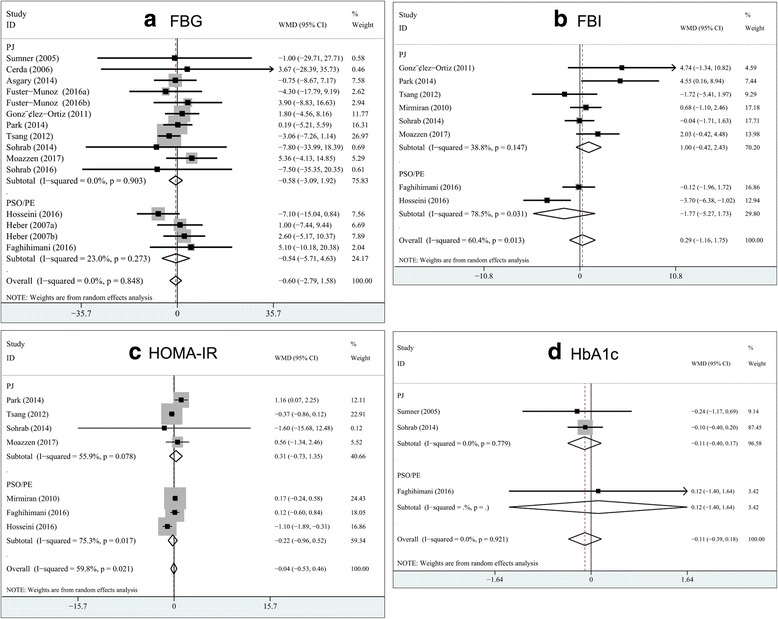
Sixteen eligible trials with 538 subjects were included. The pooled estimates suggested that pomegranate did not significantly affect the measures of FBG (WMD, -0.6 mg/dL; 95% CI, -2.79 to 1.58; P=0.59), FBI (WMD, 0.29 μIU/mL; 95% CI, -1.16 to 1.75; P=0.70), HOMA-IR (WMD, -0.04; 95% CI, -0.53 to 0.46; P=0.88) or HbA1c (WMD, -0.11%; 95% CI, -0.39 to -0.18; P=0.46). Overall, significant heterogeneity was detected for FBI and HOMA-IR, but subgroup analysis could not identify factors significantly influencing these parameters. These results were robust in sensitivity analysis, and no significant publication bias was found in the current meta-analysis.
Pomegranate intake did not show a notably favourable effect on improvements in glucose and insulin metabolism. The current evidence suggests that daily pomegranate supplementation is not recommended as a potential therapeutic strategy in glycemic management. Further large-scale RCTs with longer duration are required to confirm these results.
石榴具有降低血糖的潜力,这已在动物和观察性研究中得到报道,但人体干预研究的结果却存在差异。本文旨在对随机对照试验(RCT)进行系统评价和荟萃分析,以评估石榴补充剂对人体血糖控制、胰岛素水平和胰岛素敏感性的具体影响。
全面检索了 PubMed、Embase 和 Cochrane 图书馆,纳入了评估石榴干预成年人(≥18 岁)后糖尿病生物标志物变化的 RCT。主要结局包括空腹血糖(FBG)、空腹胰岛素(FBI)、糖化血红蛋白(HbA1c)和稳态模型评估的胰岛素抵抗(HOMA-IR)。采用随机效应模型计算加权均数差值(WMD)及其 95%置信区间(CI)。还进行了发表偏倚、亚组分析、敏感性分析和随机效应荟萃回归,以探讨协变量对空腹血糖和胰岛素浓度净变化的影响。
纳入了 16 项试验,共计 538 名受试者。汇总估计表明,石榴对 FBG(WMD,-0.6mg/dL;95%CI,-2.79 至 1.58;P=0.59)、FBI(WMD,0.29μIU/mL;95%CI,-1.16 至 1.75;P=0.70)、HOMA-IR(WMD,-0.04;95%CI,-0.53 至 0.46;P=0.88)或 HbA1c(WMD,-0.11%;95%CI,-0.39 至 -0.18;P=0.46)的测量值均无显著影响。总体而言,FBI 和 HOMA-IR 存在显著的异质性,但亚组分析未能确定显著影响这些参数的因素。敏感性分析结果稳健,当前荟萃分析未发现显著的发表偏倚。
石榴摄入对改善血糖和胰岛素代谢没有明显的有益作用。目前的证据表明,不建议将每日石榴补充作为血糖管理的潜在治疗策略。需要进行更大规模、持续时间更长的 RCT 来证实这些结果。