Moon Jee-Young, Wang Tao, Sofer Tamar, North Kari E, Isasi Carmen R, Cai Jianwen, Gellman Marc D, Moncrieft Ashley E, Sotres-Alvarez Daniela, Argos Maria, Kaplan Robert C, Qi Qibin
Department of Epidemiology and Population Health, Albert Einstein College of Medicine, Bronx, NY.
Department of Biostatistics, University of Washington, Seattle, WA.
Diabetes. 2017 Dec;66(12):3001-3012. doi: 10.2337/db17-0573. Epub 2017 Oct 6.
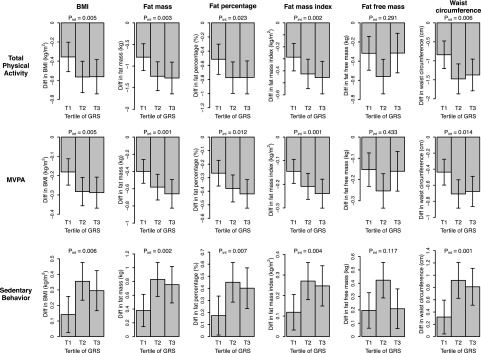
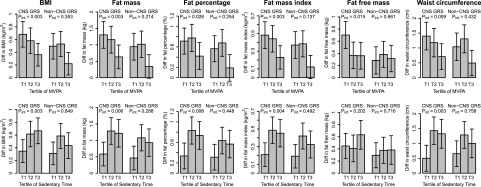
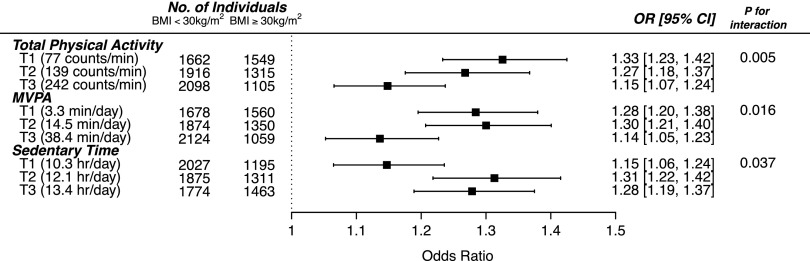
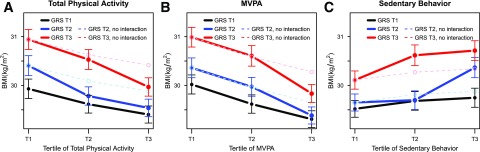
Studies using self-reported data suggest a gene-physical activity interaction on obesity, yet the influence of sedentary behavior, distinct from a lack of physical activity, on genetic associations with obesity remains unclear. We analyzed interactions of accelerometer-measured moderate to vigorous physical activity (MVPA) and time spent sedentary with genetic variants on obesity among 9,645 U.S. Hispanics/Latinos. An overall genetic risk score (GRS), a central nervous system (CNS)-related GRS, and a non-CNS-related GRS were calculated based on 97 BMI-associated single nucleotide polymorphisms (SNPs). Genetic association with BMI was stronger in individuals with lower MVPA (first tertile) versus higher MVPA (third tertile) (β = 0.78 kg/m [SE, 0.10 kg/m] vs. 0.39 kg/m [0.09 kg/m] per SD increment of GRS; = 0.005), and in those with more time spent sedentary (third tertile) versus less time spent sedentary (first tertile) (β = 0.73 kg/m [SE, 0.10 kg/m] vs. 0.44 kg/m [0.09 kg/m]; = 0.006). Similar significant interaction patterns were observed for obesity risk, body fat mass, fat percentage, fat mass index, and waist circumference, but not for fat-free mass. The CNS-related GRS, but not the non-CNS-related GRS, showed significant interactions with MVPA and sedentary behavior, with effects on BMI and other adiposity traits. Our data suggest that both increasing physical activity and reducing sedentary behavior may attenuate genetic associations with obesity, although the independence of these interaction effects needs to be investigated further.
使用自我报告数据的研究表明基因与身体活动在肥胖问题上存在相互作用,但久坐行为(有别于缺乏身体活动)对肥胖基因关联的影响仍不明确。我们分析了9645名美国西班牙裔/拉丁裔人群中,通过加速度计测量的中度至剧烈身体活动(MVPA)以及久坐时间与肥胖相关基因变异之间的相互作用。基于97个与BMI相关的单核苷酸多态性(SNP)计算了总体遗传风险评分(GRS)、中枢神经系统(CNS)相关的GRS以及非CNS相关的GRS。与MVPA较低(第一三分位数)的个体相比,MVPA较高(第三三分位数)的个体中,基因与BMI的关联更强(每增加一个标准差的GRS,β = 0.78 kg/m [标准误,0.10 kg/m] 对比 0.39 kg/m [0.09 kg/m];P = 0.005),且久坐时间较长(第三三分位数)的个体比久坐时间较短(第一三分位数)的个体中基因与BMI的关联更强(β = 0.73 kg/m [标准误,0.10 kg/m] 对比 0.44 kg/m [0.09 kg/m];P = 0.006)。在肥胖风险、体脂肪量、脂肪百分比、脂肪量指数和腰围方面观察到了类似的显著相互作用模式,但在去脂体重方面未观察到。CNS相关的GRS与MVPA和久坐行为存在显著相互作用,而与BMI和其他肥胖特征有影响,但非CNS相关的GRS未显示出这种作用。我们的数据表明,增加身体活动和减少久坐行为都可能减弱与肥胖的基因关联,尽管这些相互作用效应的独立性需要进一步研究。