Department of Chemistry, University of Illinois at Chicago , 845 West Taylor Street, Chicago, Illinois 60607-7061, United States.
J Am Chem Soc. 2017 Oct 25;139(42):14857-14860. doi: 10.1021/jacs.7b08459. Epub 2017 Oct 12.
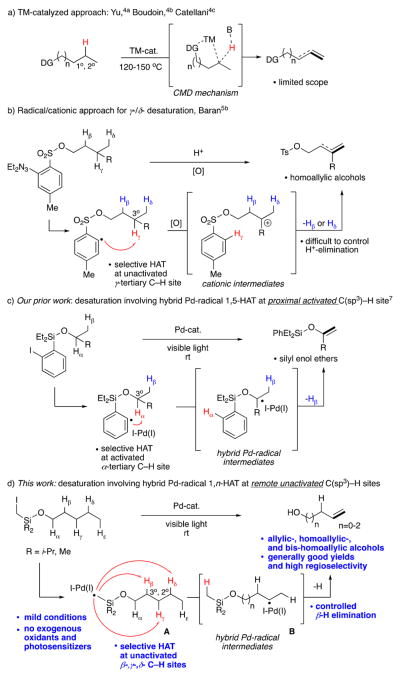
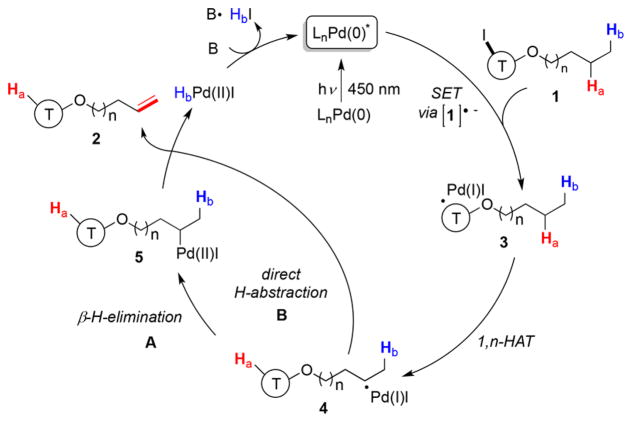
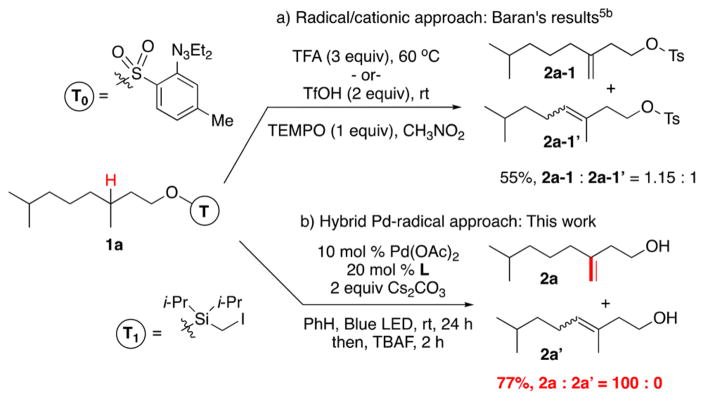
A general, efficient, and site-selective visible light-induced Pd-catalyzed remote desaturation of aliphatic alcohols into valuable allylic, homoallylic, and bis-homoallylic alcohols has been developed. This transformation operates via a hybrid Pd-radical mechanism, which synergistically combines the favorable features of radical approaches, such as a facile remote C-H HAT step, with that of transition-metal-catalyzed chemistry (selective β-hydrogen elimination step). This allows achieving superior degrees of regioselectivity and yields in the desaturation of alcohols compared to those obtained by the state-of-the-art desaturation methods. The HAT at unactivated C(sp)-H sites is enabled by the easily installable/removable Si-auxiliaries. Formation of the key hybrid alkyl Pd-radical intermediates is efficiently induced by visible light from alkyl iodides and Pd(0) complexes. Notably, this method requires no exogenous photosensitizers or external oxidants.
本文开发了一种通用、高效、位点选择性的可见光诱导钯催化脂肪醇远程去饱和反应,生成有价值的烯丙基、偕烯丙基和双偕烯丙基醇。这种转化通过混合 Pd-自由基机制进行,协同结合了自由基方法的有利特点,如易于远程 C-H HAT 步骤,以及过渡金属催化化学的特点(选择性β-氢消除步骤)。这使得在醇的去饱和反应中能够实现比最先进的去饱和方法更高的区域选择性和收率。通过易安装/可去除的 Si-助剂,可以实现未活化的 C(sp)-H 位点的 HAT。可见光从碘化烷基和 Pd(0)配合物有效地诱导形成关键的混合烷基 Pd-自由基中间体。值得注意的是,该方法不需要外加光敏剂或外部氧化剂。