Cohen Alasdair, Colford John M
Department of Environmental Science, Policy and Management, University of California at Berkeley, Berkeley, California.
Division of Epidemiology, School of Public Health, University of California at Berkeley, Berkeley, California.
Am J Trop Med Hyg. 2017 Nov;97(5):1362-1377. doi: 10.4269/ajtmh.17-0190. Epub 2017 Oct 10.
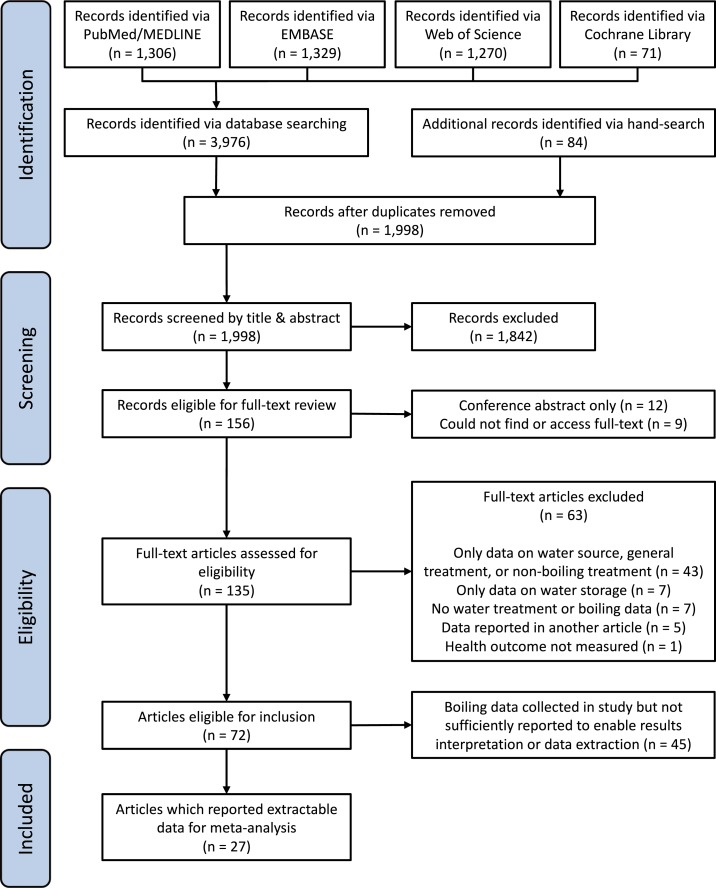
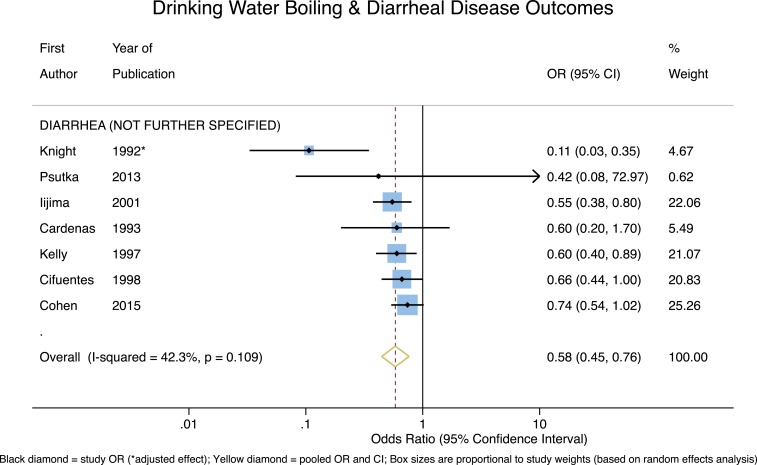
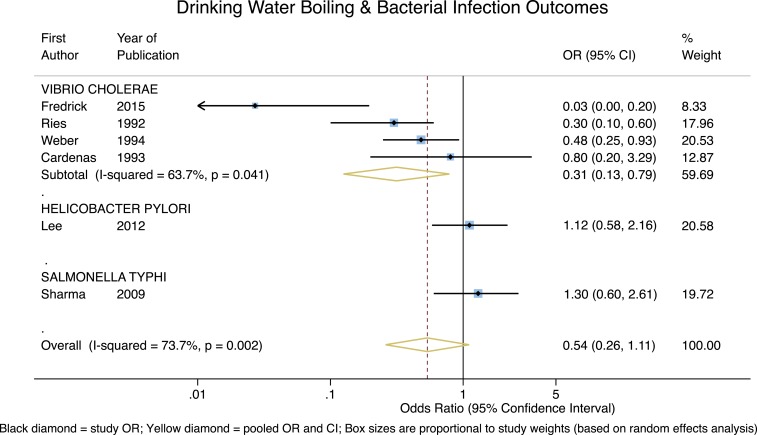
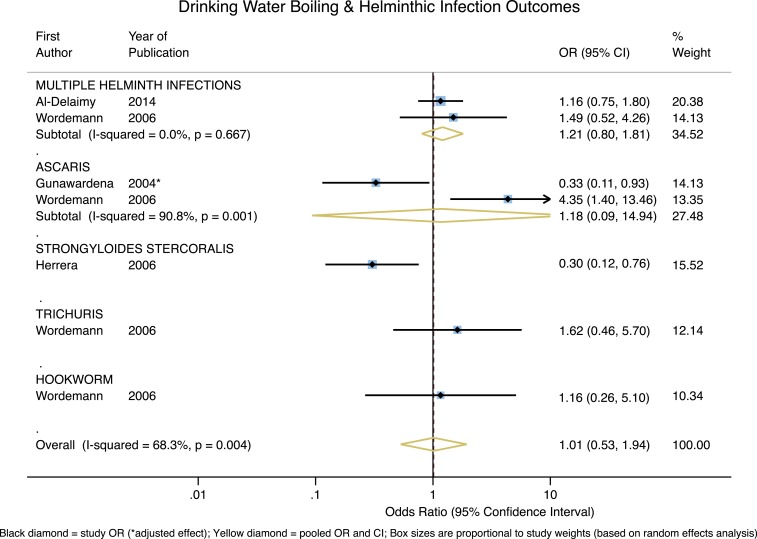
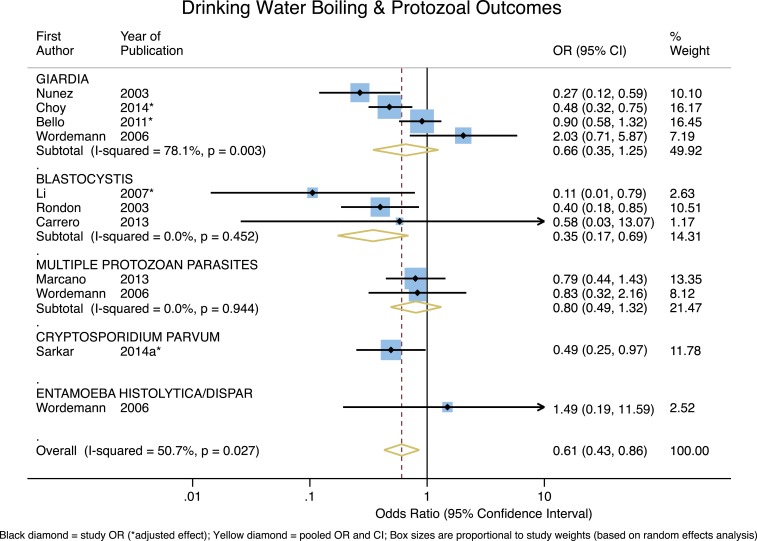
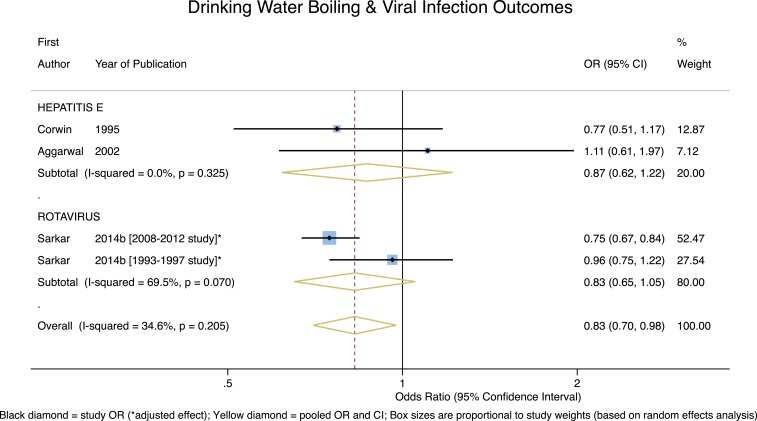
Globally, approximately 2 billion people lack microbiologically safe drinking water. Boiling is the most prevalent household water treatment method, yet evidence of its health impact is limited. To conduct this systematic review, we searched four online databases with no limitations on language or publication date. Studies were eligible if health outcomes were measured for participants who reported consuming boiled and untreated water. We used reported and calculated odds ratios (ORs) and random-effects meta-analysis to estimate pathogen-specific and pooled effects by organism group and nonspecific diarrhea. Heterogeneity and publication bias were assessed using , meta-regression, and funnel plots; study quality was also assessed. Of the 1,998 records identified, 27 met inclusion criteria and reported extractable data. We found evidence of a significant protective effect of boiling for infections (OR = 0.31, 95% confidence interval [CI] = 0.13-0.79, = 4 studies), (OR = 0.35, 95% CI = 0.17-0.69, = 3), protozoal infections overall (pooled OR = 0.61, 95% CI = 0.43-0.86, = 11), viral infections overall (pooled OR = 0.83, 95% CI = 0.7-0.98, = 4), and nonspecific diarrheal outcomes (OR = 0.58, 95% CI = 0.45-0.77, = 7). We found no evidence of a protective effect for helminthic infections. Although our study was limited by the use of self-reported boiling and non-experimental designs, the evidence suggests that boiling provides measureable health benefits for pathogens whose transmission routes are primarily water based. Consequently, we believe a randomized controlled trial of boiling adherence and health outcomes is needed.
在全球范围内,约有20亿人缺乏微生物安全的饮用水。煮沸是最普遍的家庭水处理方法,但其对健康影响的证据有限。为进行这项系统评价,我们检索了四个在线数据库,对语言和出版日期没有限制。如果对报告饮用煮沸水和未处理水的参与者测量了健康结果,则这些研究符合条件。我们使用报告的和计算的比值比(OR)以及随机效应荟萃分析来估计病原体特异性以及按生物体组和非特异性腹泻汇总的效应。使用 、元回归和漏斗图评估异质性和发表偏倚;还评估了研究质量。在识别出的1998条记录中,27条符合纳入标准并报告了可提取的数据。我们发现有证据表明煮沸对 感染有显著的保护作用(OR = 0.31,95%置信区间[CI] = 0.13 - 0.79, = 4项研究), (OR = 0.35,95% CI = 0.17 - 0.69, = 3),总体原生动物感染(汇总OR = 0.61,95% CI = 0.43 - 0.86, = 11),总体病毒感染(汇总OR = 0.83,95% CI = 0.7 - 0.98, = 4),以及非特异性腹泻结局(OR = 0.58,95% CI = 0.45 - 0.77, = 7)。我们没有发现煮沸对蠕虫感染有保护作用的证据。尽管我们的研究受到自我报告的煮沸情况和非实验设计的限制,但证据表明煮沸对传播途径主要基于水的病原体具有可测量的健康益处。因此,我们认为需要进行一项关于煮沸依从性和健康结局的随机对照试验。