Yan Xiaohui, Qi Miao, Li Pengfei, Zhan Yihong, Shao Huanjie
Key Laboratory of the Ministry of Education for Medicinal Plant Resources and Natural Pharmaceutical Chemistry, College of Life Science, Shaanxi Normal University, Xi'an, 710119 China.
Cell Biosci. 2017 Oct 5;7:50. doi: 10.1186/s13578-017-0179-x. eCollection 2017.
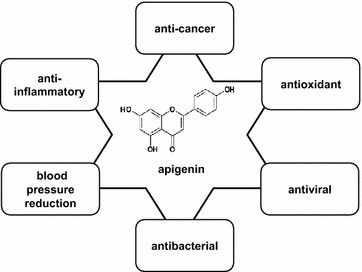
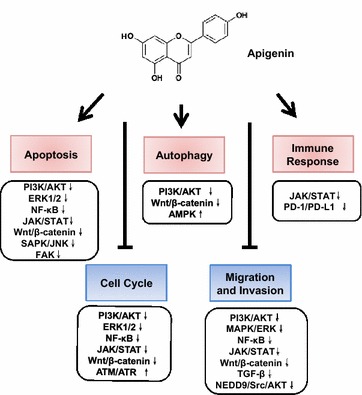
Apigenin is a common dietary flavonoid that is abundantly present in many fruits, vegetables and Chinese medicinal herbs and serves multiple physiological functions, such as strong anti-inflammatory, antioxidant, antibacterial and antiviral activities and blood pressure reduction. Therefore, apigenin has been used as a traditional medicine for centuries. Recently, apigenin has been widely investigated for its anti-cancer activities and low toxicity. Apigenin was reported to suppress various human cancers in vitro and in vivo by multiple biological effects, such as triggering cell apoptosis and autophagy, inducing cell cycle arrest, suppressing cell migration and invasion, and stimulating an immune response. In this review, we focus on the most recent advances in the anti-cancer effects of apigenin and their underlying mechanisms, and we summarize the signaling pathways modulated by apigenin, including the PI3K/AKT, MAPK/ERK, JAK/STAT, NF-κB and Wnt/β-catenin pathways. We also discuss combinatorial strategies to enhance the anti-cancer effect of apigenin on various cancers and its use as an adjuvant chemotherapeutic agent to overcome cancer drug resistance or to alleviate other adverse effects of chemotherapy. The functions of apigenin against cancer stem cells are also summarized and discussed. These data demonstrate that apigenin is a promising reagent for cancer therapy. Apigenin appears to have the potential to be developed either as a dietary supplement or as an adjuvant chemotherapeutic agent for cancer therapy.
芹菜素是一种常见的膳食类黄酮,大量存在于许多水果、蔬菜和中草药中,并具有多种生理功能,如强大的抗炎、抗氧化、抗菌和抗病毒活性以及降血压作用。因此,芹菜素作为一种传统药物已被使用了几个世纪。最近,芹菜素因其抗癌活性和低毒性而受到广泛研究。据报道,芹菜素通过多种生物学效应在体外和体内抑制各种人类癌症,如触发细胞凋亡和自噬、诱导细胞周期停滞、抑制细胞迁移和侵袭以及刺激免疫反应。在这篇综述中,我们重点关注芹菜素抗癌作用及其潜在机制的最新进展,并总结芹菜素调节的信号通路,包括PI3K/AKT、MAPK/ERK、JAK/STAT、NF-κB和Wnt/β-连环蛋白通路。我们还讨论了增强芹菜素对各种癌症抗癌作用的联合策略,以及其作为辅助化疗药物用于克服癌症耐药性或减轻化疗其他不良反应的用途。此外,还总结并讨论了芹菜素对癌症干细胞的作用。这些数据表明芹菜素是一种有前途的癌症治疗试剂。芹菜素似乎有潜力被开发为膳食补充剂或癌症治疗的辅助化疗药物。