Department of Geography, Environment and Spatial Sciences, Michigan State University, Geography Building, 673 Auditorium Rd, Room 202, East Lansing, MI, 48824, USA.
School of Geographical Sciences and Urban Planning, Arizona State University, Tempe, AZ, 85281, USA.
Int J Health Geogr. 2017 Oct 16;16(1):37. doi: 10.1186/s12942-017-0110-z.
Food access is a global issue, and for this reason, a wealth of studies are dedicated to understanding the location of food deserts and the benefits of urban gardens. However, few studies have linked these two strands of research together to analyze whether urban gardening activity may be a step forward in addressing issues of access for food desert residents.
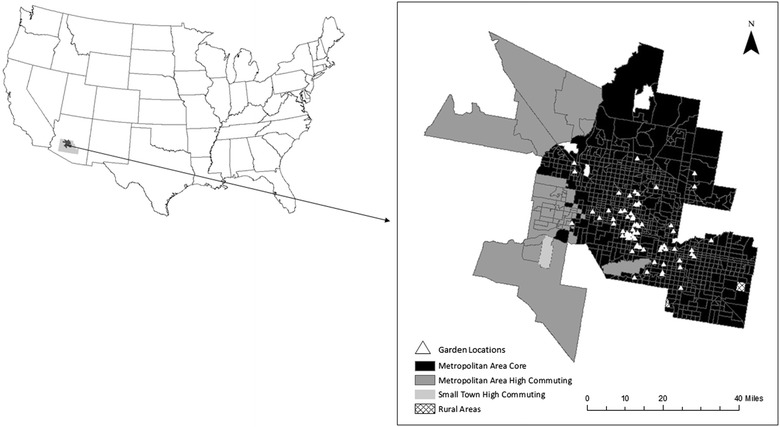
The Phoenix, Arizona metropolitan area is used as a case to demonstrate the utility of spatial optimization models for siting urban gardens near food deserts and on vacant land. The locations of urban gardens are derived from a list obtained from the Maricopa County Cooperative Extension office at the University of Arizona which were geo located and aggregated to Census tracts. Census tracts were then assigned to one of three categories: tracts that contain a garden, tracts that are immediately adjacent to a tract with a garden, and all other non-garden/non-adjacent census tracts. Analysis of variance is first used to ascertain whether there are statistical differences in the demographic, socio-economic, and land use profiles of these three categories of tracts. A maximal covering spatial optimization model is then used to identify potential locations for future gardening activities. A constraint of these models is that gardens be located on vacant land, which is a growing problem in rapidly urbanizing environments worldwide.
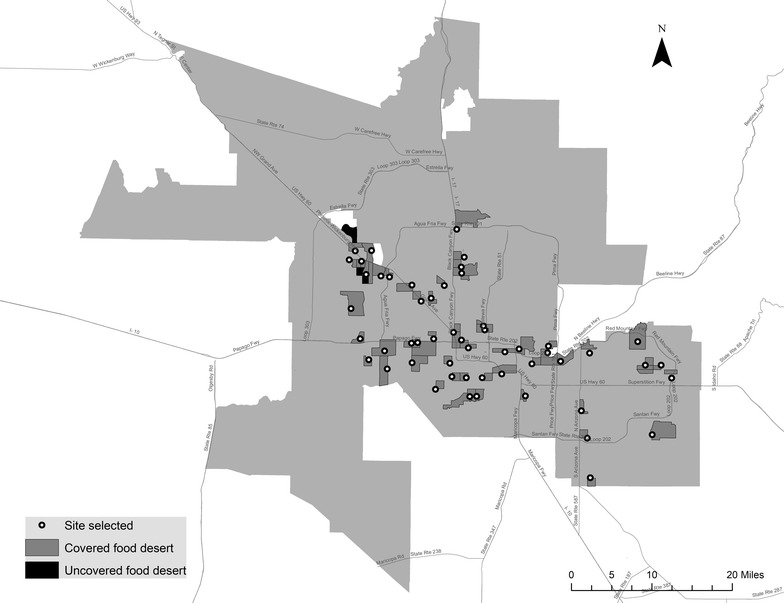
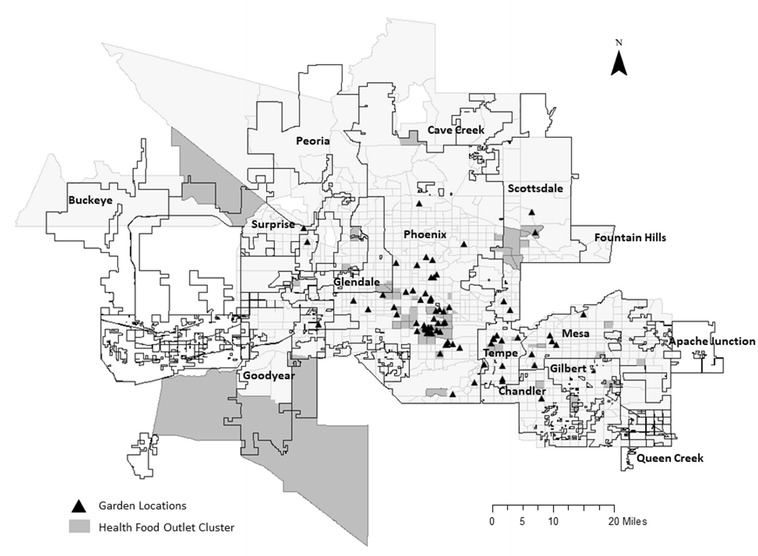
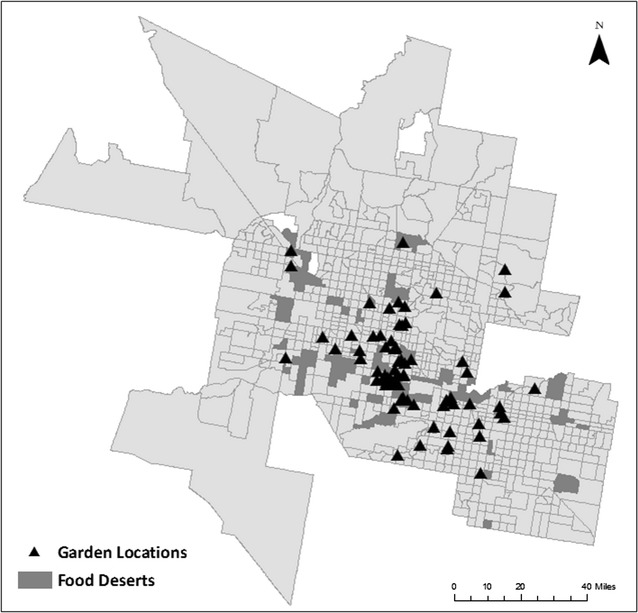
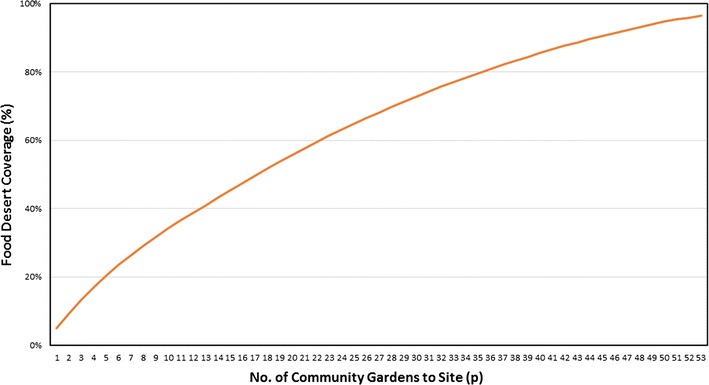
The spatial analysis of garden locations reveals that they are centrally located in tracts with good food access. Thus, the current distribution of gardens does not provide an alternative food source to occupants of food deserts. The maximal covering spatial optimization model reveals that gardens could be sited in alternative locations to better serve food desert residents. In fact, 53 gardens may be located to cover 96.4% of all food deserts. This is an improvement over the current distribution of gardens where 68 active garden sites provide coverage to a scant 8.4% of food desert residents.
People in rapidly urbanizing environments around the globe suffer from poor food access. Rapid rates of urbanization also present an unused vacant land problem in cities around the globe. This paper highlights how spatial optimization models can be used to improve healthy food access for food desert residents, which is a critical first step in ameliorating the health problems associated with lack of healthy food access including heart disease and obesity.
食品获取是一个全球性问题,因此,大量研究致力于了解食品荒漠的位置和城市花园的好处。然而,很少有研究将这两个研究领域联系起来,以分析城市园艺活动是否可以成为解决食品荒漠居民获取食品问题的一个步骤。
以凤凰城亚利桑那州大都市区为例,演示空间优化模型在为食品荒漠附近和闲置土地选址城市花园方面的效用。城市花园的位置来自于亚利桑那大学马里科帕县合作推广办公室获得的一份清单,这些花园的位置已经被地理定位并汇总到了普查区。然后,普查区被分配到以下三个类别之一:包含花园的普查区、与有花园的普查区相邻的普查区,以及所有其他无花园/无相邻普查区。首先使用方差分析来确定这三个类别普查区的人口统计学、社会经济和土地利用特征是否存在统计差异。然后使用最大覆盖空间优化模型来确定未来园艺活动的潜在地点。这些模型的一个限制是花园必须位于闲置土地上,这在全球快速城市化的环境中是一个日益严重的问题。
花园位置的空间分析表明,它们位于食物获取良好的普查区中心。因此,目前的花园分布并没有为食品荒漠居民提供替代食物来源。最大覆盖空间优化模型表明,可以在替代位置选址花园,以更好地为食品荒漠居民提供服务。事实上,可能可以在 53 个位置选址花园,以覆盖 96.4%的所有食品荒漠。这比目前花园的分布有所改善,68 个活跃的花园地点仅为 8.4%的食品荒漠居民提供了服务。
在全球快速城市化的环境中,人们面临着食品获取不足的问题。全球城市快速的城市化速度也带来了未被利用的闲置土地问题。本文强调了空间优化模型如何用于改善食品荒漠居民的健康食品获取,这是改善与缺乏健康食品获取相关的健康问题的关键第一步,包括心脏病和肥胖症。