a Department of Nanochemistry , Nano Technology Research Center, Urmia University , Urmia , Iran.
b Department of Nanochemistry , Faculty of Science, Urmia University , Urmia , Iran.
Bioengineered. 2018 Jan 1;9(1):38-47. doi: 10.1080/21655979.2017.1373539. Epub 2017 Nov 30.
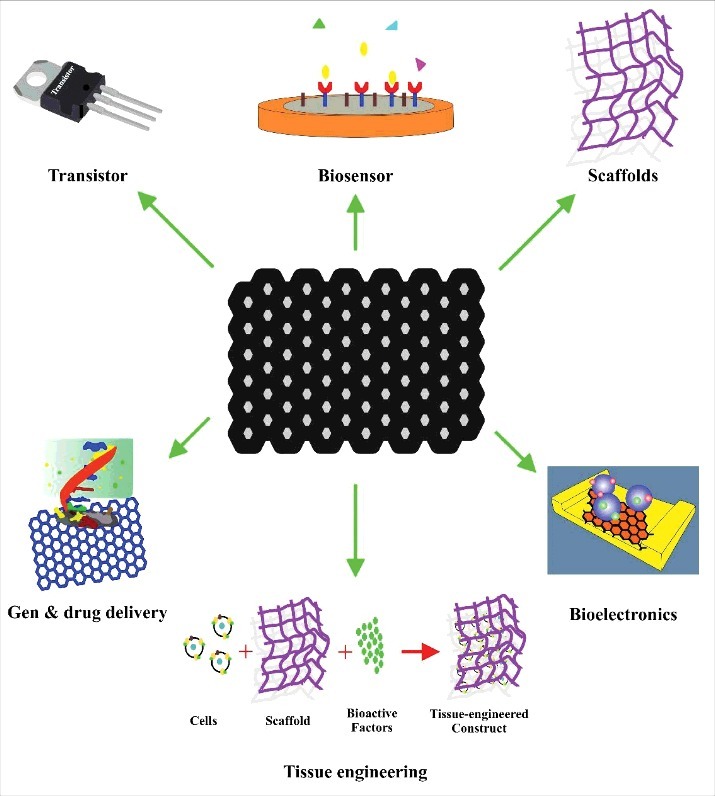
Tissue engineering has been emerging as a valid approach to the current therapies for bone regeneration/substitution. Tissue-engineered bone constructs have the potential to alleviate the demand arising from the shortage of suitable autograft and allograft materials for augmenting bone healing. Scaffolds play a central role in tissue engineering research, they not only provide as structural support for specific cells but also provide as the templates to guide new tissue growth and construction. In this survey we describe application of graphene based nano-biomaterials for bone tissue engineering. In this article, application of different graphene based materials on construction of manufacture scaffolds for bone tissue engineering was discussed. It begins by giving the reader a brief background on tissue engineering, followed by a comprehensive description of all the relevant components of graphene based materials, going from materials to scaffolds and from cells to tissue engineering strategies that will lead to "engineered" bone. In this survey, more recent studies on the effects of graphene on surface modifications of scaffold materials was discused. The ability of graphene to improve the biological properties of scaffold materials, and its ability to promote the adhesion, proliferation, and osteoblasts have been demonstrated in several studies which we discuss in this survey article. We further highlight how the properties of graphene are being exploited for scaffolds in bone tissue engineering, comprehensively surveying recent experimental works featuring graphene and graphene derivatives. Bone tissue engineering, for the purpose of this survey, is the use of a scaffolding material to either induce formation of bone from the surrounding tissue or to act as a carrier or template for implanted bone cells or other agents. Materials used as bone tissue-engineered scaffolds may be injectable or rigid, the latter requiring an operative implantation procedure.
组织工程学已成为当前骨再生/替代治疗的有效方法。组织工程骨构建物有可能缓解由于缺乏合适的自体移植物和同种异体材料来增强骨愈合而导致的需求。支架在组织工程研究中起着核心作用,它们不仅为特定细胞提供结构支撑,而且还作为模板来指导新组织的生长和构建。在本综述中,我们描述了基于石墨烯的纳米生物材料在骨组织工程中的应用。本文讨论了不同基于石墨烯的材料在制造骨组织工程支架中的应用。它首先简要介绍了组织工程的背景,然后全面描述了基于石墨烯的材料的所有相关组成部分,从材料到支架,从细胞到组织工程策略,这些都将导致“工程化”骨。在本综述中,讨论了最近关于石墨烯对支架材料表面改性影响的研究。已有研究证明,石墨烯能够改善支架材料的生物性能,促进细胞的黏附、增殖和成骨细胞的分化,我们在本综述中对此进行了讨论。我们进一步强调了石墨烯如何被用于骨组织工程中的支架,全面综述了最近使用石墨烯和石墨烯衍生物的实验工作。在本综述中,骨组织工程是指使用支架材料来诱导周围组织形成骨,或者作为植入骨细胞或其他药物的载体或模板。用作组织工程骨支架的材料可以是可注射的或刚性的,后者需要手术植入程序。