Pryor Alan, Ophus Colin, Miao Jianwei
Department of Physics and Astronomy and California NanoSystems Institute, University of California at Los Angeles, Los Angeles, CA 90095 USA.
National Center for Electron Microscopy, Molecular Foundry, Lawrence Berkeley National Laboratory, Berkeley, CA 94720 USA.
Adv Struct Chem Imaging. 2017;3(1):15. doi: 10.1186/s40679-017-0048-z. Epub 2017 Oct 25.
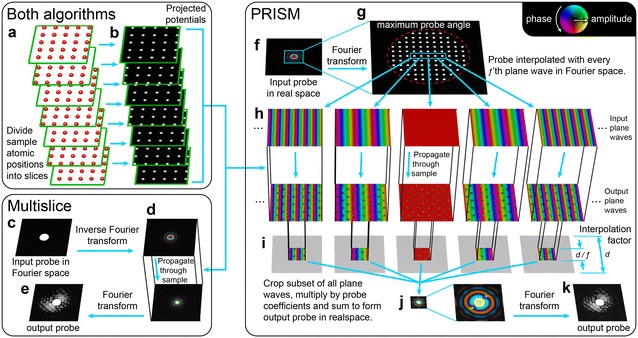
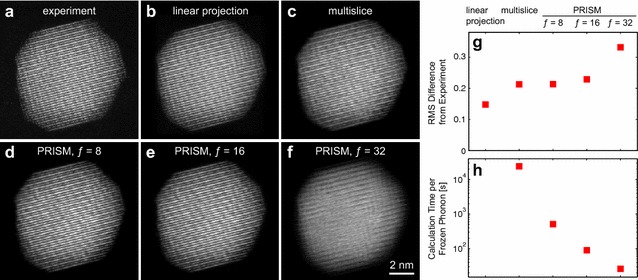
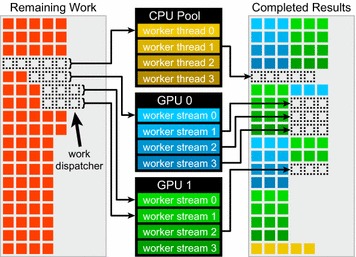
Simulation of atomic-resolution image formation in scanning transmission electron microscopy can require significant computation times using traditional methods. A recently developed method, termed plane-wave reciprocal-space interpolated scattering matrix (PRISM), demonstrates potential for significant acceleration of such simulations with negligible loss of accuracy. Here, we present a software package called for parallelized simulation of image formation in scanning transmission electron microscopy (STEM) using both the PRISM and multislice methods. By distributing the workload between multiple CUDA-enabled GPUs and multicore processors, accelerations as high as 1000 × for PRISM and 15 × for multislice are achieved relative to traditional multislice implementations using a single 4-GPU machine. We demonstrate a potentially important application of , using it to compute images for atomic electron tomography at sufficient speeds to include in the reconstruction pipeline. is freely available both as an open-source CUDA/C++ package with a graphical user interface and as a Python package, .
使用传统方法模拟扫描透射电子显微镜中的原子分辨率图像形成可能需要大量计算时间。最近开发的一种称为平面波倒易空间插值散射矩阵(PRISM)的方法,显示出在精度损失可忽略不计的情况下显著加速此类模拟的潜力。在这里,我们展示了一个名为的软件包,用于使用PRISM和多层方法并行模拟扫描透射电子显微镜(STEM)中的图像形成。通过在多个支持CUDA的GPU和多核处理器之间分配工作负载,相对于使用单台4-GPU机器的传统多层实现,PRISM可实现高达1000倍的加速,多层方法可实现15倍的加速。我们展示了的一个潜在重要应用,即使用它以足够的速度计算原子电子断层扫描的图像,以便纳入重建流程。既可以作为带有图形用户界面的开源CUDA/C++包免费获取,也可以作为Python包免费获取。