Mahieu Rafael, Reydel Thomas, Maamar Adel, Tadié Jean-Marc, Jamet Angeline, Thille Arnaud W, Chudeau Nicolas, Huntzinger Julien, Grangé Steven, Beduneau Gaetan, Courte Anne, Ehrmann Stephane, Lemarié Jérémie, Gibot Sébastien, Darmon Michael, Guitton Christophe, Champey Julia, Schwebel Carole, Dellamonica Jean, Wipf Thibaut, Meziani Ferhat, Du Cheyron Damien, Kouatchet Achille, Lerolle Nicolas
Département de réanimation médicale et médecine hyperbare, CHU Angers et faculté de santé Angers, 49933, Angers, France.
Service des Maladies Infectieuses et Réanimation Médicale, Maladies Infectieuses et Réanimation Médicale, CHU Rennes, 35033, Rennes, France.
Ann Intensive Care. 2017 Nov 7;7(1):112. doi: 10.1186/s13613-017-0333-y.
An extended course of tetanus (up to 6 weeks) requiring ICU admission and protracted mechanical ventilation (MV) may have a significant impact on short- and long-term survival. The subject is noteworthy and deserves to be discussed.
Twenty-two ICUs in France performed tetanus screenings on patients admitted between January 2000 and December 2014. Retrospective data were collected from hospital databases and through the registers of the town hall of the patients.
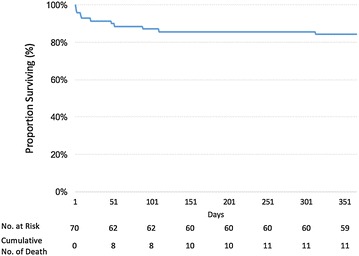
Seventy patients were included in 15 different ICUs. Sixty-three patients suffered from severe or very severe tetanus according to the Ablett classification. The median age was 80 years [interquartile range 73-84], and 86% of patients were women. Ninety per cent of patients (n = 63) required MV for a median of 36 days [26-46], and 66% required administration of a neuromuscular-blocking agent for 23 days [14-29]. A nosocomial infection occurred in 43 patients (61%). ICU and 1-year mortality rates were 14% (n = 10) and 16% (n = 11), respectively. Forty-five per cent of deaths occurred during the first week. Advanced age, a higher SAPS II, any infection, and the use of vasopressors were significantly associated with a lower number of days alive without ventilator support by day 90. Age was the only factor that significantly differed between deceased and survivors at 1 year (83 [81-85] vs. 79 [73-84] years, respectively; p = 0.03). Sixty-one per cent of survivors suffered no impairment to their functional status.
In a high-income country, tetanus mainly occurs in healthy elderly women. Despite prolonged MV and extended ICU length of stay, we observed a low 1-year mortality rate and good long-term functional status.
破伤风病程延长(长达6周),需要入住重症监护病房(ICU)并长期进行机械通气(MV),这可能对短期和长期生存产生重大影响。该主题值得关注并进行讨论。
法国的22个ICU对2000年1月至2014年12月期间收治的患者进行了破伤风筛查。回顾性数据从医院数据库以及通过患者所在城镇的登记处收集。
15个不同的ICU纳入了70例患者。根据阿布莱特分类法,63例患者患有重度或极重度破伤风。中位年龄为80岁[四分位间距73 - 84岁],86%的患者为女性。90%的患者(n = 63)需要进行机械通气,中位时间为36天[26 - 46天],66%的患者需要使用神经肌肉阻滞剂23天[14 - 29天]。43例患者(61%)发生了医院感染。ICU死亡率和1年死亡率分别为14%(n = 10)和16%(n = 11)。45%的死亡发生在第一周。高龄、较高的简化急性生理学评分系统(SAPS)II、任何感染以及使用血管升压药与90天时无呼吸机支持的存活天数减少显著相关。年龄是1年时死亡患者和存活患者之间唯一有显著差异的因素(分别为83[81 - 85]岁和79[73 - 84]岁;p = 0.03)。61%的存活者功能状态未受损害。
在高收入国家,破伤风主要发生在健康的老年女性中。尽管机械通气时间延长且ICU住院时间延长,但我们观察到1年死亡率较低且长期功能状态良好。