Nutrition and Obesity Group, Department of Nutrition and Food Science and Lucio Lascaray Research Center, University of the Basque Country (UPV/EHU), Vitoria, Spain.
CIBER Fisiopatología Obesidad y Nutrición (CIBERobn), Instituto de Salud Carlos III, Madrid, Spain.
J Transl Med. 2017 Nov 21;15(1):237. doi: 10.1186/s12967-017-1343-0.
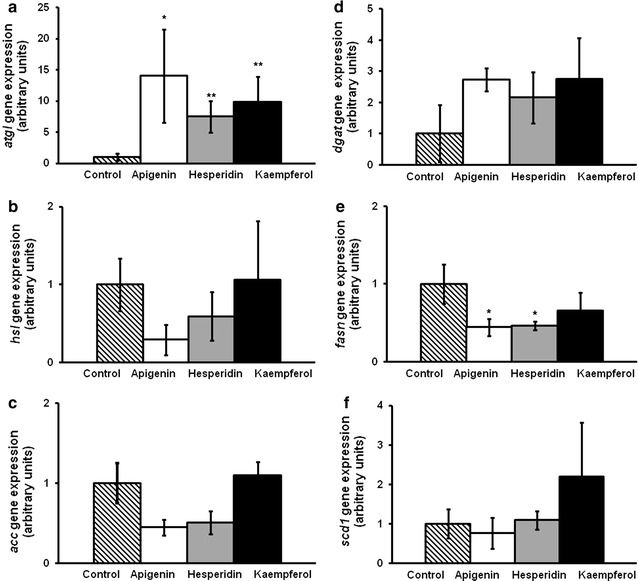
Adipocytes derived from human mesenchymal stem cells (MSCs) are widely used to investigate adipogenesis. Taking into account both the novelty of these MSCs and the scarcity of studies focused on the effects of phenolic compounds, the aim of the present study was to analyze the effect of apigenin, hesperidin and kaempferol on pre-adipocyte and mature adipocytes derived from this type of cells. In addition, the expression of genes involved in TG accumulation was also measured.
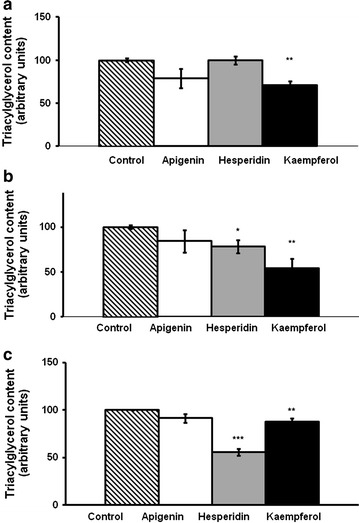
Pre-adipocytes were cultured from day 0 to day 8 and mature adipocytes for 48 h with the polyphenols at doses of 1, 10 and 25 µM.
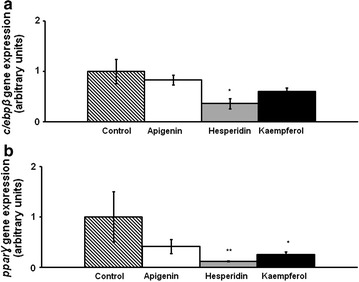
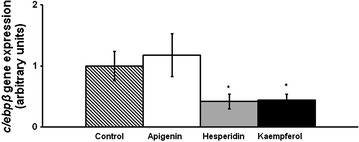
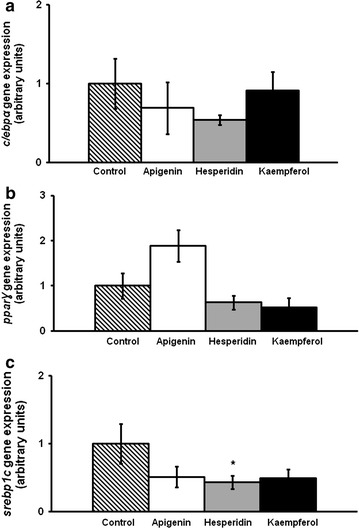
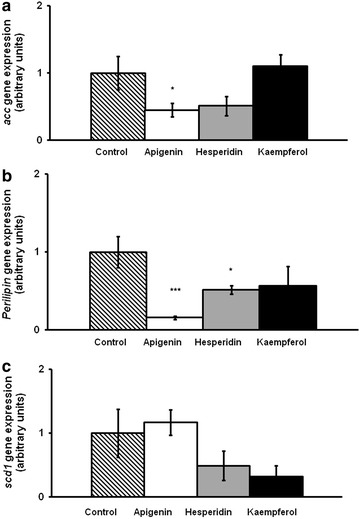
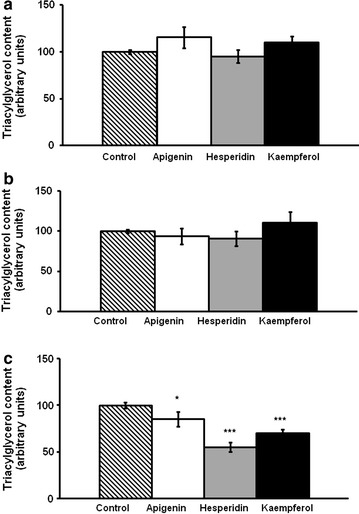
Apigenin did not show an anti-adipogenic action. Pre-adipocytes treated with hesperidin and kaempferol showed reduced TG content at the three experimental doses. Apigenin did not modify the expression of the main adipogenic genes (c/ebpβ, c/ebpα, pparγ and srebp1c), hesperidin inhibited genes involved in the three phases of adipogenesis (c/ebpβ, srebp1c and perilipin) and kaempferol reduced c/ebpβ. In mature adipocytes, the three polyphenols reduced TG accumulation at the dose of 25 µM, but not at lower doses. All compounds increased mRNA levels of atgl. Apigenin and hesperidin decreased fasn expression. The present study shows the anti-adipogenic effect and delipidating effects of apigenin, hesperidin and kaempferol in human adipocytes derived from hMSCs. While hesperidin blocks all the stages of adipogenesis, kaempferol only inhibits the early stage. Regarding mature adipocytes, the three compounds reduce TG accumulation by activating, at least in part, lipolysis, and in the case of hesperidin and apigenin, also by reducing lipogenesis.
The present study shows for the first time the anti-adipogenic effect and delipidating effect of apigenin, hesperidin and kaempferol in human adipocytes derived from MSCs for the first time.
源自人间质干细胞(MSCs)的脂肪细胞被广泛用于研究脂肪生成。考虑到这些 MSCs 的新颖性以及专注于酚类化合物影响的研究稀缺性,本研究旨在分析芹菜素、橙皮苷和山奈酚对源自这种细胞的前体脂肪细胞和成熟脂肪细胞的影响。此外,还测量了参与 TG 积累的基因的表达。
前体脂肪细胞从第 0 天培养到第 8 天,成熟脂肪细胞培养 48 小时,用多酚处理剂量为 1、10 和 25μM。
芹菜素没有表现出抗脂肪生成作用。用橙皮苷和山奈酚处理的前体脂肪细胞在三个实验剂量下 TG 含量降低。芹菜素不改变主要脂肪生成基因(c/ebpβ、c/ebpα、pparγ 和 srebp1c)的表达,橙皮苷抑制脂肪生成的三个阶段的基因(c/ebpβ、srebp1c 和 perilipin),山奈酚降低 c/ebpβ。在成熟脂肪细胞中,三种多酚在 25μM 剂量下降低 TG 积累,但在较低剂量下则没有。所有化合物均增加 atgl 的 mRNA 水平。芹菜素和橙皮苷降低 fasn 表达。本研究表明,源自 hMSCs 的人脂肪细胞中,芹菜素、橙皮苷和山奈酚具有抗脂肪生成和去脂作用。橙皮苷阻断脂肪生成的所有阶段,而山奈酚仅抑制早期阶段。关于成熟脂肪细胞,三种化合物通过激活(至少部分)脂肪分解来减少 TG 积累,在橙皮苷和芹菜素的情况下,还通过减少脂肪生成来减少 TG 积累。
本研究首次表明,源自 MSCs 的人脂肪细胞中,芹菜素、橙皮苷和山奈酚具有抗脂肪生成和去脂作用。