Research Lab of Oral H pylori, Everett, WA, USA.
Exp Mol Med. 2017 Nov 24;49(11):e397. doi: 10.1038/emm.2017.225.
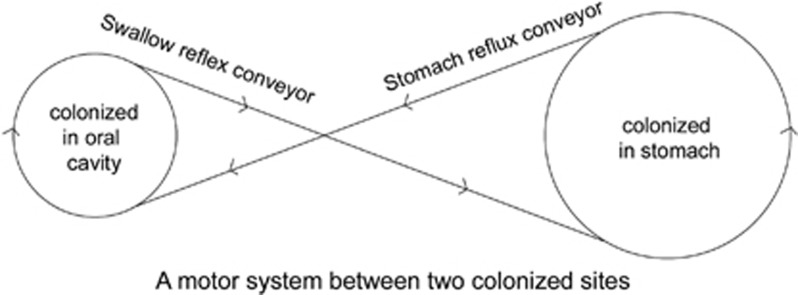
Urea breath test (UBT), as a leading preferred non-invasive diagnostic technology, but may not be able to detect oral H. pylori. With negative results of UBT, the patient may have an oral infection. On the basis of the fact of success, eradication rate may increase by 21% in the 95% Cl range after the elimination of oral H. pylori, the author believes oral H. pylori does exist and the oral cavity is the second colonized site aside its primary site of the stomach. H. pylori migrated out of Africa along with its human host circa 60 000 years ago; they are not lives in stomach only. In this review article, evidence established in recent years studies with use more appropriate technology had been listed and discussed. The author considers the oral cavity is a black hole for H. pylori infection that significant effective on gastroenterology and another medical field. The role of the oral cavity as the source of H. pylori infection is so controvert in past years. It seems like a human being having a second-time face to discover H. pylori in the history.
尿素呼气试验(UBT)作为一种主要的首选非侵入性诊断技术,但可能无法检测口腔中的幽门螺杆菌。UBT 结果为阴性时,患者可能存在口腔感染。在成功根除口腔 H. pylori 的基础上,作者认为口腔 H. pylori 确实存在,口腔是其胃内主要定植部位以外的第二个定植部位,在 95%Cl 范围内根除率可提高 21%。大约在 60000 年前,H. pylori 与其人类宿主一起从非洲迁移而来;它们不仅存在于胃中。在这篇综述文章中,作者列出并讨论了近年来使用更合适技术的研究中获得的证据。作者认为口腔是 H. pylori 感染的黑洞,对胃肠病学和其他医学领域有重要影响。口腔作为 H. pylori 感染源的作用在过去几年中存在争议。这似乎是人类在历史上第二次发现 H. pylori。