Laboratório de Fitoplâncton, Departamento do Mar e Recursos Marinhos, Instituto Português do Mar e da Atmosfera, Rua Alfredo Magalhães Ramalho, 6, 1449-006 Lisboa, Portugal.
Centro Interdisciplinar de Investigação Marinha e Ambiental, CIIMAR/CIMAR, Terminal de Cruzeiros do Porto de Leixões, Av. General Norton de Matos, 4450-208 Matosinhos, Portugal.
Toxins (Basel). 2017 Dec 3;9(12):391. doi: 10.3390/toxins9120391.
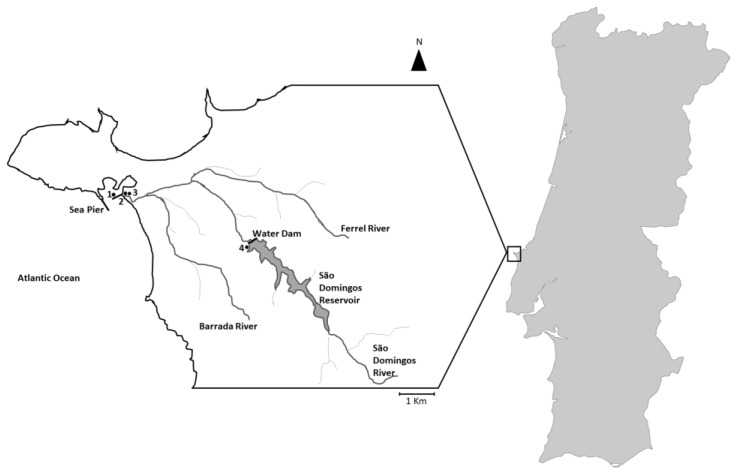
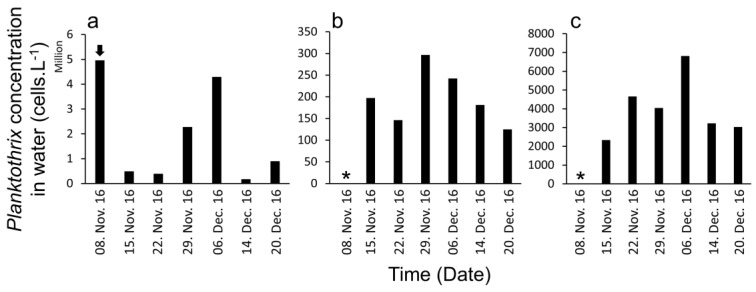
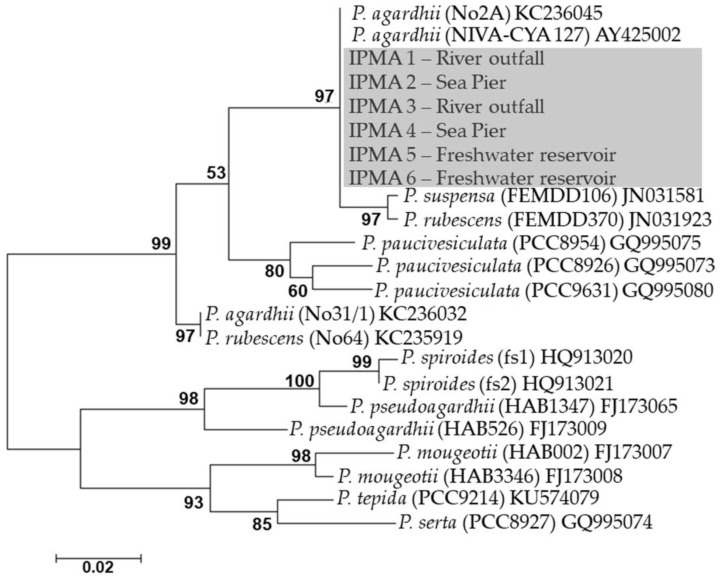
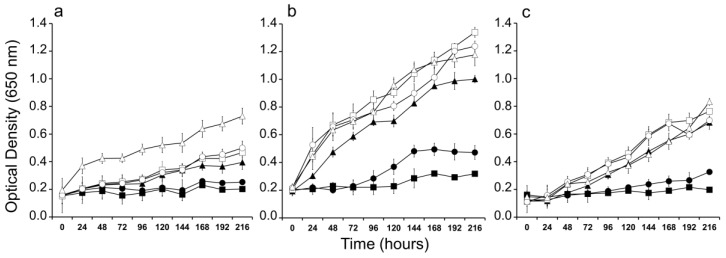
Cyanobacteria blooms are frequent in freshwaters and are responsible for water quality deterioration and human intoxication. Although, not a new phenomenon, concern exists on the increasing persistence, scale, and toxicity of these blooms. There is evidence, in recent years, of the transfer of these toxins from inland to marine waters through freshwater outflow. However, the true impact of these blooms in marine habitats has been overlooked. In the present work, we describe the detection of , which is a common microcystin producer, in the Portuguese marine coastal waters nearby a river outfall in an area used for shellfish harvesting and recreational activities. was first observed in November of 2016 in seawater samples that are in the scope of the national shellfish monitoring system. This occurrence was followed closely between November and December of 2016 by a weekly sampling of mussels and water from the sea pier and adjacent river mouth with salinity ranging from 35 to 3. High cell densities were found in the water from both sea pier and river outfall, reaching concentrations of 4,960,608 cells·L and 6810.3 × 10⁶ cells·L respectively. Cultures were also established with success from the environment and microplate salinity growth assays showed that the isolates grew at salinity 10. HPLC-PDA analysis of total microcystin content in mussel tissue, water biomass, and cultures did not retrieve a positive result. In addition, microcystin related genes were not detected in the water nor cultures. So, the present in the environment was probably a non-toxic strain. This is, to our knowledge, the first report on a bloom reaching the sea and points to the relevance to also monitoring freshwater harmful phytoplankton and related toxins in seafood harvesting and recreational coastal areas, particularly under the influence of river plumes.
蓝藻水华频繁发生于淡水水体中,是导致水质恶化和人类中毒的主要原因。尽管这并非新现象,但人们对这些水华日益增强的持续性、规模和毒性仍表示担忧。近年来,有证据表明,这些毒素通过淡水流出物从内陆转移到海洋水域。然而,这些水华对海洋生境的真正影响尚未得到重视。在本研究中,我们描述了在葡萄牙沿海海域靠近一个河口的海水样本中检测到了,这是一种常见的微囊藻毒素生产者。于 2016 年 11 月首次在国家贝类监测系统监测范围内的海水样本中观察到。随后,在 2016 年 11 月至 12 月期间,每周对来自海水码头和相邻河口的贝类和水样进行了采样,该河口的盐度范围为 35 至 3。在海水码头和河口的水中均发现了高细胞密度,分别达到 4960608 个细胞·L 和 68103000 个细胞·L。还成功地从环境中建立了培养物,微平板盐度生长实验表明,这些分离株可以在盐度为 10 的环境中生长。利用高效液相色谱-光电二极管阵列分析(HPLC-PDA)对贻贝组织、水生物量和培养物中的总微囊藻毒素含量进行分析,未得到阳性结果。此外,在水中和培养物中均未检测到微囊藻毒素相关基因。因此,环境中存在的可能是一种非毒性菌株。这是我们所知的首个蓝藻水华到达海洋的报告,并指出在受河流羽流影响的贝类捕捞和沿海娱乐区,也需要对淡水有害浮游植物及相关毒素进行监测。