Radiotherapy and Radiosurgery Department, Humanitas Clinical and Research Hospital, Rozzano, Italy.
Department of Biomedical Sciences Humanitas University, Rozzano, Italy.
BMC Cancer. 2017 Dec 6;17(1):829. doi: 10.1186/s12885-017-3847-7.
To appraise the ability of a radiomics based analysis to predict local response and overall survival for patients with hepatocellular carcinoma.
A set of 138 consecutive patients (112 males and 26 females, median age 66 years) presented with Barcelona Clinic Liver Cancer (BCLC) stage A to C were retrospectively studied. For a subset of these patients (106) complete information about treatment outcome, namely local control, was available. Radiomic features were computed for the clinical target volume. A total of 35 features were extracted and analyzed. Univariate analysis was used to identify clinical and radiomics significant features. Multivariate models by Cox-regression hazards model were built for local control and survival outcome. Models were evaluated by area under the curve (AUC) of receiver operating characteristic (ROC) curve. For the LC analysis, two models selecting two groups of uncorrelated features were analyzes while one single model was built for the OS analysis.
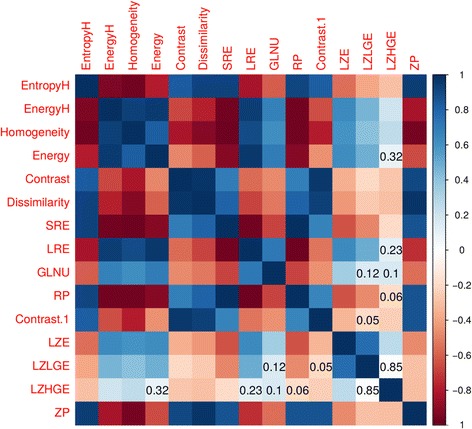
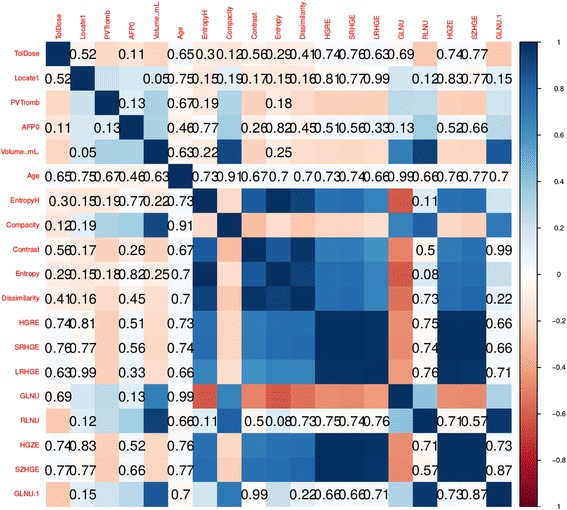
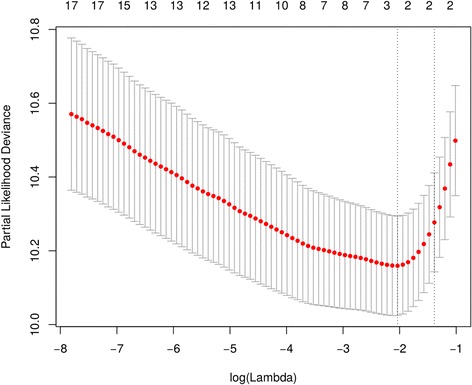
The univariate analysis lead to the identification of 15 significant radiomics features but the analysis of cross correlation showed several cross related covariates. The un-correlated variables were used to build two separate models; both resulted into a single significant radiomic covariate: model-1: energy p < 0.05, AUC of ROC 0.6659, C.I.: 0.5585-0.7732; model-2: GLNU p < 0.05, AUC 0.6396, C.I.:0.5266-0.7526. The univariate analysis for covariates significant with respect to local control resulted in 9 clinical and 13 radiomics features with multiple and complex cross-correlations. After elastic net regularization, the most significant covariates were compacity and BCLC stage, with only compacity significant to Cox model fitting (Cox model likelihood ratio test p < 0.0001, compacity p < 0.00001; AUC of the model is 0.8014 (C.I. = 0.7232-0.8797)).
A robust radiomic signature, made by one single feature was finally identified. A validation phases, based on independent set of patients is scheduled to be performed to confirm the results.
评估基于放射组学分析预测肝细胞癌患者局部反应和总体生存率的能力。
回顾性研究了一组 138 例连续患者(112 名男性和 26 名女性,中位年龄 66 岁),这些患者均患有巴塞罗那临床肝癌(BCLC)分期 A 至 C。对于其中一部分患者(106 名),有完整的治疗结果信息,即局部控制。为临床靶区计算了放射组学特征。共提取和分析了 35 个特征。采用单因素分析确定临床和放射组学显著特征。使用 Cox 回归风险模型建立局部控制和生存结果的多变量模型。通过接受者操作特征(ROC)曲线的曲线下面积(AUC)评估模型。对于 LC 分析,选择两组不相关特征的两个模型进行分析,而对于 OS 分析则建立一个单一的模型。
单因素分析导致确定了 15 个显著的放射组学特征,但交叉相关分析显示出几个相互关联的协变量。使用不相关变量建立了两个单独的模型;这两个模型都得到了一个单一的显著放射组学协变量:模型 1:能量 p < 0.05,ROC 曲线的 AUC 为 0.6659,CI:0.5585-0.7732;模型 2:GLNU p < 0.05,AUC 为 0.6396,CI:0.5266-0.7526。对于与局部控制显著相关的协变量的单因素分析导致 9 个临床和 13 个放射组学特征存在复杂的多向交叉相关性。在弹性网络正则化后,最显著的协变量是紧凑性和 BCLC 分期,只有紧凑性对 Cox 模型拟合具有显著意义(Cox 模型似然比检验 p < 0.0001,紧凑性 p < 0.00001;模型的 AUC 为 0.8014(CI = 0.7232-0.8797))。
最终确定了一个由单个特征组成的稳健的放射组学特征。计划基于独立的患者组进行验证阶段,以确认结果。