• 文献检索
  • 文档翻译
  • 深度研究
  • 学术资讯
  • Suppr Zotero 插件Zotero 插件
  • 邀请有礼
  • 套餐&价格
  • 历史记录
应用&插件
Suppr Zotero 插件Zotero 插件浏览器插件Mac 客户端Windows 客户端微信小程序
定价
高级版会员购买积分包购买API积分包
服务
文献检索文档翻译深度研究API 文档MCP 服务
关于我们
关于 Suppr公司介绍联系我们用户协议隐私条款
关注我们

Suppr 超能文献

核心技术专利:CN118964589B侵权必究
粤ICP备2023148730 号-1Suppr @ 2026

文献检索

告别复杂PubMed语法,用中文像聊天一样搜索,搜遍4000万医学文献。AI智能推荐,让科研检索更轻松。

立即免费搜索

文件翻译

保留排版,准确专业,支持PDF/Word/PPT等文件格式,支持 12+语言互译。

免费翻译文档

深度研究

AI帮你快速写综述,25分钟生成高质量综述,智能提取关键信息,辅助科研写作。

立即免费体验

临床实践中患者生成数据的信息质量挑战

Information Quality Challenges of Patient-Generated Data in Clinical Practice.

作者信息

West Peter, Van Kleek Max, Giordano Richard, Weal Mark, Shadbolt Nigel

机构信息

Faculty of Health Sciences, University of Southampton, Southampton, United Kingdom.

Department of Computer Science, University of Oxford, Oxford, United Kingdom.

出版信息

Front Public Health. 2017 Nov 1;5:284. doi: 10.3389/fpubh.2017.00284. eCollection 2017.

DOI:10.3389/fpubh.2017.00284
PMID:29209601
原文链接:https://pmc.ncbi.nlm.nih.gov/articles/PMC5701635/
Abstract

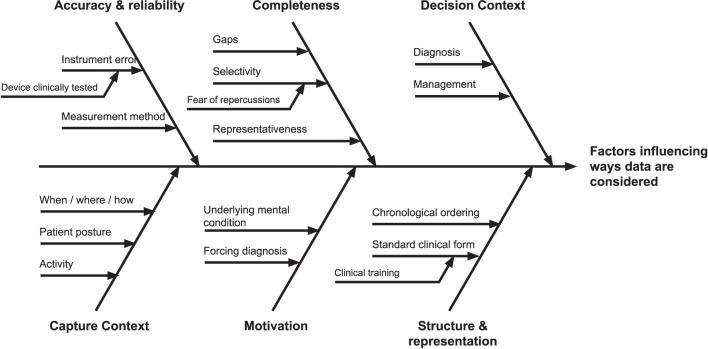
A characteristic trend of digital health has been the dramatic increase in being presented to clinicians, which follows from the increased ubiquity of self-tracking practices by individuals, driven, in turn, by the proliferation of self-tracking tools and technologies. Such tools not only make self-tracking easier but also potentially more reliable by automating data collection, curation, and storage. While self-tracking practices themselves have been studied extensively in human-computer interaction literature, little work has yet looked at whether these patient-generated data might be able to support clinical processes, such as providing evidence for diagnoses, treatment monitoring, or postprocedure recovery, and how we can define information quality with respect to self-tracked data. In this article, we present the results of a literature review of empirical studies of self-tracking tools, in which we identify how clinicians perceive quality of information from such tools. In the studies, clinicians perceive several characteristics of information quality relating to accuracy and reliability, completeness, context, patient motivation, and representation. We discuss the issues these present in admitting self-tracked data as evidence for clinical decisions.

摘要

数字健康的一个显著趋势是,呈递给临床医生的数据急剧增加,这源于个人自我追踪行为的日益普遍,而这又反过来受到自我追踪工具和技术激增的推动。此类工具不仅使自我追踪变得更加容易,还通过自动化数据收集、整理和存储,使其可能更加可靠。虽然自我追踪行为本身在人机交互文献中已得到广泛研究,但很少有研究探讨这些患者生成的数据是否能够支持临床流程,如为诊断、治疗监测或术后恢复提供证据,以及我们如何定义自我追踪数据的信息质量。在本文中,我们展示了对自我追踪工具实证研究的文献综述结果,其中我们确定了临床医生如何看待此类工具的信息质量。在这些研究中,临床医生认识到与准确性和可靠性、完整性、背景、患者动机及呈现方式相关的几个信息质量特征。我们讨论了在将自我追踪数据作为临床决策证据时所出现的这些问题。
https://cdn.ncbi.nlm.nih.gov/pmc/blobs/3c82/5701635/3fdba670c19b/fpubh-05-00284-g002.jpg
https://cdn.ncbi.nlm.nih.gov/pmc/blobs/3c82/5701635/a7fae8c7ee20/fpubh-05-00284-g001.jpg
https://cdn.ncbi.nlm.nih.gov/pmc/blobs/3c82/5701635/3fdba670c19b/fpubh-05-00284-g002.jpg
https://cdn.ncbi.nlm.nih.gov/pmc/blobs/3c82/5701635/a7fae8c7ee20/fpubh-05-00284-g001.jpg
https://cdn.ncbi.nlm.nih.gov/pmc/blobs/3c82/5701635/3fdba670c19b/fpubh-05-00284-g002.jpg

相似文献

1
Information Quality Challenges of Patient-Generated Data in Clinical Practice.临床实践中患者生成数据的信息质量挑战
Front Public Health. 2017 Nov 1;5:284. doi: 10.3389/fpubh.2017.00284. eCollection 2017.
2
Understanding Mental Health Clinicians' Perceptions and Concerns Regarding Using Passive Patient-Generated Health Data for Clinical Decision-Making: Qualitative Semistructured Interview Study.了解心理健康临床医生对使用被动患者生成的健康数据进行临床决策的看法和担忧:定性半结构化访谈研究
JMIR Form Res. 2023 Aug 10;7:e47380. doi: 10.2196/47380.
3
The future of Cochrane Neonatal.考克兰新生儿协作网的未来。
Early Hum Dev. 2020 Nov;150:105191. doi: 10.1016/j.earlhumdev.2020.105191. Epub 2020 Sep 12.
4
How Self-tracking and the Quantified Self Promote Health and Well-being: Systematic Review.自我追踪和量化自我如何促进健康和幸福:系统评价。
J Med Internet Res. 2021 Sep 21;23(9):e25171. doi: 10.2196/25171.
5
Clinician and Patient Perspectives on the Use of Passive Mobile Monitoring and Self-Tracking for Patients With Serious Mental Illness: User-Centered Approach.临床医生和患者对严重精神疾病患者使用被动移动监测和自我追踪的看法:以用户为中心的方法。
JMIR Hum Factors. 2023 Oct 24;10:e46909. doi: 10.2196/46909.
6
Decision-support tools via mobile devices to improve quality of care in primary healthcare settings.移动设备决策支持工具改善基层医疗服务质量。
Cochrane Database Syst Rev. 2021 Jul 27;7(7):CD012944. doi: 10.1002/14651858.CD012944.pub2.
7
8
A multiple-scenario assessment of the effect of a continuous-care, guideline-based decision support system on clinicians' compliance to clinical guidelines.基于指南的持续护理决策支持系统对临床医生遵循临床指南情况影响的多情景评估。
Int J Med Inform. 2015 Apr;84(4):248-62. doi: 10.1016/j.ijmedinf.2015.01.004. Epub 2015 Jan 17.
9
Going digital: a narrative overview of the clinical and organisational impacts of eHealth technologies in hospital practice.走向数字化:电子健康技术在医院实践中临床及组织影响的叙述性概述
Aust Health Rev. 2017 Dec;41(6):646-664. doi: 10.1071/AH16233.
10
More Than Telemonitoring: Health Provider Use and Nonuse of Life-Log Data in Irritable Bowel Syndrome and Weight Management.不仅仅是远程监测:医疗服务提供者在肠易激综合征和体重管理中对生活日志数据的使用与未使用情况
J Med Internet Res. 2015 Aug 21;17(8):e203. doi: 10.2196/jmir.4364.

引用本文的文献

1
The one-key-to-two-doors role of lipidomics: plasma lipidome, cardiovascular risk and statin usage.脂质组学的一键双门作用:血浆脂质组、心血管风险与他汀类药物的使用
J Lipid Res. 2025 May;66(5):100802. doi: 10.1016/j.jlr.2025.100802. Epub 2025 Apr 14.
2
Conceptualizing Patient as an Organization With the Adoption of Digital Health.将患者概念化为采用数字健康技术的组织。
Biomed Eng Comput Biol. 2024 Sep 24;15:11795972241277292. doi: 10.1177/11795972241277292. eCollection 2024.
3
Oncologists' Perceptions of a Digital Tool to Improve Cancer Survivors' Cardiovascular Health.

本文引用的文献

1
Older Adults' Use of and Attitudes toward Activity Monitoring Technologies.老年人对活动监测技术的使用及态度。
Proc Hum Factors Ergon Soc Annu Meet. 2013 Sep;57(1):1683-1687. doi: 10.1177/1541931213571374. Epub 2013 Sep 30.
2
Supporting the Self-Management of Chronic Pain Conditions with Tailored Momentary Self-Assessments.通过量身定制的即时自我评估支持慢性疼痛状况的自我管理。
Proc SIGCHI Conf Hum Factor Comput Syst. 2017 May;2017:1065-1077. doi: 10.1145/3025453.3025832.
3
Large-scale physical activity data reveal worldwide activity inequality.
肿瘤学家对一种改善癌症幸存者心血管健康的数字工具的看法。
ACI open. 2019 Jul;3(2):e78-e87. doi: 10.1055/s-0039-1696732. Epub 2019 Oct 3.
4
Enhancing data practices for Whole Health: Strategies for a transformative future.加强整体健康的数据实践:迈向变革性未来的策略。
Learn Health Syst. 2024 May 30;8(Suppl 1):e10426. doi: 10.1002/lrh2.10426. eCollection 2024 Jun.
5
Use of Patient-Generated Health Data From Consumer-Grade Devices by Health Care Professionals in the Clinic: Systematic Review.医疗保健专业人员在诊所中使用消费者级设备生成的患者健康数据:系统评价。
J Med Internet Res. 2024 May 31;26:e49320. doi: 10.2196/49320.
6
Recommendations for the Quality Management of Patient-Generated Health Data in Remote Patient Monitoring: Mixed Methods Study.远程患者监测中患者生成健康数据质量管理的建议:混合方法研究。
JMIR Mhealth Uhealth. 2023 Feb 24;11:e35917. doi: 10.2196/35917.
7
The Influence of Personal Health Data on the Health Coaching Process.个人健康数据对健康指导过程的影响。
Front Big Data. 2022 Jun 14;5:678061. doi: 10.3389/fdata.2022.678061. eCollection 2022.
8
Digital Self-monitoring of Multiple Sclerosis: Interview Study With Dutch Health Care Providers on the Expected New Configuration of Roles and Responsibilities.数字多发性硬化症自我监测:荷兰医疗保健提供者对预期的新角色和职责配置的访谈研究。
JMIR Mhealth Uhealth. 2022 Apr 27;10(4):e30224. doi: 10.2196/30224.
9
Understanding the attitudes and experiences of people living with potentially stigmatised long-term health conditions with respect to collecting and sharing health and lifestyle data.了解患有可能遭受污名化的长期健康状况的人群在收集和共享健康及生活方式数据方面的态度和经历。
Digit Health. 2022 Apr 18;8:20552076221089798. doi: 10.1177/20552076221089798. eCollection 2022 Jan-Dec.
10
Collecting and sharing self-generated health and lifestyle data: Understanding barriers for people living with long-term health conditions - a survey study.收集和共享自我生成的健康与生活方式数据:了解长期健康状况患者面临的障碍——一项调查研究。
Digit Health. 2022 Mar 7;8:20552076221084458. doi: 10.1177/20552076221084458. eCollection 2022 Jan-Dec.
大规模身体活动数据揭示了全球范围内的活动不平等现象。
Nature. 2017 Jul 20;547(7663):336-339. doi: 10.1038/nature23018. Epub 2017 Jul 10.
4
TummyTrials: A Feasibility Study of Using Self-Experimentation to Detect Individualized Food Triggers.腹部试验:一项利用自我实验来检测个性化食物触发因素的可行性研究。
Proc SIGCHI Conf Hum Factor Comput Syst. 2017 May 2;2017:6850-6863. doi: 10.1145/3025453.3025480.
5
Supporting Patient-Provider Collaboration to Identify Individual Triggers using Food and Symptom Journals.支持患者与医护人员协作,利用饮食和症状日记识别个体触发因素。
CSCW Conf Comput Support Coop Work. 2017 Feb 25;2017:1726-1739. doi: 10.1145/2998181.2998276.
6
Boundary Negotiating Artifacts in Personal Informatics: Patient-Provider Collaboration with Patient-Generated Data.个人信息学中的边界协商工件:患者与医疗服务提供者利用患者生成数据的协作
CSCW Conf Comput Support Coop Work. 2016 Feb 27;2016:770-786. doi: 10.1145/2818048.2819926.
7
"Not Just a Receiver": Understanding Patient Behavior in the Hospital Environment.“不仅仅是接受者”:理解医院环境中的患者行为
Proc SIGCHI Conf Hum Factor Comput Syst. 2016 May 7;2016:3103-3114. doi: 10.1145/2858036.2858167.
8
Sharing Patient-Generated Data in Clinical Practices: An Interview Study.临床实践中患者生成数据的共享:一项访谈研究。
AMIA Annu Symp Proc. 2017 Feb 10;2016:1303-1312. eCollection 2016.
9
Care Partnerships: Toward Technology to Support Teens' Participation in Their Health Care.关爱伙伴关系:迈向支持青少年参与自身医疗保健的技术。
Proc SIGCHI Conf Hum Factor Comput Syst. 2016 May 7;2016:5337-5349. doi: 10.1145/2858036.2858508.
10
Integrating Patient-Generated Health Data Into Clinical Care Settings or Clinical Decision-Making: Lessons Learned From Project HealthDesign.将患者生成的健康数据整合到临床护理环境或临床决策中:从健康设计项目中汲取的经验教训。
JMIR Hum Factors. 2016 Oct 19;3(2):e26. doi: 10.2196/humanfactors.5919.