Wabeto Wondimu, Abraham Yishak, Anjulo Antehun Alemayehu
Dubbo Preparatory School, Wolaita Zone, Ethiopia.
Department of Medical Laboratory, College of Health Sciences and Medicine, Wolaita Sodo University, P.O. Box: 138, Wolaita Sodo, Ethiopia.
J Health Popul Nutr. 2017 Dec 16;36(1):52. doi: 10.1186/s41043-017-0131-z.
The consumption of multidrug resistant Salmonella isolates along with a raw meat dish is directly relevant to the global public health crisis of antimicrobial resistance. All countries around the globe are suffering from food-borne diseases. In developing countries, more than one billion individuals suffering from gastroenteritis and around five million infected individuals die annually.
A cross-sectional study was carried out from December 2015 to May 2016 to show the risk of Salmonella associated with consuming traditional raw meat dishes and to characterize the antimicrobial resistance profile at Wolaita Sodo municipal abattoir. Animals were being processed as part of the normal work of the abattoir, and 448 carcass samples were taken after getting a written consent from the municipality. Samples were transported to Wolaita Sodo University Microbiology Laboratory in an ice box within an hour of collection. Swab samples were pre-enriched in tetrathionate broth and Rappaport-Vassiliadis R10 broth. Broth culture was sub-cultured on xylose lysine deoxycholate and brilliant green agar and incubated at a temperature of 37 °C for overnight. Antimicrobial susceptibility test was done by disk diffusion method. Microbiological and observational data entry and analysis were done using Microsoft Excel 2007.
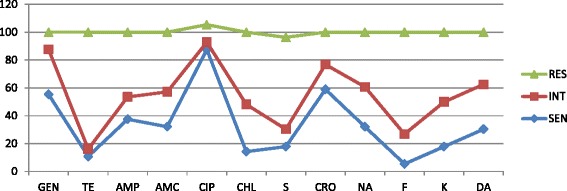
From the total 448 sampled carcasses, Salmonella growth was observed in 56 (12.5%) samples. The isolates had various resistance profiles, with resistance to 1 to 12 antimicrobial drugs. Tetracycline- and nitrofurantion-resistant isolates were frequent, 83.93 and 73.21% respectively, and followed by streptomycin-resistant isolates (66%). Ciprofloxacin-resistant isolates were rare (7%).
Salmonella species contamination frequency was high in raw beef, and most of the isolates exhibited resistance to commonly used antibiotics. People living in the town and consuming the raw meat are at risk for developing diseases, and attention should be given to select antimicrobials in treating Salmonella infections in both animals and human being based on antimicrobial susceptibility test. Moreover, intersectoral working and developing one health approach is essential. Health information should be given to individuals who have the habit of eating raw meat. Training on sanitary and hygiene practice should be given to the abattoir workers.
食用含有多重耐药性沙门氏菌分离株的生肉菜肴与全球抗菌药物耐药性的公共卫生危机直接相关。全球所有国家都在遭受食源性疾病的困扰。在发展中国家,每年有超过10亿人患肠胃炎,约500万感染者死亡。
于2015年12月至2016年5月开展了一项横断面研究,以揭示食用传统生肉菜肴与沙门氏菌相关的风险,并对沃莱塔索多市屠宰场的抗菌药物耐药性特征进行描述。动物作为屠宰场正常工作的一部分进行处理,在获得市政府的书面同意后采集了448份胴体样本。样本在采集后一小时内用冰盒运至沃莱塔索多大学微生物学实验室。拭子样本在四硫磺酸盐肉汤和Rappaport-Vassiliadis R10肉汤中进行预增菌。肉汤培养物在木糖赖氨酸脱氧胆酸盐和亮绿琼脂上进行继代培养,并在37°C下孵育过夜。采用纸片扩散法进行抗菌药物敏感性试验。微生物学和观察数据的录入及分析使用Microsoft Excel 2007完成。
在总共448份采样胴体中,有56份(12.5%)样本观察到沙门氏菌生长。分离株具有多种耐药模式,对1至12种抗菌药物耐药。耐四环素和呋喃妥因的分离株较为常见,分别为83.93%和73.21%,其次是耐链霉素的分离株(66%)。耐环丙沙星的分离株较少见(7%)。
生牛肉中沙门氏菌的污染频率较高,且大多数分离株对常用抗生素耐药。居住在该镇并食用生肉的人群有患病风险,应根据抗菌药物敏感性试验来选择用于治疗动物和人类沙门氏菌感染的抗菌药物。此外,跨部门合作和发展“同一健康”方法至关重要。应向有食用生肉习惯的个人提供健康信息。应对屠宰场工人进行卫生和卫生操作培训。