Atterby Clara, Börjesson Stefan, Ny Sofia, Järhult Josef D, Byfors Sara, Bonnedahl Jonas
Zoonosis Science Center, Department of Medical Biochemistry and Microbiology, Uppsala University, Uppsala, Sweden.
Department of Animal Health and Antimicrobial strategies, National Veterinary Institute (SVA), Uppsala, Sweden.
PLoS One. 2017 Dec 28;12(12):e0190380. doi: 10.1371/journal.pone.0190380. eCollection 2017.
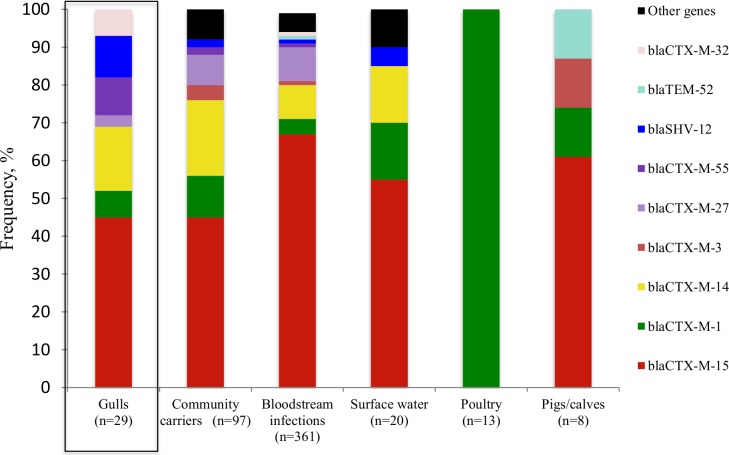
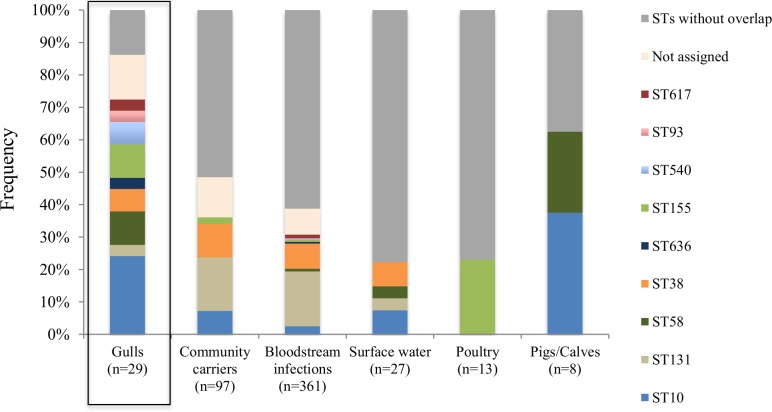
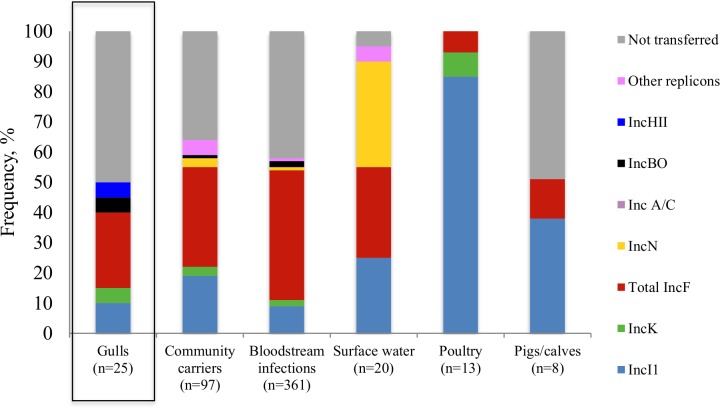
ESBL-producing bacteria are present in wildlife and the environment might serve as a resistance reservoir. Wild gulls have been described as frequent carriers of ESBL-producing E. coli strains with genotypic characteristics similar to strains found in humans. Therefore, potential dissemination of antibiotic resistance genes and bacteria between the human population and wildlife need to be further investigated. Occurrence and characterization of ESBL-producing E. coli in Swedish wild gulls were assessed and compared to isolates from humans, livestock and surface water collected in the same country and similar time-period. Occurrence of ESBL-producing E. coli in Swedish gulls is about three times higher in gulls compared to Swedish community carriers (17% versus 5%) and the genetic characteristics of the ESBL-producing E. coli population in Swedish wild gulls and Swedish human are similar. ESBL-plasmids IncF- and IncI1-type carrying ESBL-genes blaCTX-M-15 or blaCTX-M-14 were most common in isolates from both gulls and humans, but there was limited evidence of clonal transmission. Isolates from Swedish surface water harbored similar genetic characteristics, which highlights surface waters as potential dissemination routes between wildlife and the human population. Even in a low-prevalence country such as Sweden, the occurrence of ESBL producing E. coli in wild gulls and the human population appears to be connected and the occurrence of ESBL-producing E. coli in Swedish gulls is likely a case of environmental pollution.
产超广谱β-内酰胺酶(ESBL)细菌存在于野生动物中,环境可能充当耐药菌库。野生海鸥被描述为产ESBL大肠杆菌菌株的常见携带者,其基因型特征与在人类中发现的菌株相似。因此,抗生素耐药基因和细菌在人类与野生动物之间的潜在传播需要进一步研究。对瑞典野生海鸥中产ESBL大肠杆菌的发生情况和特征进行了评估,并与同一国家和相似时间段内从人类、家畜和地表水分离出的菌株进行了比较。瑞典海鸥中产ESBL大肠杆菌的发生率比瑞典社区携带者高出约三倍(分别为17%和5%),并且瑞典野生海鸥和瑞典人类中产ESBL大肠杆菌群体的遗传特征相似。携带ESBL基因blaCTX-M-15或blaCTX-M-14的ESBL质粒IncF型和IncI1型在海鸥和人类的分离株中最为常见,但克隆传播的证据有限。瑞典地表水分离株具有相似的遗传特征,这突出了地表水作为野生动物与人类之间潜在传播途径的作用。即使在瑞典这样一个低流行率国家,野生海鸥和人类中产ESBL大肠杆菌的发生情况似乎也有关联,瑞典海鸥中产ESBL大肠杆菌的出现很可能是环境污染的一个例子。