State Key Laboratory of Veterinary Etiological Biology, Key Laboratory of Veterinary Parasitology of Gansu Province, Lanzhou Veterinary Research Institute, Chinese Academy of Agricultural Sciences, Lanzhou, Gansu Province, 730046, People's Republic of China.
Military Veterinary Institute, Key Laboratory of Jilin Province for Zoonosis Prevention and Control, Academy of Military Medical Sciences, Changchun, Jilin Province, 130122, People's Republic of China.
Parasit Vectors. 2018 Jan 9;11(1):28. doi: 10.1186/s13071-017-2558-x.
Diarrhea caused by opportunistic intestinal protozoa is a common problem in HIV infection. We aimed to establish the prevalence of Cryptosporidium, misrosporidia, and Isospora in HIV-infected people using a systematic review and meta-analysis, which is central to developing public policy and clinical services.
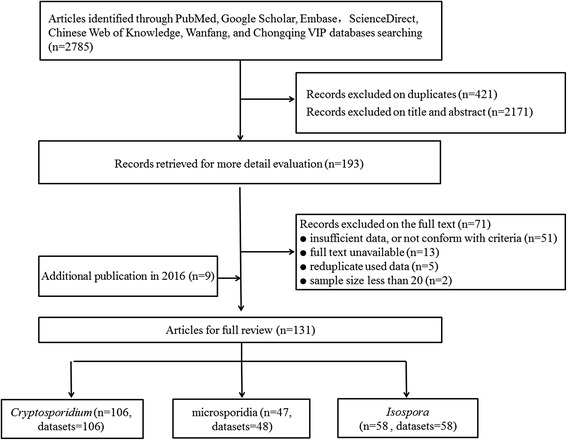
We searched PubMed, ScienceDirect, Google Scholar, Embase, Chinese Web of Knowledge, Wanfang, and Chongqing VIP databases for studies reporting Cryptosporidium, microsporidia, or Isospora infection in HIV-infected people. We extracted the numbers of people with HIV and protozoa infection, and estimated the pooled prevalence of parasite infection by a random effects model.
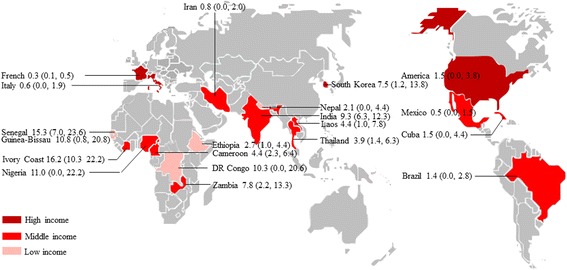
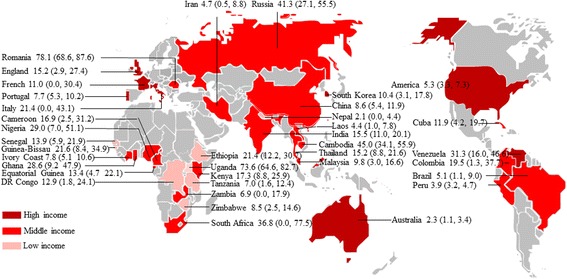
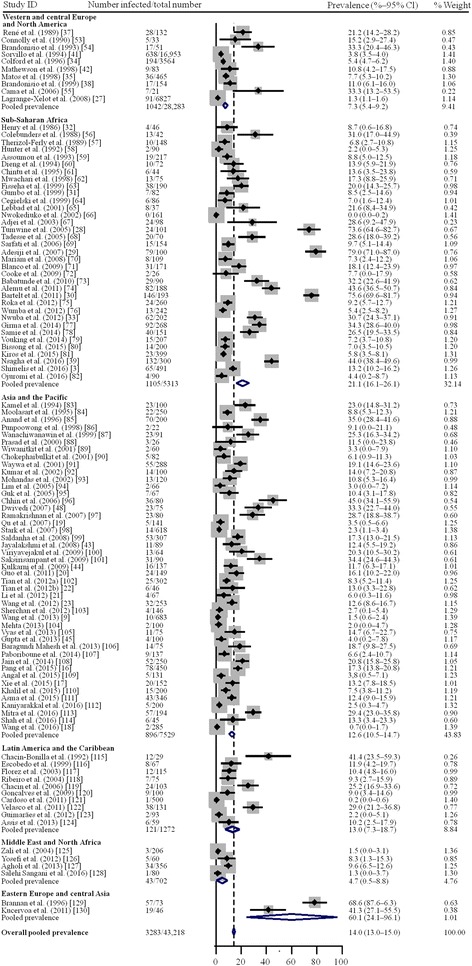
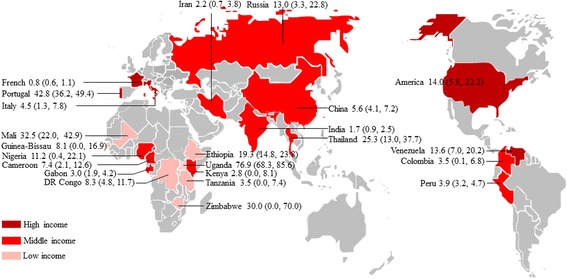
Our research identified 131 studies that reported Cryptosporidium, microsporidia, and Isospora infection in HIV-infected people. We estimated the pooled prevalence to be 14.0% (3283/43,218; 95% CI: 13.0-15.0%) for Cryptosporidium, 11.8% (1090/18,006; 95% CI: 10.1-13.4%) for microsporidia, and 2.5% (788/105,922; 95% CI: 2.1-2.9%) for Isospora. A low prevalence of microsporidia and Isospora infection was found in high-income countries, and a high prevalence of Cryptosporidium and Isospora infection was found in sub-Saharan Africa. We also detected a high prevalence of Cryptosporidium, microsporidia, and Isospora infection in patients with diarrhea. Sensitivity analysis showed that three studies significantly affect the prevalence of Isospora, which was adjusted to 5.0% (469/8570; 95% CI: 4.1-5.9%) by excluding these studies.
Our findings suggest that HIV-infected people have a high prevalence of Cryptosporidium, microsporidia, and Isospora infection in low-income countries and patients with diarrhea, especially in sub-Saharan Africa, reinforcing the importance of routine surveillance for opportunistic intestinal protozoa in HIV-infected people.
机会性肠道原虫引起的腹泻是 HIV 感染的常见问题。我们旨在通过系统评价和荟萃分析来确定 HIV 感染者中隐孢子虫、微孢子虫和等孢子虫的流行率,这对于制定公共政策和临床服务至关重要。
我们在 PubMed、ScienceDirect、Google Scholar、Embase、中国知网、万方和重庆维普数据库中搜索了报道 HIV 感染者隐孢子虫、微孢子虫或等孢子虫感染的研究。我们提取了 HIV 感染者和寄生虫感染者的数量,并采用随机效应模型估计寄生虫感染的总患病率。
我们的研究确定了 131 项报道 HIV 感染者隐孢子虫、微孢子虫和等孢子虫感染的研究。我们估计总患病率为 14.0%(3283/43218;95%CI:13.0-15.0%)为隐孢子虫,11.8%(1090/18006;95%CI:10.1-13.4%)为微孢子虫,2.5%(788/105922;95%CI:2.1-2.9%)为等孢子虫。高收入国家微孢子虫和等孢子虫感染的患病率较低,而撒哈拉以南非洲地区隐孢子虫和等孢子虫感染的患病率较高。我们还发现腹泻患者中隐孢子虫、微孢子虫和等孢子虫感染的患病率较高。敏感性分析表明,有三项研究显著影响等孢子虫的患病率,排除这些研究后,将其调整为 5.0%(469/8570;95%CI:4.1-5.9%)。
我们的研究结果表明,在低收入国家和腹泻患者中,HIV 感染者中隐孢子虫、微孢子虫和等孢子虫感染的患病率较高,特别是在撒哈拉以南非洲地区,这强调了对 HIV 感染者中机会性肠道原虫进行常规监测的重要性。