The Department of Internal Medicine, Kyushu University Beppu Hospital, 4546 Tsurumihara, Beppu, Oita, 874-0838, Japan.
The Department of Surgery, Kyushu University Beppu Hospital, 4546 Tsurumihara, Beppu, Oita, 874-0838, Japan.
Sci Rep. 2018 Jan 9;8(1):133. doi: 10.1038/s41598-017-18488-3.
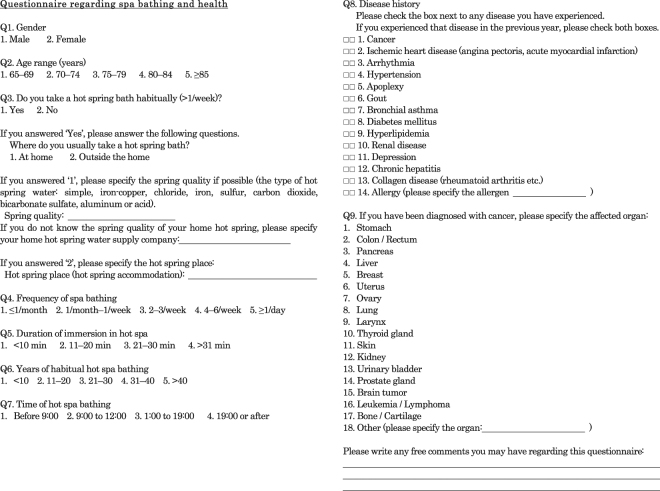
Although body-warming with hot spa-bathing has been proposed to exert medical therapeutic effects on certain diseases, whether body-warming has preventive and promotive effects remains unknown. To clarify this issue, an epidemiological questionnaire study regarding personal hot spa-bathing habits and disease history was carried out in Japan, where individuals engage in daily warm water bathing. Questionnaires regarding hot spa-bathing habits and disease history were randomly sent to 20,000 residents aged ≥65 years living in Beppu, a city in Japan that has the highest concentration of hot spa sources in the world. The results showed that habitual hot spa-bathing exerts preventive or promotive effects on the occurrence of certain diseases, such as hypertension (preventive) and collagen disease (promotive) in women, and cardiovascular diseases (preventive) and colon cancer survival (promotive) in men. These findings suggest that habitual body warming is an effective and economical method with beneficial preventive and promotive effects on various diseases.
虽然热温泉浴被认为对某些疾病具有医学治疗效果,但身体变暖是否具有预防和促进作用尚不清楚。为了澄清这个问题,在日本进行了一项关于个人热温泉浴习惯和病史的流行病学问卷调查研究,因为日本人每天都进行温水沐浴。问卷调查关于热温泉浴习惯和病史的问卷随机发送给了 20,000 名居住在日本别府市的 65 岁及以上的居民,该城市拥有世界上温泉资源最集中的地方。结果表明,习惯性的热温泉浴对某些疾病的发生具有预防或促进作用,如女性的高血压(预防)和胶原病(促进),以及男性的心血管疾病(预防)和结肠癌存活(促进)。这些发现表明,习惯性的身体变暖是一种有效且经济的方法,对各种疾病具有有益的预防和促进作用。