College of Animal Bioscience and Technology, Department of Bioindustrial Technologies, Konkuk University, Hwayang-dong, Kwangjin-gu, Seoul 05029, Korea.
Laboratory of Cardiovascular Regeneration, Division of Cardiology, Seoul St. Mary's Hospital, The Catholic University of Korea School of Medicine, Seoul 02841, Korea.
Int J Mol Sci. 2018 Jan 17;19(1):280. doi: 10.3390/ijms19010280.
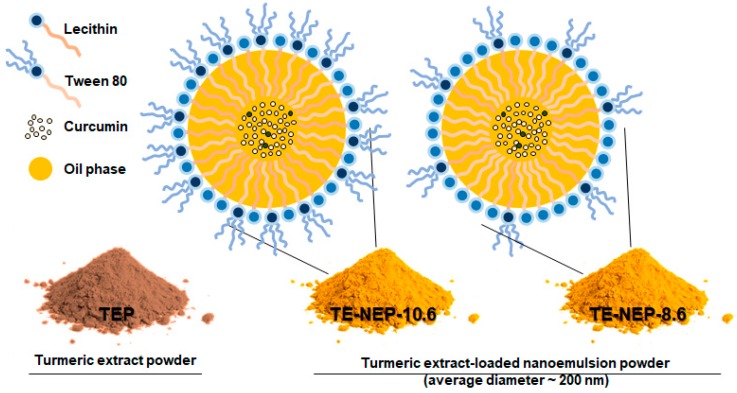
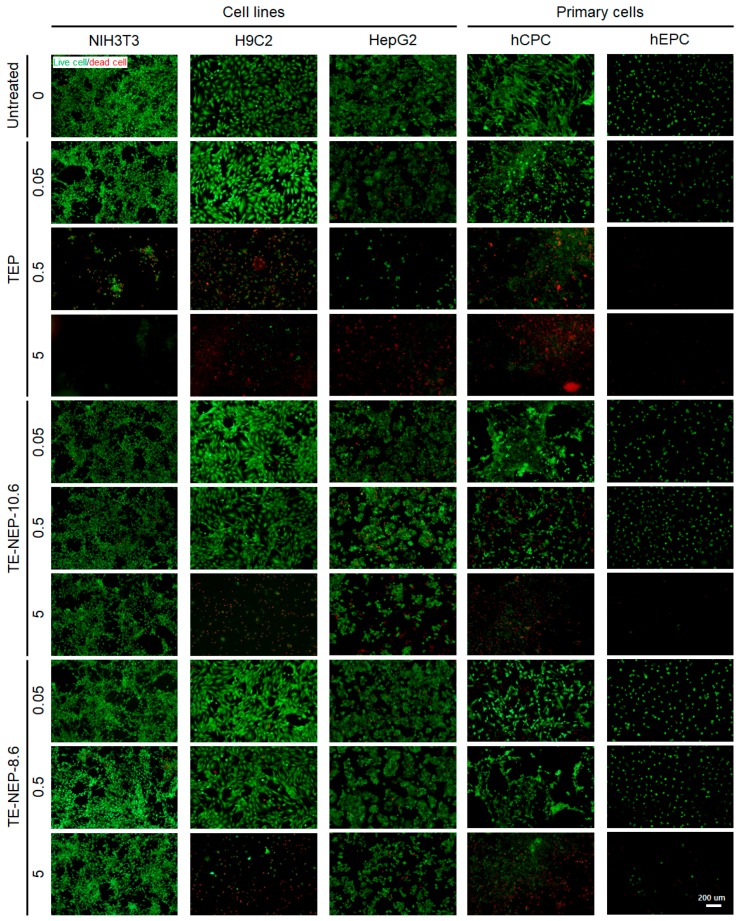
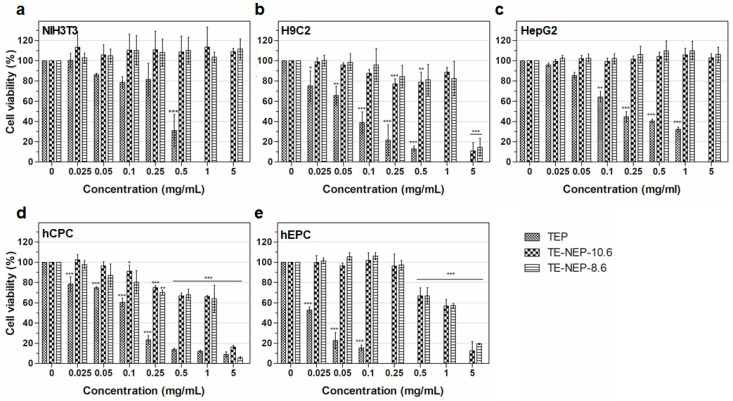
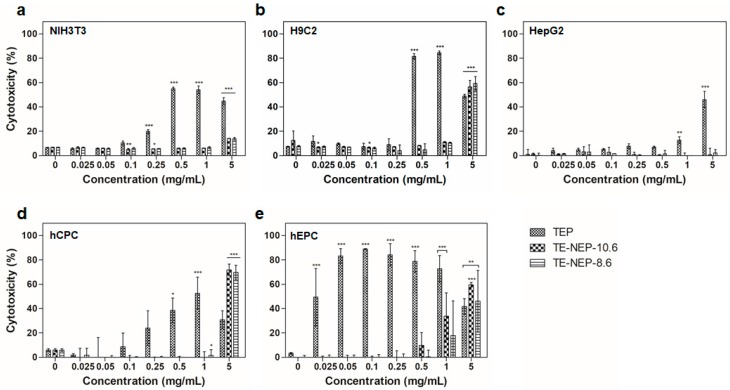
To overcome the drawbacks of conventional drug delivery system, nanoemulsion have been developed as an advanced form for improving the delivery of active ingredients. However, safety evaluation is crucial during the development stage before the commercialization. Therefore, the aim of this study was to evaluate the cytotoxicity of two types of newly developed nanoemulsions. Turmeric extract-loaded nanoemulsion powder-10.6 (TE-NEP-10.6, high content of artificial surfactant Tween 80), which forms the optimal nanoemulsion, and the TE-NEP-8.6 made by increasing the content of natural emulsifier (lecithin) to reduce the potential toxicity of nanoemulsion were cultured with various cells (NIH3T3, H9C2, HepG2, hCPC, and hEPC) and the changes of each cell were observed followed by nanoemulsion treatment. As a result, the two nanoemulsions (TE-NEP-10.6 and TE-NEP-8.6) did not show significant difference in cell viability. In the case of cell line (NIH3T3, H9C2, and HepG2), toxicity was not observed at an experimental concentration of less than 1 mg/mL, however, the cell survival rate decreased in a concentration dependent manner in the case of primary cultured cells. These results from our study can be used as a basic data to confirm the cell type dependent toxicity of nanoemulsion.
为了克服传统药物传递系统的缺点,已经开发出纳米乳液作为一种改进活性成分传递的先进形式。然而,在商业化之前的开发阶段,安全性评估是至关重要的。因此,本研究的目的是评估两种新型纳米乳液的细胞毒性。用各种细胞(NIH3T3、H9C2、HepG2、hCPC 和 hEPC)培养负载姜黄提取物的纳米乳液粉末-10.6(TE-NEP-10.6,高含量人工表面活性剂吐温 80)和通过增加天然乳化剂(卵磷脂)的含量来降低纳米乳液潜在毒性的 TE-NEP-8.6,并观察每个细胞的变化,然后进行纳米乳液处理。结果,两种纳米乳液(TE-NEP-10.6 和 TE-NEP-8.6)在细胞活力方面没有显著差异。在细胞系(NIH3T3、H9C2 和 HepG2)的情况下,在实验浓度低于 1mg/mL 时没有观察到毒性,然而,在原代培养细胞中,细胞存活率随浓度依赖性降低。我们研究的这些结果可作为基本数据,用于确认纳米乳液的细胞类型依赖性毒性。