Pedersen Synne Garder, Heiberg Guri Anita, Nielsen Jørgen Feldbæk, Friborg Oddgeir, Stabel Henriette Holm, Anke Audny, Arntzen Cathrine
Department of Rehabilitation, University Hospital of North Norway, Tromsø, Norway.
Department of Health and Care Science, Faculty of Health Sciences, University of Tromsø - Arctic University of Norway, Tromsø, Norway.
SAGE Open Med. 2018 Jan 8;6:2050312117752031. doi: 10.1177/2050312117752031. eCollection 2018.
There is a paucity of stroke-specific instruments to assess health-related quality of life in the Norwegian language. The objective was to examine the validity and reliability of a Norwegian version of the 12-domain Stroke-Specific Quality of Life scale.
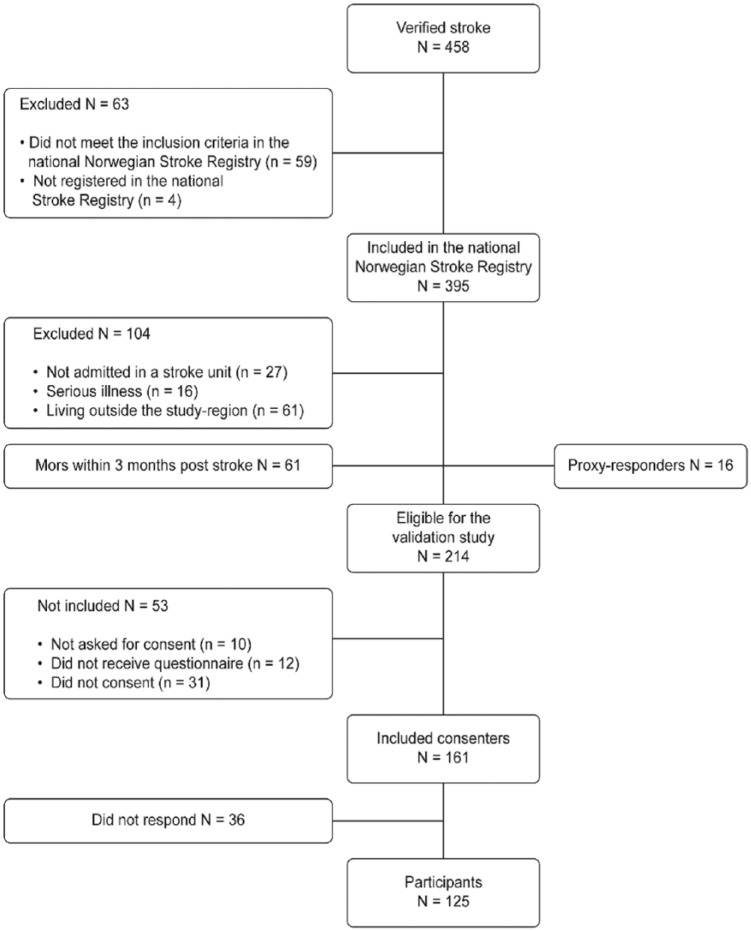
A total of 125 stroke survivors were prospectively recruited. Questionnaires were administered at 3 months; 36 test-retests were performed at 12 months post stroke. The translation was conducted according to guidelines. The internal consistency was assessed with Cronbach's alpha; convergent validity, with item-to-subscale correlations; and test-retest, with Spearman's correlations. Scaling validity was explored by calculating both floor and ceiling effects. A priori hypotheses regarding the associations between the Stroke-Specific Quality of Life domain scores and scores of established measures were tested. Standard error of measurement was assessed.
The Norwegian version revealed no major changes in back translations. The internal consistency values of the domains were Cronbach's alpha = 0.79-0.93. Rates of missing items were small, and the item-to-subscale correlation coefficients supported convergent validity (0.48-0.87). The observed floor effects were generally small, whereas the ceiling effects had moderate or high values (16%-63%). Test-retest reliability indicated stability in most domains, with Spearman's rho = 0.67-0.94 (all p < 0.001), whereas the rho was 0.35 (p < 0.05) for the 'Vision' domain. Hypothesis testing supported the construct validity of the scale. Standard error of measurement values for each domain were generated to indicate the required magnitudes of detectable change.
The Norwegian version of the Stroke-Specific Quality of Life scale is a reliable and valid instrument with good psychometric properties. It is suited for use in health research as well as in individual assessments of persons with stroke.
挪威语中缺乏专门用于评估中风患者健康相关生活质量的工具。目的是检验挪威语版12个领域的中风特异性生活质量量表的有效性和可靠性。
前瞻性招募了125名中风幸存者。在3个月时进行问卷调查;在中风后12个月进行了36次重测。翻译按照指南进行。用Cronbach's alpha评估内部一致性;用项目与子量表的相关性评估收敛效度;用Spearman相关性评估重测信度。通过计算地板效应和天花板效应来探索量表效度。检验了关于中风特异性生活质量领域得分与既定测量得分之间关联的先验假设。评估了测量标准误差。
挪威语版的回译未显示重大变化。各领域的内部一致性值为Cronbach's alpha = 0.79 - 0.93。缺失项目的发生率较低,项目与子量表的相关系数支持收敛效度(0.48 - 0.87)。观察到的地板效应一般较小,而天花板效应具有中度或较高值(16% - 63%)。重测信度表明大多数领域具有稳定性,Spearman's rho = 0.67 - 0.94(所有p < 0.001),而“视力”领域的rho为0.35(p < 0.05)。假设检验支持该量表的结构效度。生成了每个领域的测量标准误差值,以表明可检测变化所需的幅度。
挪威语版的中风特异性生活质量量表是一种可靠有效的工具,具有良好的心理测量特性。它适用于健康研究以及中风患者的个体评估。