Łaszewska Agata, Österle August, Wancata Johannes, Simon Judit
Department of Health Economics, Center for Public Health, Medical University of Vienna, Kinderspitalgasse 15/I, 1090, Vienna, Austria.
Institute for Social Policy, Vienna University of Economics and Business, Welthandelsplatz 1, 1020, Vienna, Austria.
Wien Klin Wochenschr. 2018 Feb;130(3-4):141-150. doi: 10.1007/s00508-018-1316-1. Epub 2018 Jan 24.
Addressing the growing burden of mental diseases is a public health priority. Nevertheless, many countries lack reliable estimates of the proportion of the population affected, which are crucial for health and social policy planning. This study aimed to collect existing evidence on the prevalence of mental diseases in Austria.
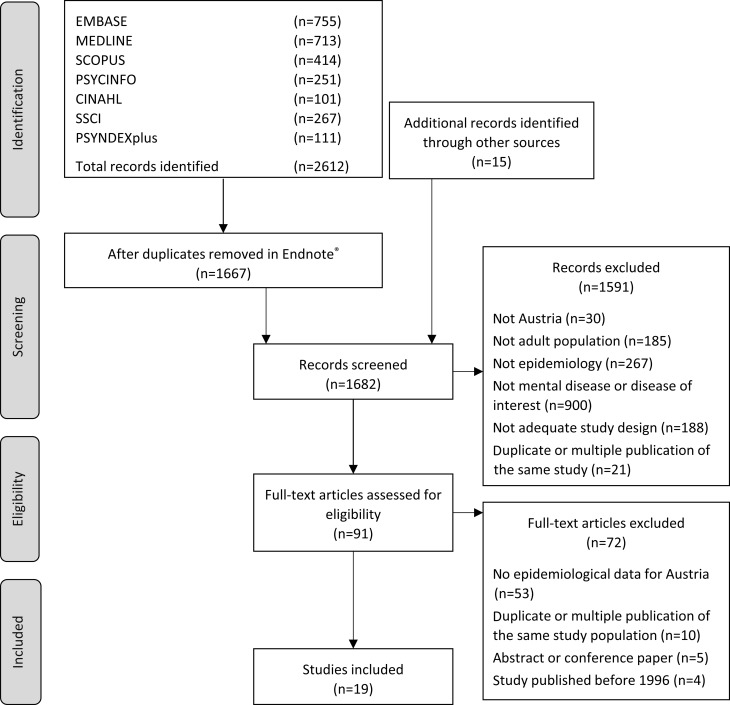
A systematic review was conducted using MeSH, EMTREE and free-text terms in seven bibliographic databases. In addition, the references of included papers and relevant Austria-specific websites were searched. Articles published after 1996 pertaining to the Austrian adult population and presenting prevalence data for mental diseases were included in the analysis.
A total of 2612 records were identified in the database search, 19 of which were included in the analysis, 13 were community-based studies and 6 examined institutionalized populations. Sample sizes ranged from 200 to 15,474. The evidence was centered around depression (n = 6, 32%), eating disorders (n = 4, 21%) and alcohol dependence (n = 3, 16%). While most studies (n = 10, 53%) used questionnaires and scales to identify mental diseases, seven studies used structured clinical interviews, and two studies examined use of psychotropic drugs. Due to the diversity of methodologies, no statistical pooling of prevalence estimates was possible.
Information on the prevalence of mental diseases in Austria is limited and comparability between studies is restricted. A variety of diagnostic instruments, targeted populations and investigated diseases contribute to discrepancies in the prevalence rates. A systematic, large-scale study on the prevalence of mental diseases in Austria is needed for comprehensive and robust epidemiological evidence.
应对日益加重的精神疾病负担是公共卫生的一项优先任务。然而,许多国家缺乏对受影响人口比例的可靠估计,而这对于卫生和社会政策规划至关重要。本研究旨在收集奥地利精神疾病患病率的现有证据。
在七个文献数据库中使用医学主题词表(MeSH)、EMTREE和自由文本词进行系统评价。此外,还检索了纳入论文的参考文献以及奥地利特定的相关网站。纳入分析的是1996年以后发表的、涉及奥地利成年人口且提供精神疾病患病率数据的文章。
在数据库检索中总共识别出2612条记录,其中19条纳入分析,13项为基于社区的研究,6项研究的是机构化人群。样本量从200到15474不等。证据主要集中在抑郁症(n = 6,32%)、饮食失调(n = 4,21%)和酒精依赖(n = 3,16%)。虽然大多数研究(n = 10,53%)使用问卷和量表来识别精神疾病,但有7项研究使用结构化临床访谈,2项研究考察了精神药物的使用情况。由于方法的多样性,无法对患病率估计值进行统计合并。
奥地利精神疾病患病率的信息有限,各研究之间的可比性也受到限制。多种诊断工具、目标人群和所研究疾病导致了患病率的差异。需要对奥地利精神疾病患病率进行系统的大规模研究,以获得全面且可靠的流行病学证据。