University Research Co., LLC, USAID Applying Science to Strengthen and Improve Systems (ASSIST) Project, USAID, Kampala, Uganda.
United States Agency for International Development (USAID), Kampala, Uganda.
AIDS Res Ther. 2018 Jan 25;15(1):4. doi: 10.1186/s12981-018-0190-2.
Despite the conventional approaches to HIV prevention being the bedrock for early reductions in HIV infections in Uganda, innovations that demonstrate reduction in risk to infection in vulnerable populations need to be embraced urgently. In the past 2 years, a USAID-funded project tested a quality improvement for behavior change model (QBC) to address barriers to behavioral change among adolescent girls and young women (AGYW) at high risk of HIV infection. The model comprised skills building to improve ability of AGYW to stop risky behavior; setting up and empowering community quality improvement (QI) teams to mobilize community resources to support AGYW to stop risky behavior; and service delivery camps to provide HIV prevention services and commodities to AGYW and other community members.
We recruited and followed a cohort of 409 AGYW at high risk of HIV infection over a 2-year period to examine the effect of the QBC model on risky behaviors. High-risk behavior was defined to include transactional sex, having multiple sexual partners, and non-use of condoms in high-risk sex. We documented unique experiences over the period to assess the effect of QBC model in reducing risky behavior. We analyzed for variances in risk factors over time using repeated measures ANOVA.
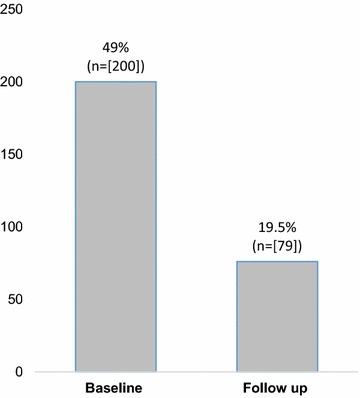
There were statistically significant declines in high-risk behavior among AGYW over the QBC roll-out period (p < 0.05). Univariate analysis indicated reduction in AGYW reporting multiple sexual partners from 16.6% at baseline to 3.2% at follow up and transactional sex from 13.2 to 3.6%. The proportion of AGYW experiencing sexual and other forms of gender based violence reduced from 49% a baseline to 19.5% at follow up due to the complementary targeting of parents and partners by QI teams.
The QBC model is appropriate for the context of northern Uganda because it provides a framework for the community to successfully drive HIV prevention efforts and therefore is recommended as a model for HIV prevention in high-risk groups.
尽管传统的 HIV 预防方法是乌干达早期减少 HIV 感染的基础,但需要紧急采用创新方法,以减少易感染人群的感染风险。在过去的 2 年中,一个由美国国际开发署资助的项目测试了一种行为改变质量改进模型(QBC),以解决感染 HIV 风险高的青少年女孩和年轻妇女(AGYW)面临的行为改变障碍。该模型包括技能培养,以提高 AGYW 停止危险行为的能力;建立和授权社区质量改进(QI)团队,动员社区资源,支持 AGYW 停止危险行为;以及提供 HIV 预防服务和商品的服务提供营地,以提供给 AGYW 和其他社区成员。
我们招募并跟踪了 409 名高感染 HIV 风险的 AGYW,为期 2 年,以研究 QBC 模型对危险行为的影响。高危行为定义为包括性交易、拥有多个性伴侣和高危性行为中不使用避孕套。我们记录了在此期间的独特经历,以评估 QBC 模型在减少危险行为方面的效果。我们使用重复测量方差分析分析了随时间变化的风险因素的差异。
在 QBC 推出期间,AGYW 的高危行为有统计学显著下降(p < 0.05)。单变量分析表明,AGYW 报告的多个性伴侣从基线时的 16.6%减少到随访时的 3.2%,性交易从 13.2%减少到 3.6%。由于 QI 团队对父母和伴侣的互补性定位,经历性暴力和其他形式性别暴力的 AGYW 比例从基线时的 49%下降到随访时的 19.5%。
QBC 模型适合乌干达北部的情况,因为它为社区提供了一个成功推动 HIV 预防工作的框架,因此被推荐作为高危人群 HIV 预防的模型。