Lopez-Guzman Silvia, Konova Anna B, Louie Kenway, Glimcher Paul W
Center for Neural Science, New York University, New York, United States of America.
Institute for the Study of Decision Making, New York University, New York, United States of America.
PLoS One. 2018 Jan 26;13(1):e0191357. doi: 10.1371/journal.pone.0191357. eCollection 2018.
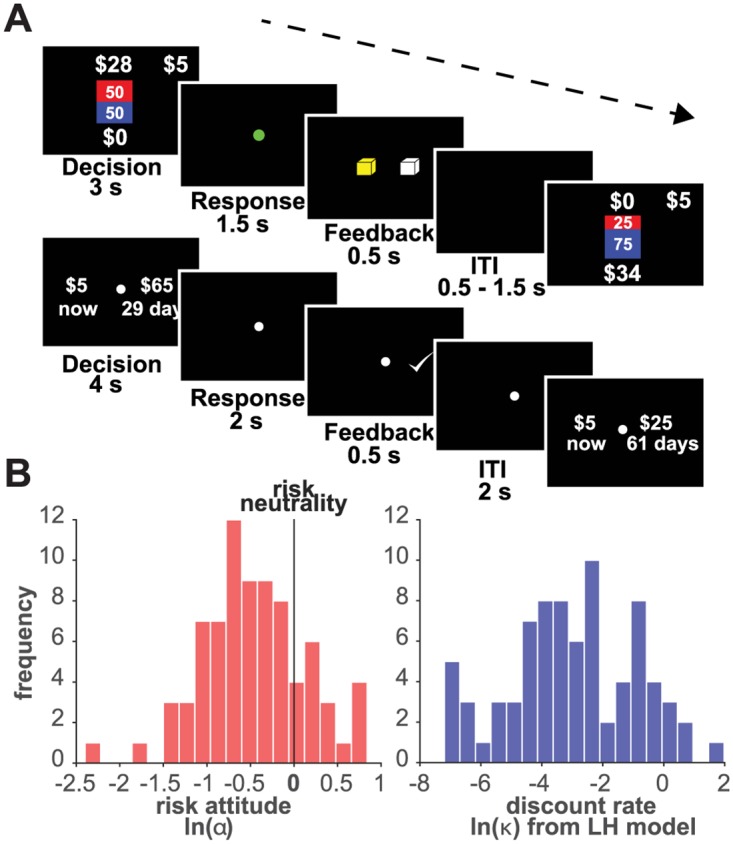
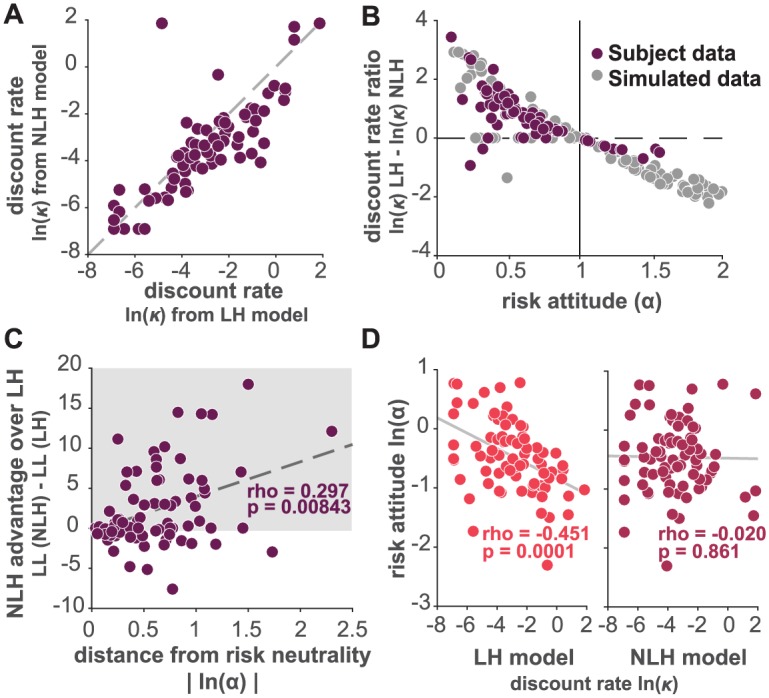
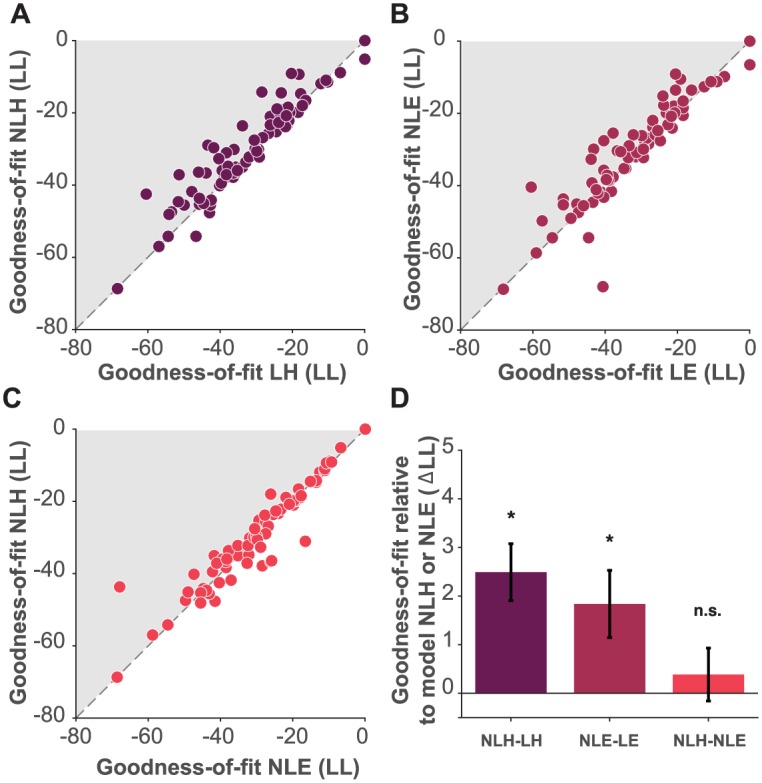
Measuring temporal discounting through the use of intertemporal choice tasks is now the gold standard method for quantifying human choice impulsivity (impatience) in neuroscience, psychology, behavioral economics, public health and computational psychiatry. A recent area of growing interest is individual differences in discounting levels, as these may predispose to (or protect from) mental health disorders, addictive behaviors, and other diseases. At the same time, more and more studies have been dedicated to the quantification of individual attitudes towards risk, which have been measured in many clinical and non-clinical populations using closely related techniques. Economists have pointed to interactions between measurements of time preferences and risk preferences that may distort estimations of the discount rate. However, although becoming standard practice in economics, discount rates and risk preferences are rarely measured simultaneously in the same subjects in other fields, and the magnitude of the imposed distortion is unknown in the assessment of individual differences. Here, we show that standard models of temporal discounting -such as a hyperbolic discounting model widely present in the literature which fails to account for risk attitudes in the estimation of discount rates- result in a large and systematic pattern of bias in estimated discounting parameters. This can lead to the spurious attribution of differences in impulsivity between individuals when in fact differences in risk attitudes account for observed behavioral differences. We advance a model which, when applied to standard choice tasks typically used in psychology and neuroscience, provides both a better fit to the data and successfully de-correlates risk and impulsivity parameters. This results in measures that are more accurate and thus of greater utility to the many fields interested in individual differences in impulsivity.
通过跨期选择任务来测量时间折扣,如今已成为神经科学、心理学、行为经济学、公共卫生和计算精神病学领域中量化人类选择冲动性(缺乏耐心)的黄金标准方法。近期一个越来越受关注的领域是折扣水平的个体差异,因为这些差异可能使人易患(或预防)心理健康障碍、成瘾行为及其他疾病。与此同时,越来越多的研究致力于量化个体对风险的态度,人们已使用密切相关的技术在许多临床和非临床人群中对其进行了测量。经济学家指出,时间偏好和风险偏好的测量之间存在相互作用,这可能会扭曲贴现率的估计。然而,尽管在经济学中这已成为标准做法,但在其他领域,贴现率和风险偏好很少在同一受试者中同时测量,而且在评估个体差异时,这种相互作用所造成的扭曲程度尚不清楚。在此,我们表明,时间折扣的标准模型——例如文献中广泛存在的双曲贴现模型,该模型在估计贴现率时未考虑风险态度——会导致估计的贴现参数出现大且系统的偏差模式。当实际上风险态度的差异导致了观察到的行为差异时,这可能会导致对个体间冲动性差异的错误归因。我们提出了一个模型,当将其应用于心理学和神经科学中常用的标准选择任务时,该模型能更好地拟合数据,并成功使风险和冲动性参数去相关。这使得测量结果更准确,因此对许多关注冲动性个体差异的领域更有用。