Huang Hao, Lv Weibiao, Chen Ying, Zheng Xiufeng, Hu Yong, Wang Ruihua, Huang Meiling, Tang Hongfeng
Department of Dermatology, Shunde Hospital, Southern Medical University, Foshan, China.
Clinical Laboratory, Shunde Hospital, Southern Medical University, Foshan, China.
Front Microbiol. 2018 Jan 9;8:2636. doi: 10.3389/fmicb.2017.02636. eCollection 2017.
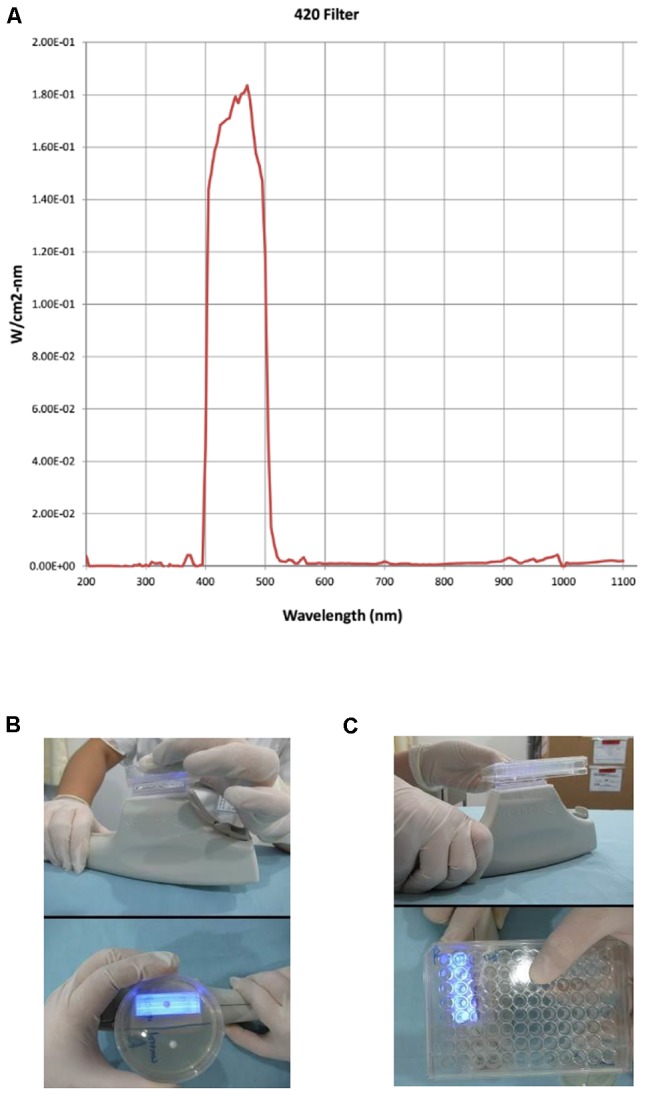
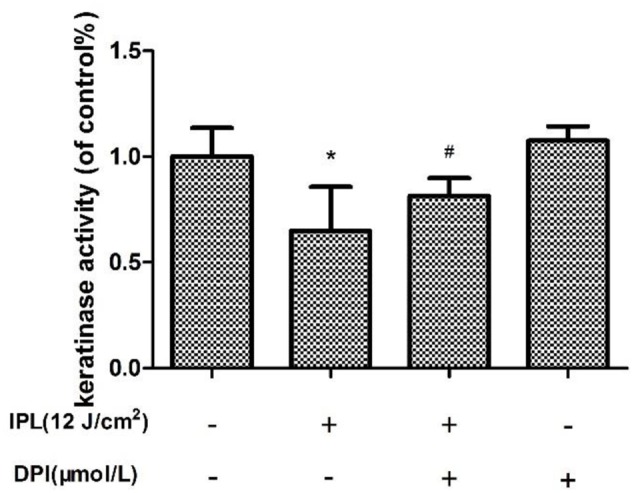
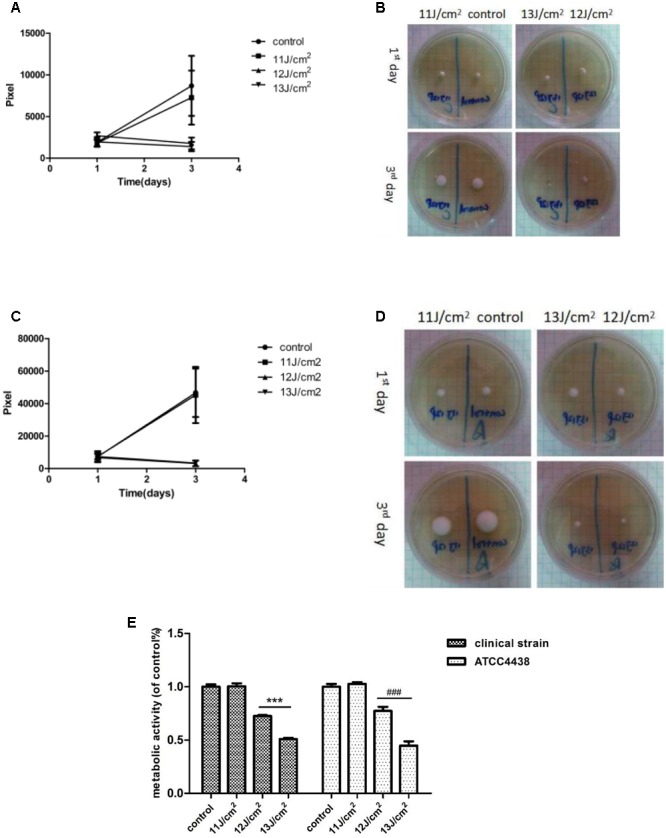
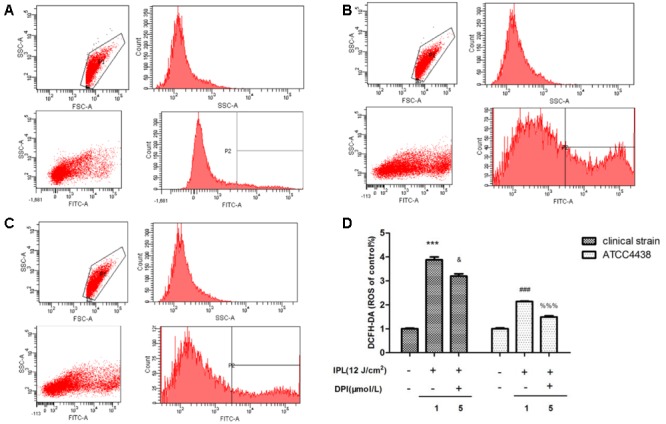
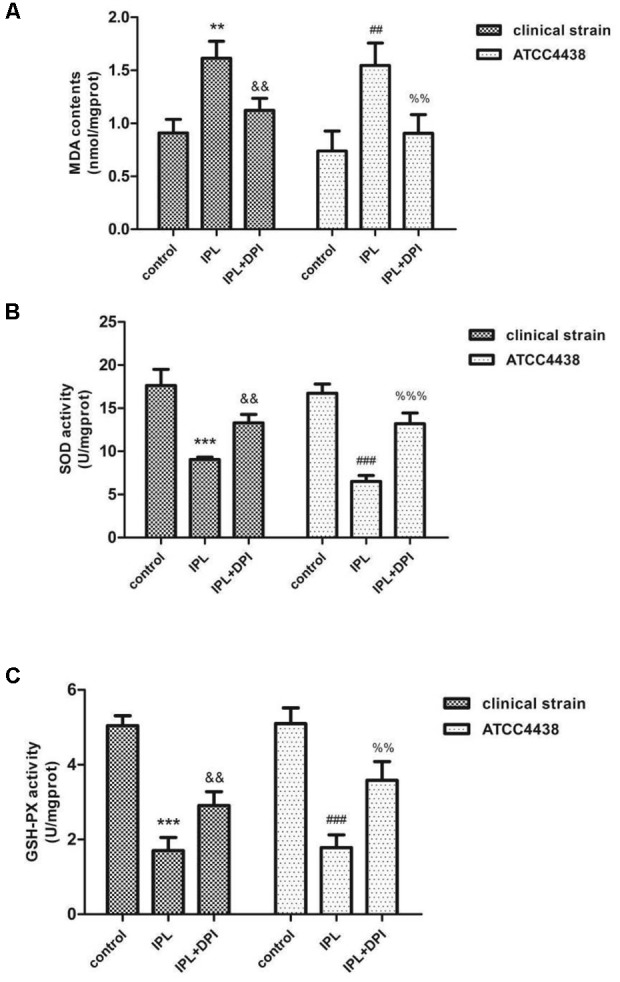
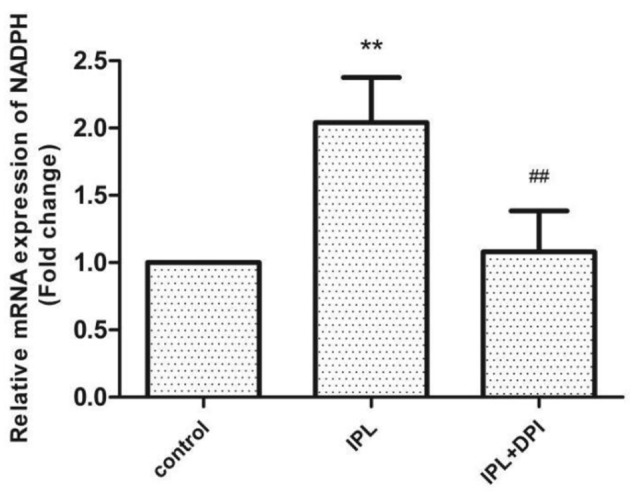
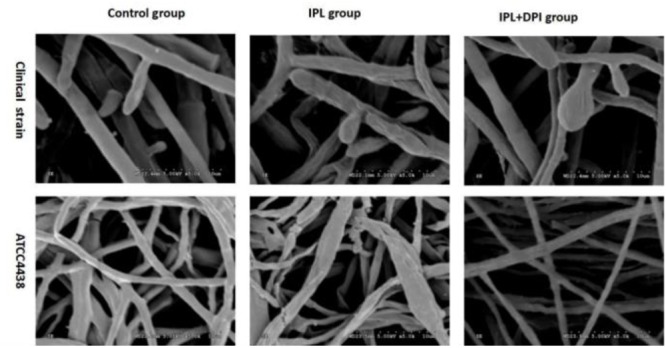
To evaluate the effect of intense pulsed light (IPL) on and investigate its mechanism of action. The viability of fungi treated with IPL alone and with IPL combined with an NADPH oxidase inhibitor (DPI) pretreatment was determined by MTT assays. The reactive oxygen species (ROS) were quantified with a DCFH-DA fluorescent probe. Malondialdehyde (MDA) content and superoxide dismutase (SOD) and glutathione peroxidase (GSH-Px) activities were determined by commercial kits. The transcription of the Nox gene was quantified using quantitative real-time PCR (qRT-PCR) analysis, and micromorphology was observed using scanning electron microscopy (SEM). In addition, fungal keratinase activity was detected by measuring dye release from keratin azure. The growth declined with statistical significance after 6 h of treatment ( < 0.001). The ROS and MDA content increased after IPL treatment, whereas the SOD and GSH-Px activity decreased. Nox gene expression was upregulated, and the micromorphology was damaged. Keratinase activity decreased. Fungi that received DPI pretreatment exhibited contrasting outcomes. We found that 420-nm IPL significantly inhibited the growth and pathogenicity of . A suggested mechanism involves Nox as a factor that mediates 420-nm IPL-induced oxidative damage of
评估强脉冲光(IPL)对[具体真菌名称未给出]的影响并研究其作用机制。通过MTT法测定单独用IPL处理以及用IPL联合烟酰胺腺嘌呤二核苷酸磷酸(NADPH)氧化酶抑制剂(DPI)预处理后的真菌活力。用2',7'-二氯二氢荧光素二乙酸酯(DCFH-DA)荧光探针定量测定活性氧(ROS)。通过商业试剂盒测定丙二醛(MDA)含量以及超氧化物歧化酶(SOD)和谷胱甘肽过氧化物酶(GSH-Px)活性。使用定量实时聚合酶链反应(qRT-PCR)分析对Nox基因的转录进行定量,并使用扫描电子显微镜(SEM)观察微观形态。此外,通过测量角蛋白天青染料释放来检测真菌角蛋白酶活性。处理6小时后生长下降具有统计学意义(<0.001)。IPL处理后ROS和MDA含量增加,而SOD和GSH-Px活性降低。Nox基因表达上调,微观形态受损。角蛋白酶活性降低。接受DPI预处理的真菌表现出相反的结果。我们发现420纳米的IPL显著抑制[具体真菌名称未给出]的生长和致病性。一种推测的机制涉及Nox作为介导420纳米IPL诱导的[具体真菌名称未给出]氧化损伤的一个因素