Kurowski Marcin, Jurczyk Janusz, Moskwa Sylwia, Jarzębska Marzanna, Krysztofiak Hubert, Kowalski Marek L
Department of Immunology, Rheumatology and Allergy, Healthy Ageing Research Centre, Medical University of Lodz, Lodz, Poland.
National Centre for Sports Medicine (COMS), Warsaw, Poland.
Arch Med Sci. 2018 Jan;14(1):60-68. doi: 10.5114/aoms.2017.69438. Epub 2017 Dec 19.
Regular training modulates airway inflammation and modifies susceptibility to respiratory infections. The impact of exercise and ambient conditions on airway hyperreactivity and innate immunity has not been well studied. We aimed to assess exercise-related symptoms, lung function, airway hyperresponsiveness and innate immunity proteins in relation to meteorological conditions and exercise load in competitive athletes.
Thirty-six speed skaters were assessed during winter (WTP) and summer (STP) periods. The control group comprised 22 non-exercising subjects. An allergy questionnaire for athletes (AQUA) and IPAQ (International Physical Activity Questionnaire) were used to assess symptoms and exercise. Meteorological parameters were acquired from World Meteorological Organization resources. Serum innate immunity proteins were measured by ELISA.
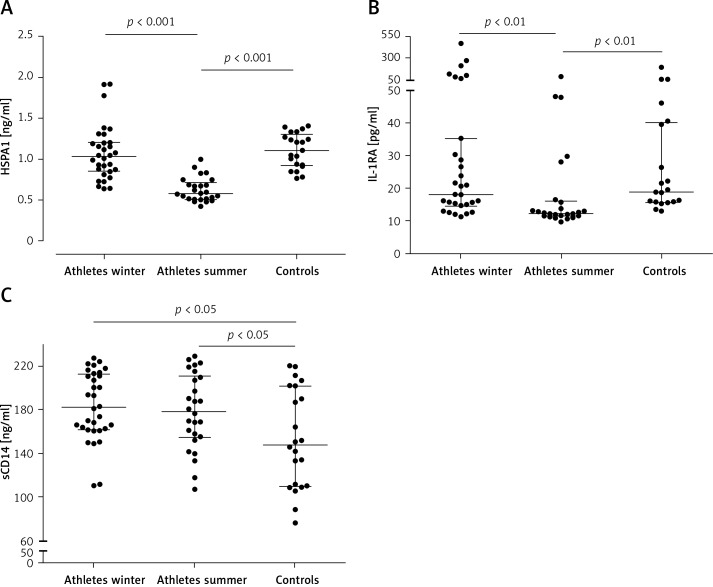
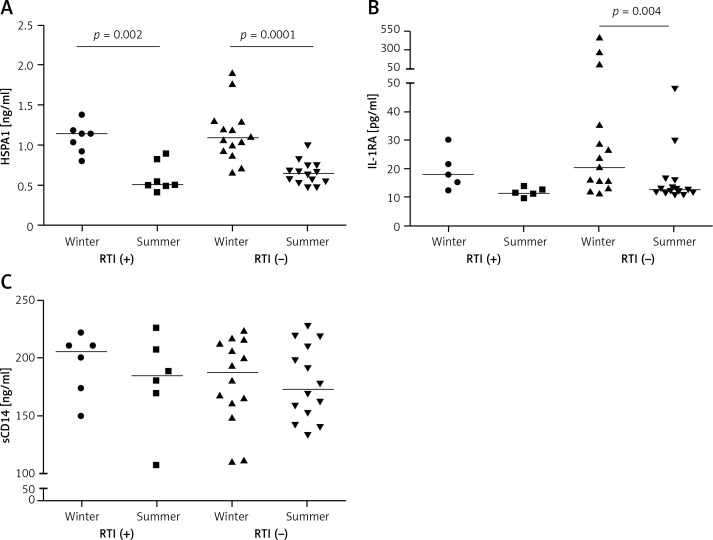
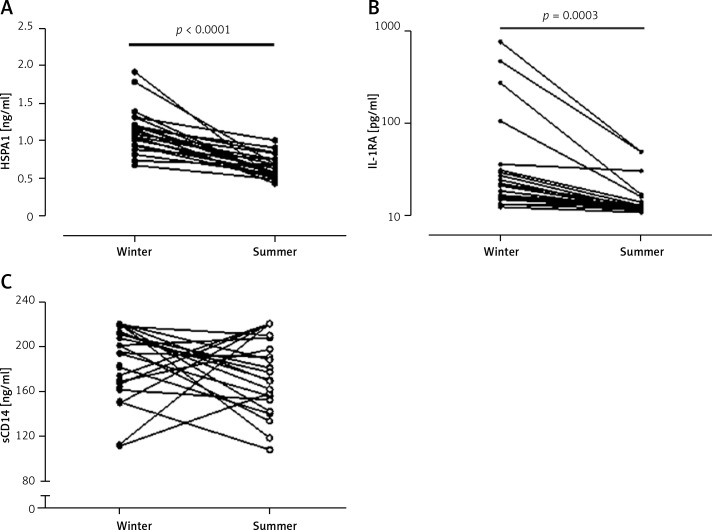
Exercise-associated respiratory symptoms were reported by 79.4% of skaters. Despite similar exercise load and lung parameters during both periods, positive methacholine challenge was more frequent during winter ( = 0.04). Heat shock protein HSPA1 and IL-1RA were significantly decreased during STP compared to WTP and controls. During WTP, IL-1RA was elevated in skaters reporting exercise-induced symptoms ( = 0.007). sCD14 was elevated in athletes versus controls in both periods ( < 0.05). HSPA1 was significantly higher in WTP compared to STP irrespective of presence of respiratory tract infections (RTIs). IL-1RA in WTP was elevated versus STP ( = 0.004) only in RTI-negative athletes. Serum IL-1RA negatively correlated with most meteorological parameters during WTP.
Ambient training conditions, but not training load, influence bronchial hyperreactivity and the innate immune response in competitive athletes assessed during winter. The protective effect of regular exercise against respiratory infections is associated with a shift in serum innate immunity proteins.
规律训练可调节气道炎症并改变对呼吸道感染的易感性。运动和环境条件对气道高反应性和先天免疫的影响尚未得到充分研究。我们旨在评估竞技运动员中与运动相关的症状、肺功能、气道高反应性和先天免疫蛋白与气象条件和运动负荷的关系。
在冬季(WTP)和夏季(STP)对36名速滑运动员进行评估。对照组包括22名不运动的受试者。使用运动员过敏问卷(AQUA)和国际体力活动问卷(IPAQ)评估症状和运动情况。气象参数来自世界气象组织的资源。通过酶联免疫吸附测定法测量血清先天免疫蛋白。
79.4%的速滑运动员报告有与运动相关的呼吸道症状。尽管两个时期的运动负荷和肺参数相似,但冬季乙酰甲胆碱激发试验阳性更为频繁(P = 0.04)。与WTP和对照组相比,STP期间热休克蛋白HSPA1和IL-1RA显著降低。在WTP期间,报告有运动诱发症状的速滑运动员中IL-1RA升高(P = 0.007)。两个时期运动员的sCD14均高于对照组(P < 0.05)。无论是否存在呼吸道感染(RTIs),WTP期间的HSPA1均显著高于STP。仅在RTI阴性的运动员中,WTP的IL-1RA高于STP(P = 0.004)。WTP期间血清IL-1RA与大多数气象参数呈负相关。
在冬季评估的竞技运动员中,环境训练条件而非训练负荷会影响支气管高反应性和先天免疫反应。规律运动对呼吸道感染的保护作用与血清先天免疫蛋白的变化有关。