Department of Infectious Diseases, Institute of Biomedicine at Sahlgrenska Academy, University of Gothenburg, 41346 Gothenburg, Sweden.
Department of Pathology and Genetics, Institute of Biomedicine at Sahlgrenska Academy, University of Gothenburg, 41345 Gothenburg, Sweden; Clinical Genomics Gothenburg, SciLife Labs, Gothenburg, Sweden.
Int J Hyg Environ Health. 2018 Apr;221(3):479-488. doi: 10.1016/j.ijheh.2018.01.012. Epub 2018 Feb 1.
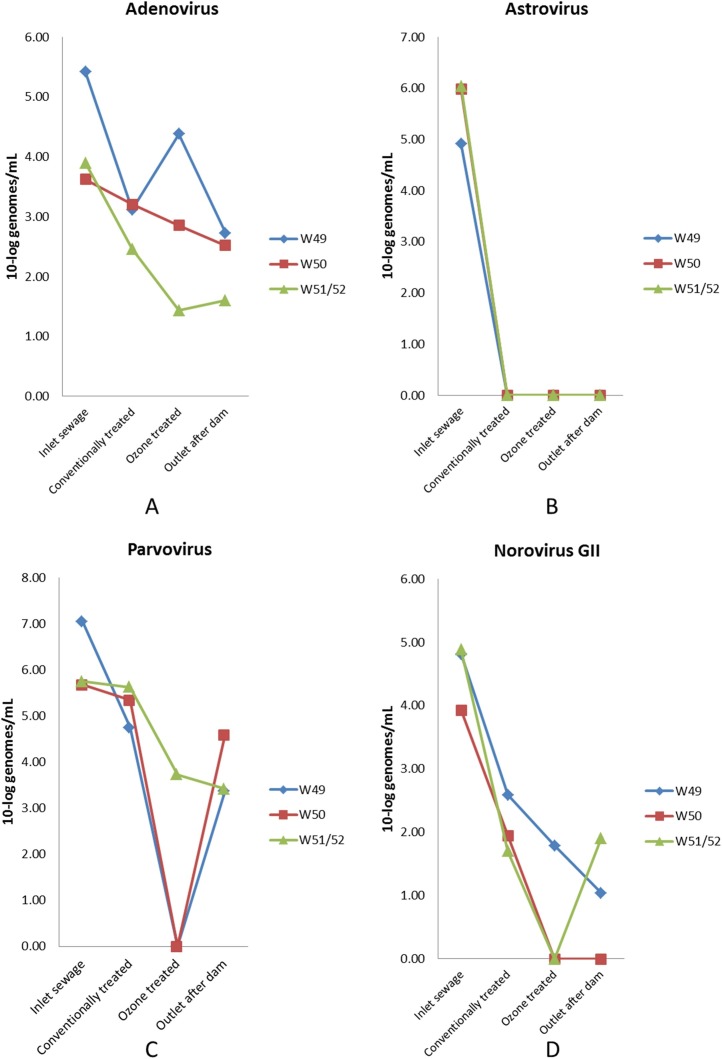
Sewage contains a mixed ecosystem of diverse sets of microorganisms, including human pathogenic viruses. Little is known about how conventional as well as advanced treatments of sewage, such as ozonation, reduce the environmental spread of viruses. Analyses for viruses were therefore conducted for three weeks in influent, after conventional treatment, after additional ozonation, and after passing an open dam system at a full-scale treatment plant in Knivsta, Sweden. Viruses were concentrated by adsorption to a positively charged filter, from which they were eluted and pelleted by ultracentrifugation, with a recovery of about 10%. Ion Torrent sequencing was used to analyze influent, leading to the identification of at least 327 viral species, most of which belonged to 25 families with some having unclear classification. Real-time PCR was used to test for 21 human-related viruses in inlet, conventionally treated, and ozone-treated sewage and outlet waters. The viruses identified in influent and further analyzed were adenovirus, norovirus, sapovirus, parechovirus, hepatitis E virus, astrovirus, pecovirus, picobirnavirus, parvovirus, and gokushovirus. Conventional treatment reduced viral concentrations by one to four log10, with the exception of adenovirus and parvovirus, for which the removal was less efficient. Ozone treatment led to a further reduction by one to two log10, but less for adenovirus. This study showed that the amount of all viruses was reduced by conventional sewage treatment. Further ozonation reduced the amounts of several viruses to undetectable levels, indicating that this is a promising technique for reducing the transmission of many pathogenic human viruses.
污水中包含着多样化的微生物混合生态系统,包括人类致病性病毒。对于常规处理以及高级处理(例如臭氧处理)如何减少病毒在环境中的传播,人们知之甚少。因此,在瑞典 Knivsta 的一个全规模处理厂,对进水、常规处理后、额外臭氧处理后以及经过开敞式大坝系统后的污水进行了为期三周的病毒分析。病毒通过吸附到带正电荷的过滤器上进行浓缩,然后通过超速离心将其洗脱并沉淀,回收率约为 10%。离子激流测序被用于分析进水,鉴定出至少 327 种病毒,其中大多数属于 25 个科,有些分类不明确。实时 PCR 用于测试入口、常规处理和臭氧处理污水以及出口水中的 21 种人类相关病毒。在进水、经常规处理和臭氧处理的污水以及出水口水中鉴定出的病毒有腺病毒、诺如病毒、星状病毒、肠道病毒、戊型肝炎病毒、星状病毒、肠道病毒、微小 RNA 病毒、细小病毒和 gokushovirus。常规处理可将病毒浓度降低 1 到 4 个对数级,但腺病毒和细小病毒除外,它们的去除效率较低。臭氧处理可再降低 1 到 2 个对数级,但对腺病毒的降低效果较小。本研究表明,常规污水净化处理可减少所有病毒的数量。进一步的臭氧处理可将几种病毒的数量降低至无法检测的水平,表明这是减少多种致病性人类病毒传播的一种很有前景的技术。