Department of Epidemiology and Biostatistics, University of South Carolina, Columbia, South Carolina.
Cancer Prevention and Control Program, University of South Carolina, Columbia, South Carolina.
Cancer. 2018 May 1;124(9):1912-1920. doi: 10.1002/cncr.31250. Epub 2018 Feb 7.
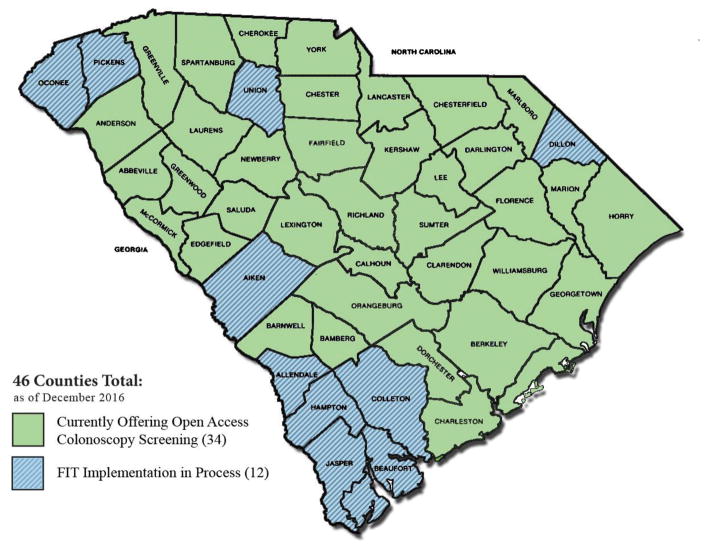
Cancer screening rates are lowest in those without insurance or a regular provider. Since 2008, the Colorectal Cancer Prevention Network (CCPN) has provided open access colonoscopy to uninsured residents of South Carolina through established, statewide partnerships and patient navigation. Herein, we describe the structure, implementation, and clinical outcomes of this program.
The CCPN provides access to colonoscopy screening at no cost to uninsured, asymptomatic patients aged 50-64 years (African Americans age 45-64 years are eligible) who live at or below 150% of the poverty line and seek medical care in free medical clinics, federally qualified health centers, or hospital-based indigent practices in South Carolina. Screening is performed by board-certified gastroenterologists. Descriptive statistics and regression analysis are used to describe the population screened, and to assess compliance rates and colonoscopy quality metrics.
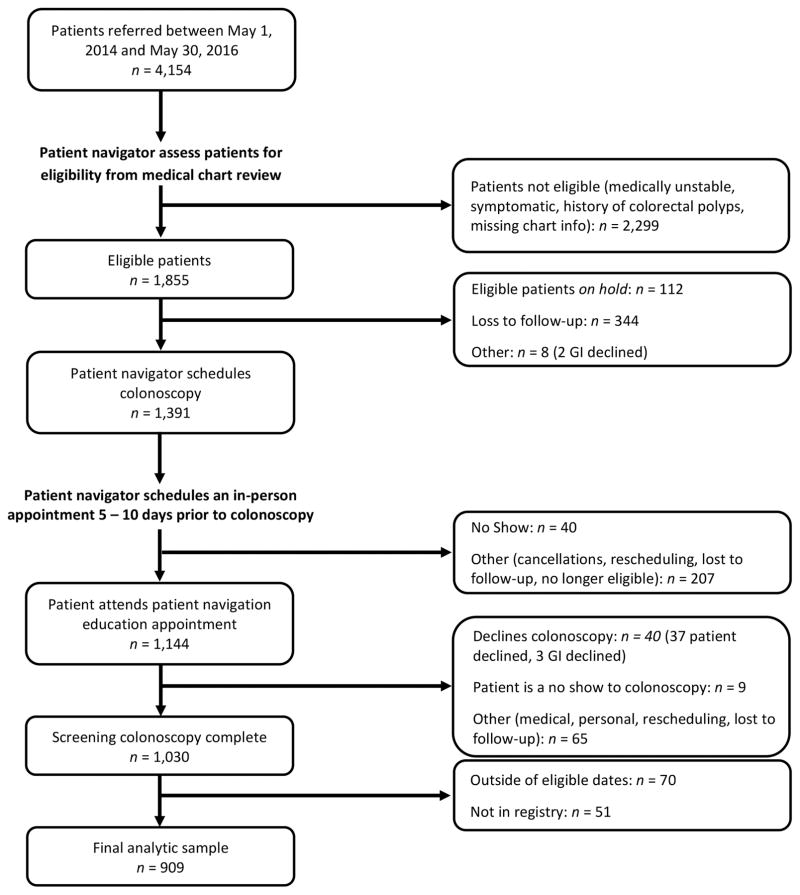
Out of >4000 patients referred to the program, 1854 were deemed eligible, 1144 attended an in-person navigation visit, and 1030 completed a colonoscopy; 909 were included in the final sample. Nearly 90% of participants exhibited good-to-excellent bowel preparation. An overall cecal intubation rate of 99% was measured. The polyp detection rate and adenoma detection rate were 63% and 36%, respectively, with male sex and urban residence positively associated with adenoma detection. Over 13% of participants had an advanced polyp, and 1% had a cancer diagnosis or surgical intervention.
The CCPN program is characterized by strong collaboration with clinicians statewide, low no-show rates, and high colonoscopy quality. Future work will assess the effectiveness of the navigation approach and will explore the mechanisms driving higher adenoma detection in urban participants. Cancer 2018;124:1912-20. © 2018 American Cancer Society.
在没有保险或常规医疗服务提供者的人群中,癌症筛查率最低。自 2008 年以来,大肠癌预防网络(CCPN)通过建立全州范围的合作伙伴关系和患者导航,为南卡罗来纳州的无保险居民提供了免费的结肠镜检查。在此,我们描述了该项目的结构、实施和临床结果。
CCPN 为符合条件的 50-64 岁(45-64 岁的非裔美国人符合条件)的无保险、无症状患者提供免费的结肠镜检查服务,这些患者的收入处于或低于贫困线的 150%,并在南卡罗来纳州的免费医疗诊所、合格的联邦健康中心或医院的贫困患者医疗服务中寻求医疗服务。筛查由经董事会认证的胃肠病学家进行。描述性统计和回归分析用于描述被筛查的人群,并评估合规率和结肠镜检查质量指标。
在 4000 多名被推荐参加该项目的患者中,有 1854 名被认为符合条件,1144 名参加了面对面的导航访问,1030 名完成了结肠镜检查;909 名被纳入最终样本。近 90%的参与者肠道准备良好至优秀。总体盲肠插管率为 99%。息肉检出率和腺瘤检出率分别为 63%和 36%,男性和城市居住与腺瘤检出呈正相关。超过 13%的参与者有高级息肉,1%的参与者有癌症诊断或手术干预。
CCPN 项目的特点是与全州的临床医生密切合作,低失约率和高结肠镜检查质量。未来的工作将评估导航方法的有效性,并探讨导致城市参与者腺瘤检出率较高的机制。癌症 2018;124:1912-20. © 2018 美国癌症协会。