Papapetridis Ioannis, Goudriaan Maaike, Vázquez Vitali María, de Keijzer Nikita A, van den Broek Marcel, van Maris Antonius J A, Pronk Jack T
1Department of Biotechnology, Delft University of Technology, Van der Maasweg 9, 2629 HZ Delft, The Netherlands.
2Present Address: School of Biotechnology, Division of Industrial Biotechnology, KTH Royal Institute of Technology, AlbaNova University Centre, 10691 Stockholm, Sweden.
Biotechnol Biofuels. 2018 Jan 25;11:17. doi: 10.1186/s13068-017-1001-z. eCollection 2018.
Reduction or elimination of by-product formation is of immediate economic relevance in fermentation processes for industrial bioethanol production with the yeast . Anaerobic cultures of wild-type require formation of glycerol to maintain the intracellular NADH/NAD balance. Previously, functional expression of the Calvin-cycle enzymes ribulose-1,5-bisphosphate carboxylase (RuBisCO) and phosphoribulokinase (PRK) in was shown to enable reoxidation of NADH with CO as electron acceptor. In slow-growing cultures, this engineering strategy strongly decreased the glycerol yield, while increasing the ethanol yield on sugar. The present study explores engineering strategies to improve rates of growth and alcoholic fermentation in yeast strains that functionally express RuBisCO and PRK, while maximizing the positive impact on the ethanol yield.
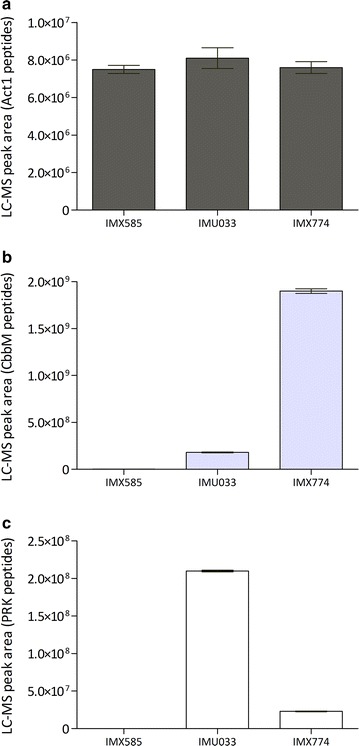
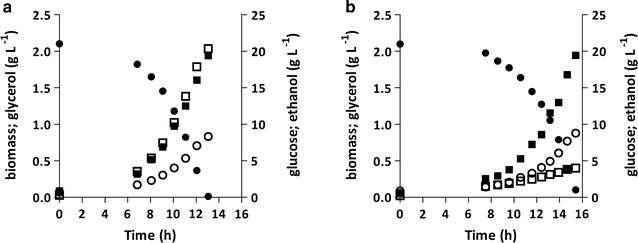
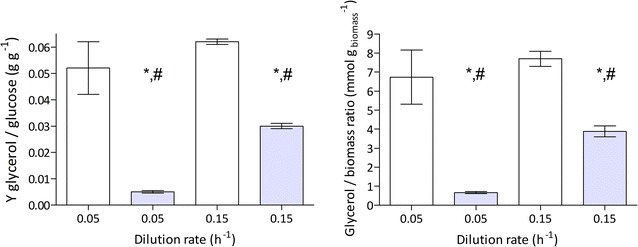
Multi-copy integration of a bacterial-RuBisCO expression cassette was combined with expression of the GroEL/GroES chaperones and expression of PRK from the anaerobically inducible promoter. In anaerobic, glucose-grown bioreactor batch cultures, the resulting strain showed a 31% lower glycerol yield and a 31% lower specific growth rate than a non-engineered reference strain. Growth of the engineered strain in anaerobic, glucose-limited chemostat cultures revealed a negative correlation between its specific growth rate and the contribution of the Calvin-cycle enzymes to redox homeostasis. Additional deletion of , which encodes an isoenzyme of NAD-dependent glycerol-3-phosphate dehydrogenase, combined with overexpression of the structural genes for enzymes of the non-oxidative pentose-phosphate pathway, yielded a CO-reducing strain that grew at the same rate as a non-engineered reference strain in anaerobic bioreactor batch cultures, while exhibiting a 86% lower glycerol yield and a 15% higher ethanol yield.
The metabolic engineering strategy presented here enables an almost complete elimination of glycerol production in anaerobic, glucose-grown batch cultures of , with an associated increase in ethanol yield, while retaining near wild-type growth rates and a capacity for glycerol formation under osmotic stress. Using current genome-editing techniques, the required genetic modifications can be introduced in one or a few transformations. Evaluation of this concept in industrial strains and conditions is therefore a realistic next step towards its implementation for improving the efficiency of first- and second-generation bioethanol production.
在利用酵母进行工业生物乙醇生产的发酵过程中,减少或消除副产物的形成具有直接的经济意义。野生型酵母的厌氧培养需要形成甘油来维持细胞内NADH/NAD平衡。此前研究表明,在酵母中功能性表达卡尔文循环酶核酮糖-1,5-二磷酸羧化酶(RuBisCO)和磷酸核酮糖激酶(PRK)能够以CO作为电子受体实现NADH的再氧化。在生长缓慢的培养物中,这种工程策略显著降低了甘油产量,同时提高了糖的乙醇产量。本研究探索工程策略,以提高功能性表达RuBisCO和PRK的酵母菌株的生长速率和酒精发酵速率,同时最大化对乙醇产量的积极影响。
细菌RuBisCO表达盒的多拷贝整合与大肠杆菌GroEL/GroES伴侣蛋白的表达以及来自厌氧诱导型丙酮酸激酶启动子的PRK表达相结合。在厌氧、葡萄糖生长的生物反应器分批培养中,所得酵母菌株的甘油产量比未工程改造的参考菌株低31%,比生长速率低31%。工程菌株在厌氧、葡萄糖限制的恒化器培养中的生长表明,其比生长速率与卡尔文循环酶对氧化还原稳态的贡献之间呈负相关。额外缺失编码NAD依赖性甘油-3-磷酸脱氢酶同工酶的基因,再结合非氧化戊糖磷酸途径酶结构基因的过表达,得到了一种CO还原菌株,该菌株在厌氧生物反应器分批培养中的生长速率与未工程改造的参考菌株相同,同时甘油产量降低86%,乙醇产量提高15%。
本文提出的代谢工程策略能够在厌氧、葡萄糖生长的酵母分批培养中几乎完全消除甘油的产生,同时提高乙醇产量,同时保持接近野生型的生长速率以及在渗透胁迫下形成甘油的能力。利用当前的基因组编辑技术,可以通过一次或几次转化引入所需的基因修饰。因此,在工业菌株和条件下评估这一概念是朝着将其应用于提高第一代和第二代生物乙醇生产效率迈出的现实下一步。