Ralph N. Adams Institute for Bioanalytical Chemistry, University of Kansas, 66045, Lawrence, KS, USA.
Department of Pharmaceutical Chemistry, University of Kansas, 66045, Lawrence, KS, USA.
Cell Death Dis. 2018 Feb 14;9(2):245. doi: 10.1038/s41419-018-0280-z.
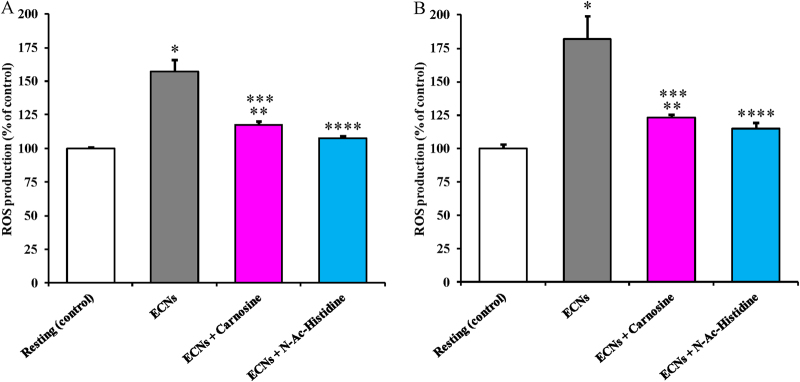
Engineered nanoparticles are finding a wide spectrum of biomedical applications, including drug delivery and capacity to trigger cytotoxic phenomena, potentially useful against tumor cells. The full understanding of their biosafety and interactions with cell processes is mandatory. Using microglial (BV-2) and alveolar basal epithelial (A549) cells, in this study we determined the effects of engineered carbon nanodiamonds (ECNs) on cell viability, nitric oxide (NO) and reactive oxygen species (ROS) production, as well as on energy metabolism. Particularly, we initially measured decrease in cell viability as a function of increasing ECNs doses, finding similar cytotoxic ECN effects in the two cell lines. Subsequently, using apparently non-cytotoxic ECN concentrations (2 µg/mL causing decrease in cell number < 5%) we determined NO and ROS production, and measured the concentrations of compounds related to energy metabolism, mitochondrial functions, oxido-reductive reactions, and antioxidant defences. We found that in both cell lines non-cytotoxic ECN concentrations increased NO and ROS production with sustained oxidative/nitrosative stress, and caused energy metabolism imbalance (decrease in high energy phosphates and nicotinic coenzymes) and mitochondrial malfunctioning (decrease in ATP/ADP ratio).These results underline the importance to deeply investigate the molecular and biochemical changes occurring upon the interaction of ECNs (and nanoparticles in general) with living cells, even at apparently non-toxic concentration. Since the use of ECNs in biomedical field is attracting increasing attention the complete evaluation of their biosafety, toxicity and/or possible side effects both in vitro and in vivo is mandatory before these highly promising tools might find the correct application.
工程纳米粒子在生物医药领域有着广泛的应用,包括药物输送和触发细胞毒性现象的能力,这对肿瘤细胞可能是有用的。充分了解它们的生物安全性和与细胞过程的相互作用是强制性的。本研究使用小胶质细胞(BV-2)和肺泡基底上皮细胞(A549),确定了工程碳纳米金刚石(ECN)对细胞活力、一氧化氮(NO)和活性氧(ROS)产生以及能量代谢的影响。特别是,我们最初测量了细胞活力随 ECN 剂量增加而降低的情况,发现两种细胞系的 ECN 具有相似的细胞毒性作用。随后,使用明显非细胞毒性的 ECN 浓度(2μg/mL 导致细胞数量减少<5%),我们测定了 NO 和 ROS 的产生,并测量了与能量代谢、线粒体功能、氧化还原反应和抗氧化防御相关的化合物的浓度。我们发现,在两种细胞系中,非细胞毒性的 ECN 浓度增加了 NO 和 ROS 的产生,同时伴有持续的氧化/硝化应激,并导致能量代谢失衡(高能磷酸化合物和烟酰胺辅酶减少)和线粒体功能障碍(ATP/ADP 比值降低)。这些结果强调了深入研究 ECN(以及一般纳米粒子)与活细胞相互作用时发生的分子和生化变化的重要性,即使在似乎非毒性的浓度下也是如此。由于 ECN 在生物医学领域的应用越来越受到关注,因此在这些极具前景的工具可能得到正确应用之前,必须在体外和体内对其生物安全性、毒性和/或可能的副作用进行全面评估。