Lancaster Medical School, Lancaster University, Lancaster, UK.
National Malaria Control Programme, Garowe, Puntland, Somalia.
Malar J. 2018 Feb 20;17(1):88. doi: 10.1186/s12936-018-2238-0.
Countries planning malaria elimination must adapt from sustaining universal control to targeted intervention and surveillance. Decisions to make this transition require interpretable information, including malaria parasite survey data. As transmission declines, observed parasite prevalence becomes highly heterogeneous with most communities reporting estimates close to zero. Absolute estimates of prevalence become hard to interpret as a measure of transmission intensity and suitable statistical methods are required to handle uncertainty of area-wide predictions that are programmatically relevant.
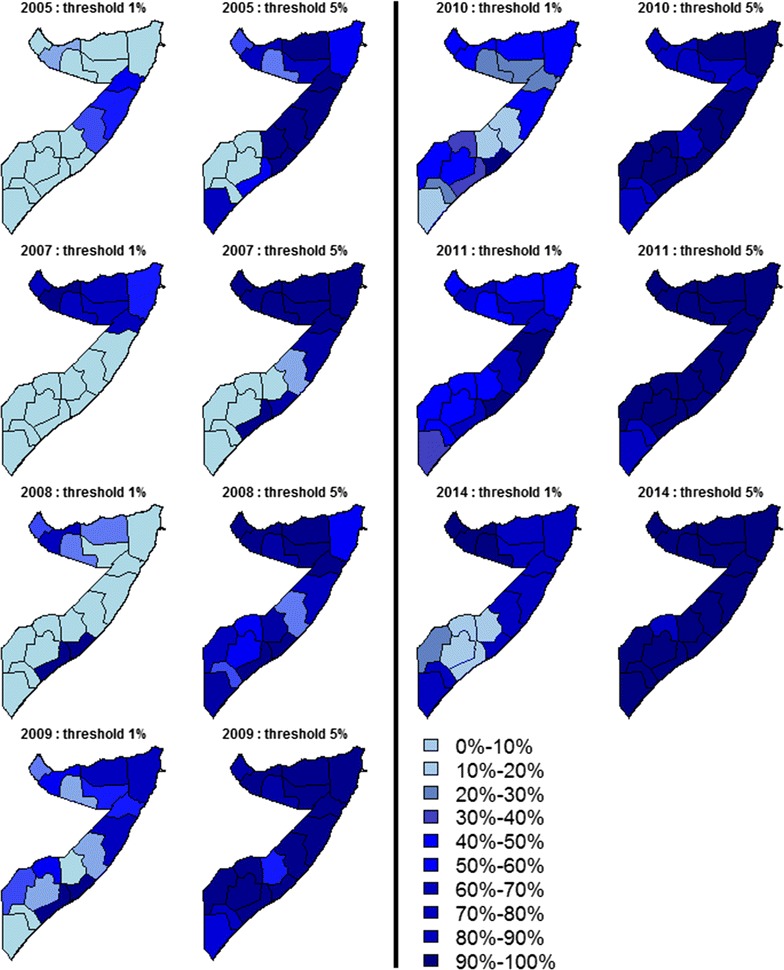
A spatio-temporal geostatistical binomial model for Plasmodium falciparum prevalence (PfPR) was developed using data from cross-sectional surveys conducted in Somalia in 2005, 2007-2011 and 2014. The fitted model was then used to generate maps of non-exceedance probabilities, i.e. the predictive probability that the region-wide population-weighted average PfPR for children between 2 and 10 years (PfPR) lies below 1 and 5%. A comparison was carried out with the decision-making outcomes from those of standard approaches that ignore uncertainty in prevalence estimates.
By 2010, most regions in Somalia were at least 70% likely to be below 5% PfPR and, by 2014, 17 regions were below 5% PfPR with a probability greater than 90%. Larger uncertainty is observed using a threshold of 1%. By 2011, only two regions were more than 90% likely of being < 1% PfPR and, by 2014, only three regions showed such low level of uncertainty. The use of non-exceedance probabilities indicated that there was weak evidence to classify 10 out of the 18 regions as < 1% in 2014, when a greater than 90% non-exceedance probability was required.
Unlike standard approaches, non-exceedance probabilities of spatially modelled PfPR allow to quantify uncertainty of prevalence estimates in relation to policy relevant intervention thresholds, providing programmatically relevant metrics to make decisions on transitioning from sustained malaria control to strategies that encompass methods of malaria elimination.
计划消除疟疾的国家必须从持续的全面控制转向有针对性的干预和监测。做出这一转变的决定需要可解释的信息,包括疟疾寄生虫调查数据。随着传播的减少,观察到的寄生虫流行率变得高度异质,大多数社区报告的估计值接近零。作为衡量传播强度的指标,流行率的绝对估计变得难以解释,并且需要合适的统计方法来处理与规划相关的全区域预测的不确定性。
使用 2005 年、2007-2011 年和 2014 年在索马里进行的横断面调查数据,开发了一种用于恶性疟原虫流行率(PfPR)的时空地理统计学二项式模型。然后,使用拟合模型生成非超越概率图,即预测该地区 2 至 10 岁儿童全人群加权平均 PfPR(PfPR)低于 1%和 5%的概率。将其与忽略流行率估计不确定性的标准方法的决策结果进行了比较。
到 2010 年,索马里的大多数地区至少有 70%的可能性低于 5%的 PfPR,到 2014 年,有 17 个地区的 PfPR 低于 5%的概率大于 90%。使用 1%的阈值会观察到更大的不确定性。到 2011 年,只有两个地区有超过 90%的可能性低于 1%的 PfPR,到 2014 年,只有三个地区显示出如此低的不确定性。非超越概率的使用表明,在需要大于 90%的非超越概率的情况下,2014 年有 10 个地区有弱证据被归类为<1%。
与标准方法不同,空间建模 PfPR 的非超越概率可以量化与政策相关干预阈值相关的流行率估计的不确定性,为从持续的疟疾控制转向包含消除疟疾方法的策略做出决策提供了具有规划意义的指标。