New York Obesity Research Center, Department of Medicine, College of Physicians and Surgeons, Columbia University, New York, New York, USA.
Institute of Human Nutrition, College of Physicians and Surgeons, Columbia University, New York, New York, USA.
Obesity (Silver Spring). 2018 Mar;26(3):578-587. doi: 10.1002/oby.22079.
The objective of this study was to determine the effectiveness of controlling maternal gestational weight gain (GWG) in the second and third trimesters on neonate body composition.
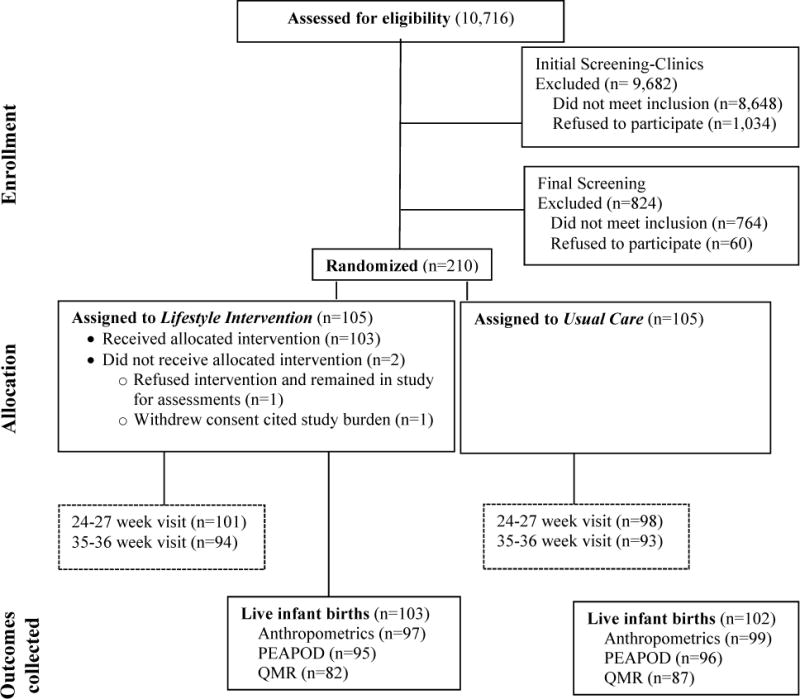
Two hundred ten healthy women with overweight (25 > BMI < 30) or obesity (BMI ≥ 30) were randomly assigned to a lifestyle intervention (LI) program focused on controlling GWG through nutrition and activity behaviors or to usual obstetrical care (UC). Infant fat and fat-free mass (FFM) at birth were measured by using air displacement plethysmography (PEA POD) and by using quantitative magnetic resonance (QMR).
At baseline, there were no between-group differences in maternal characteristics (mean [SD]): age: 33.8 (4.3) years, weight: 81.9 (13.7) kg, BMI: 30.4 (4.5), and gestational age at randomization: 14.9 (0.8) weeks. GWG was less in the LI group by 1.79 kg (P = 0.003) or 0.0501 kg/wk (P = 0.002). Compared with UC infants, LI infants had greater weight (131 ± 59 g P = 0.03), FFM (98 ± 45 g; P = 0.03) measured by PEA POD, and lean mass (105 ± 38 g; P = 0.006) measured by QMR. Fat mass and percent fat were not significantly different.
Intervening in women with overweight and obesity through behaviors promoting healthy diet and physical activity to control GWG resulted in neonates with similar fat and greater FFM.
本研究旨在确定控制孕中期和孕晚期孕妇体重增长(GWG)对新生儿身体成分的有效性。
将 210 名超重(25<BMI<30)或肥胖(BMI≥30)的健康女性随机分配至生活方式干预(LI)组,通过营养和活动行为来控制 GWG,或常规产科护理(UC)组。通过空气置换体描仪(PEA POD)和定量磁共振(QMR)测量婴儿出生时的脂肪和去脂体重(FFM)。
在基线时,两组间母亲特征(均值[标准差])无差异:年龄:33.8(4.3)岁,体重:81.9(13.7)kg,BMI:30.4(4.5),随机分组时的孕龄:14.9(0.8)周。LI 组 GWG 减少 1.79kg(P=0.003)或 0.0501kg/wk(P=0.002)。与 UC 组婴儿相比,LI 组婴儿体重(131±59g,P=0.03)、PEA POD 测量的 FFM(98±45g,P=0.03)和 QMR 测量的瘦体重(105±38g,P=0.006)更大。脂肪量和脂肪百分比无显著差异。
通过促进健康饮食和体育活动的行为对超重和肥胖女性进行干预以控制 GWG,可使新生儿脂肪含量相似,FFM 更大。