Tan Zhen, Wang Yuan, Yang Ting, Ao Hong, Chen Shaokang, Xing Kai, Zhang Fengxia, Zhao Xitong, Liu Jianfeng, Wang Chuduan
National Engineering Laboratory for Animal Breeding, Key Laboratory of Animal Genetics, Breeding and Reproduction, Ministry of Agriculture, College of Animal Science and Technology, China Agricultural University, Beijing, China.
Institute of Animal Sciences, Chinese Academy of Agricultural Sciences, Beijing, China.
Antonie Van Leeuwenhoek. 2018 Sep;111(9):1673-1685. doi: 10.1007/s10482-018-1057-1. Epub 2018 Mar 1.
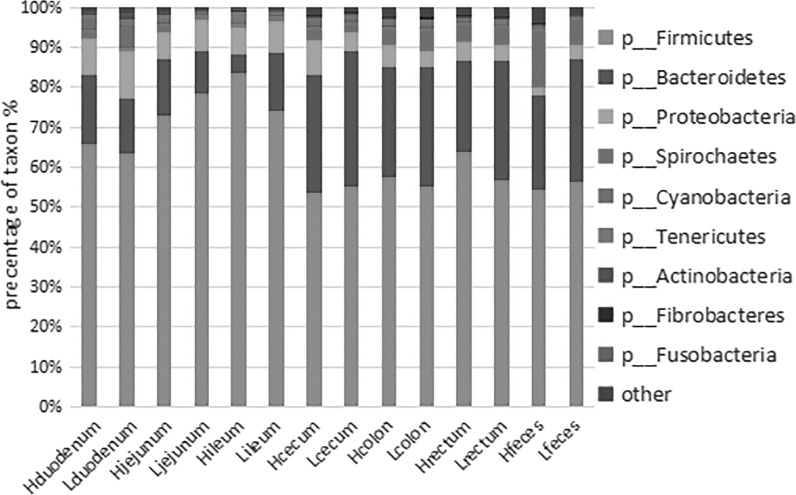
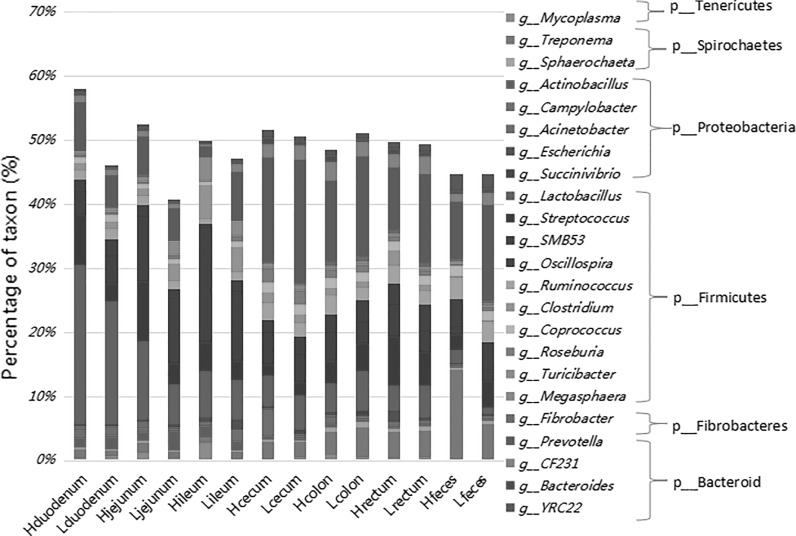
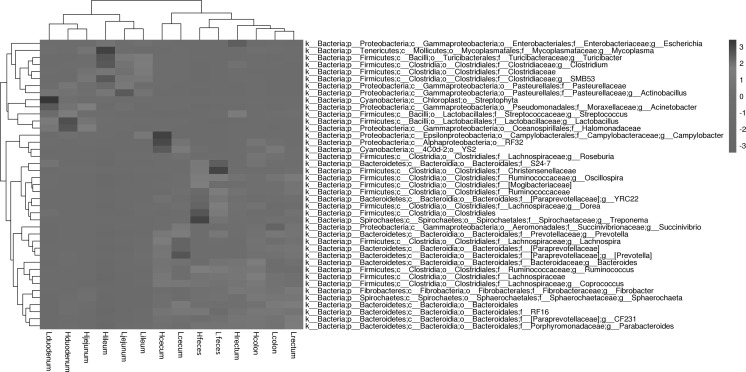
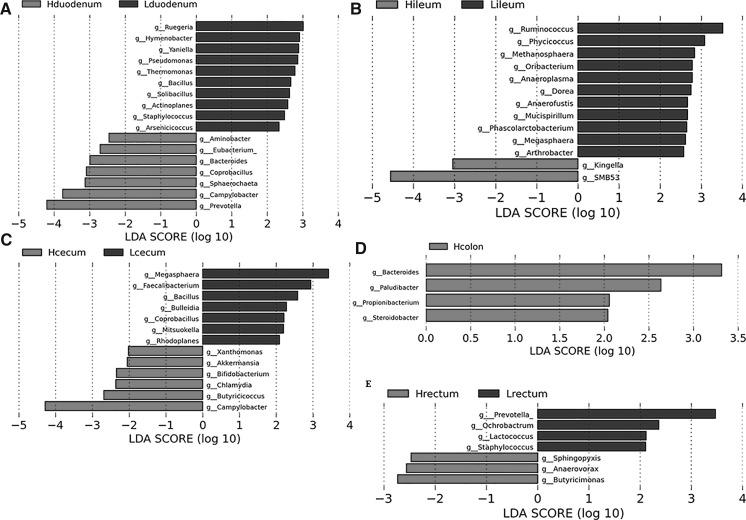
The goal of this study was to evaluate the microbial communities in the gut and feces from female finishing Landrace pigs with high and low feed conversion ratio (FCR) by 16S rRNA gene amplicon sequencing. Many potential biomarkers can distinguish between high and low FCR groups in the duodenum, ileum, cecum, colon, and rectum, according to linear discriminant analysis effect sizes. The relative abundance of microbes were tested by Mann-Whitney test between the high and low FCR groups in different organs: Campylobacter, Prevotella and Sphaerochaeta were different in the duodenum (P < 0.05); Sanguibacter, Kingella and Anaeroplasma in jejunum; Anaeroplasma, Arthrobacter, Kingella, Megasphaera and SMB53 in the ileum; Butyricicoccus, Campylobacter, Mitsuokella, and Coprobacillus in the cecum; Lactococcus and Peptococcus in the colon; Staphylococcus in the rectum; and Rothia in feces. The prevalence of microbial genera in certain locations could potentially be used as biomarkers to distinguish between high and low FCR. Functional prediction clustering analysis suggested that bacteria in the hindgut mainly participated in carbohydrate metabolism and amino acid metabolism, and different in the relative abundance of metabolic pathways, as predicted from the microbial taxa present, were identified by comparing the high and low groups of each location. The results may provide insights for the alteration of the intestinal microbial communities to improve the growth rate of pigs.
本研究的目的是通过16S rRNA基因扩增子测序评估高饲料转化率(FCR)和低饲料转化率的雌性长白育肥猪肠道和粪便中的微生物群落。根据线性判别分析效应大小,许多潜在的生物标志物可以区分十二指肠、回肠、盲肠、结肠和直肠中的高FCR组和低FCR组。通过Mann-Whitney检验对不同器官中高FCR组和低FCR组之间的微生物相对丰度进行了测试:十二指肠中弯曲杆菌属、普雷沃氏菌属和螺旋体属存在差异(P<0.05);空肠中的血杆菌属、金氏菌属和厌氧原体属;回肠中的厌氧原体属、节杆菌属、金氏菌属、巨球形菌属和SMB53;盲肠中的丁酸球菌属、弯曲杆菌属、光岗菌属和粪杆菌属;结肠中的乳球菌属和消化球菌属;直肠中的葡萄球菌属;粪便中的罗氏菌属。某些部位微生物属的患病率可能被用作区分高FCR和低FCR的生物标志物。功能预测聚类分析表明,后肠中的细菌主要参与碳水化合物代谢和氨基酸代谢,通过比较每个部位的高组和低组,从存在的微生物分类群预测出代谢途径的相对丰度存在差异。该结果可能为改变肠道微生物群落以提高猪的生长速度提供见解。