College of Pharmacy, Nanjing University of Chinese Medicine, Nanjing 210023, China.
Molecules. 2018 Mar 13;23(3):643. doi: 10.3390/molecules23030643.
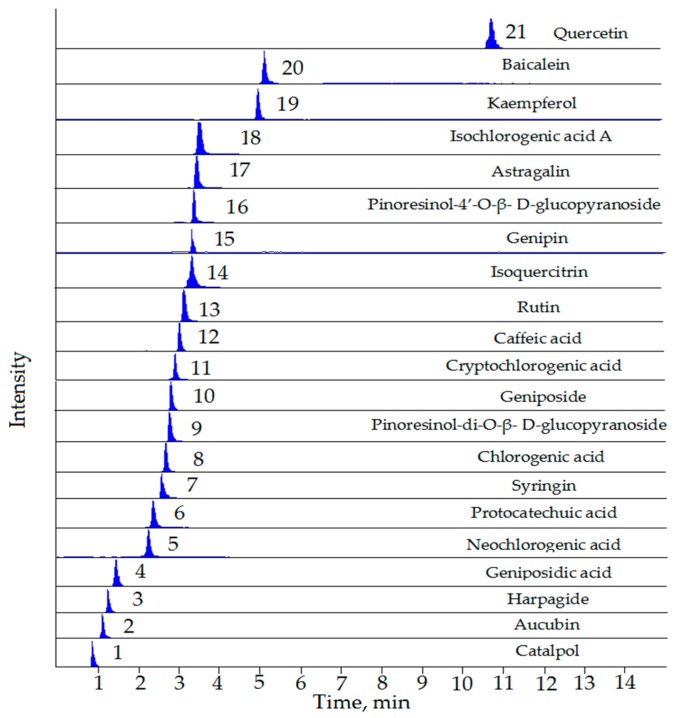
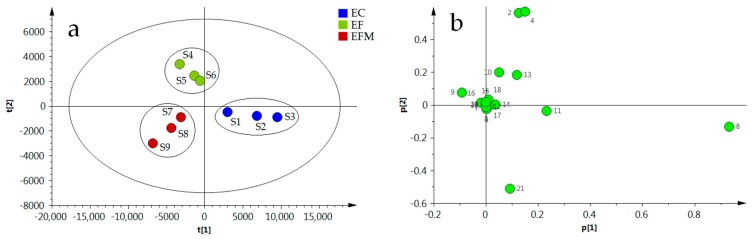
Oilv. (EU), also called Du-zhong, is a classical traditional Chinese medicine. Its bark, leaf, and male flower are all used for medicinal purposes, called Eucommiae Cortex (EC), Eucommiae Folium (EF), and Eucommiae Flos Male (EFM). In order to study the difference in synthesis and the accumulation of metabolites in different parts of EU, a reliable method based on ultra-fast liquid chromatography tandem triple quadrupole mass spectrometry (UFLC-QTRAP-MS/MS) was developed for the simultaneous determination of a total of 21 constituents, including two lignans, 6 iridoids, 6 penylpropanoids, 6 flavonoids, and one phenol in the samples (EC, EF, and EFM). Furthermore, principal component analysis (PCA) was performed to evaluate and classify the samples according to the contents of these 21 constituents. All of the results demonstrated that the chemical compositions in EC, EF, and EFM were significantly different and the differential constituents (i.e., aucubin, geniposidic acid, chlorogenic acid, pinoresinol-di--β-d-glucopyranoside, geniposide, cryptochlorogenic acid, rutin, and quercetin) were remarkably associated with sample classifications. The research will provide the basic information for revealing the laws of metabolite accumulation in EC, EF, and EFM from the same origin.
杜仲(Oilv. (EU)),又称杜仲,是一种经典的传统中药。其树皮、叶和雄花均可入药,分别称为杜仲皮(Eucommiae Cortex,EC)、杜仲叶(Eucommiae Folium,EF)和杜仲雄花(Eucommiae Flos Male,EFM)。为了研究杜仲不同部位合成和代谢物积累的差异,本研究建立了一种基于超快速液相色谱串联三重四极杆质谱(UFLC-QTRAP-MS/MS)的可靠方法,用于同时测定 21 种成分,包括 EC、EF 和 EFM 中的 2 种木脂素、6 种环烯醚萜、6 种苯丙素、6 种黄酮类和 1 种酚类化合物。此外,还进行了主成分分析(PCA),根据这 21 种成分的含量对样品进行评估和分类。所有结果表明,EC、EF 和 EFM 的化学成分有显著差异,差异成分(即桃叶珊瑚苷、京尼平酸、绿原酸、松脂醇二-β-D-吡喃葡萄糖苷、京尼平苷、隐绿原酸、芦丁和槲皮素)与样品分类密切相关。本研究将为揭示 EC、EF 和 EFM 从同一来源积累代谢物的规律提供基础信息。