Bae Junu, Zhou Zijian, Theis Thomas, Warren Warren S, Wang Qiu
Department of Chemistry, Duke University, Durham, NC 27708, USA.
Department of Physics, Duke University, Durham, NC 27708, USA.
Sci Adv. 2018 Mar 9;4(3):eaar2978. doi: 10.1126/sciadv.aar2978. eCollection 2018 Mar.
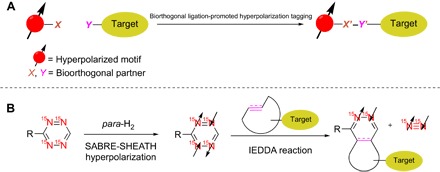
Hyperpolarized magnetic resonance (HP-MR) is a powerful, sensitive, and noninvasive approach to visualize molecular structure, function, and dynamics in vitro and in vivo. Current applications of HP-MR mostly rely on hyperpolarization of target compounds in dedicated hyperpolarizers because biomolecules can typically not be hyperpolarized directly in vivo. The injected hyperpolarized probes often undergo multiple metabolic pathways in living systems, and it remains challenging to localize and identify specific targets with high chemical selectivity. To address these current limitations in HP-MR, we report a novel hyperpolarization tagging strategy that integrates bioorthogonal chemistry and hyperpolarization to achieve the specific hyperpolarization of targets. This strategy is demonstrated by studies of hyperpolarized N-1,2,4,5-tetrazines, which undergo rapid and selective cycloaddition with cyclooctyne to provide hyperpolarized N-containing cycloaddition products and hyperpolarized N gas. This work not only suggests great potential of N-1,2,4,5-tetrazines as molecular tags in HP-MR imaging (HP-MRI) but also supports the production of hyperpolarized -N gas, a biologically and medically innocuous gas with great potential for HP-MRI. This bioorthogonal reaction-based hyperpolarization tagging strategy enables a new class of in vitro and in vivo applications.
超极化磁共振(HP-MR)是一种强大、灵敏且无创的方法,可在体外和体内可视化分子结构、功能及动力学。目前HP-MR的应用大多依赖于在专用超极化器中对目标化合物进行超极化,因为生物分子通常无法在体内直接被超极化。注入的超极化探针在生物系统中常常会经历多种代谢途径,要以高化学选择性定位和识别特定靶点仍然具有挑战性。为解决HP-MR目前存在的这些局限性,我们报告了一种新型超极化标记策略,该策略整合了生物正交化学和超极化技术以实现对靶点的特异性超极化。通过对超极化的1,2,4,5-四嗪的研究证明了这一策略,1,2,4,5-四嗪与环辛炔快速且选择性地发生环加成反应,生成超极化的含氮环加成产物和超极化的氮气。这项工作不仅表明1,2,4,5-四嗪作为HP-MR成像(HP-MRI)中的分子标记具有巨大潜力,还支持了超极化氮气的产生,氮气是一种对生物和医学无害且在HP-MRI方面具有巨大潜力的气体。这种基于生物正交反应的超极化标记策略开启了一类新的体外和体内应用。