Division of Microbiology and Immunology, Pathology Department and Biology Department, University of Utah School of Medicine, Salt Lake City, UT, USA.
Biology Department, University of Utah, Salt Lake City, UT, USA.
BMC Genomics. 2018 Mar 27;19(1):218. doi: 10.1186/s12864-018-4597-x.
With approximately one-third of their genomes consisting of linear and circular plasmids, the Lyme disease agent cluster of species has the most complex genomes among known bacteria. We report here a comparative analysis of plasmids in eleven Borreliella (also known as Borrelia burgdorferi sensu lato) species.
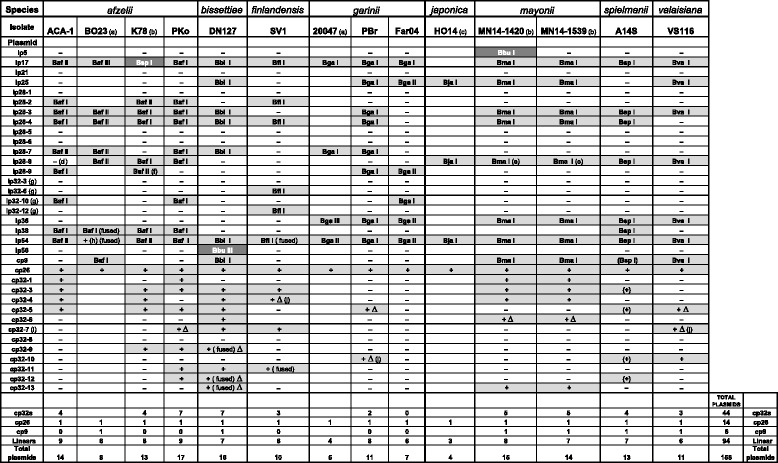
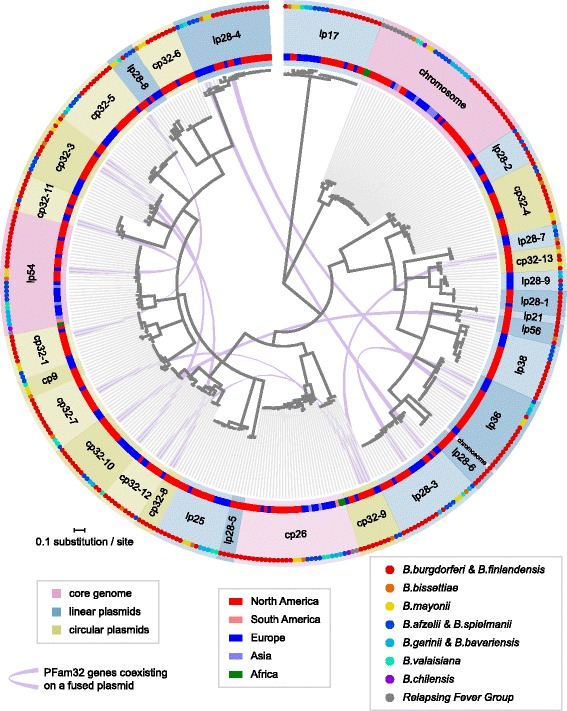
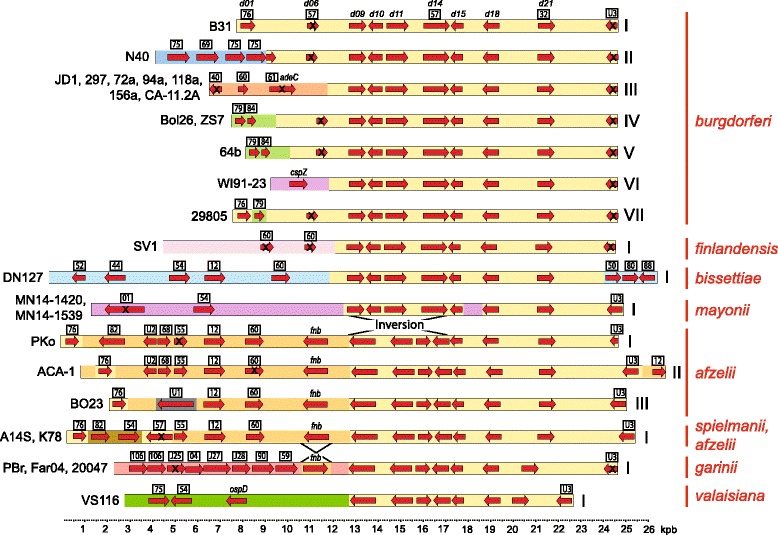
We sequenced the complete genomes of two B. afzelii, two B. garinii, and individual B. spielmanii, B. bissettiae, B. valaisiana and B. finlandensis isolates. These individual isolates carry between seven and sixteen plasmids, and together harbor 99 plasmids. We report here a comparative analysis of these plasmids, along with 70 additional Borreliella plasmids available in the public sequence databases. We identify only one new putative plasmid compatibility type (the 30th) among these 169 plasmid sequences, suggesting that all or nearly all such types have now been discovered. We find that the linear plasmids in the non-B. burgdorferi species have undergone the same kinds of apparently random, chaotic rearrangements mediated by non-homologous recombination that we previously discovered in B. burgdorferi. These rearrangements occurred independently in the different species lineages, and they, along with an expanded chromosomal phylogeny reported here, allow the identification of several whole plasmid transfer events among these species. Phylogenetic analyses of the plasmid partition genes show that a majority of the plasmid compatibility types arose early, most likely before separation of the Lyme agent Borreliella and relapsing fever Borrelia clades, and this, with occasional cross species plasmid transfers, has resulted in few if any species-specific or geographic region-specific Borreliella plasmid types.
The primordial origin and persistent maintenance of the Borreliella plasmid types support their functional indispensability as well as evolutionary roles in facilitating genome diversity. The improved resolution of Borreliella plasmid phylogeny based on conserved partition-gene clusters will lead to better determination of gene orthology which is essential for prediction of biological function, and it will provide a basis for inferring detailed evolutionary mechanisms of Borreliella genomic variability including homologous gene and plasmid exchanges as well as non-homologous rearrangements.
莱姆病病原体种簇的基因组约有三分之一由线性和圆形质粒组成,是已知细菌中基因组最为复杂的。我们在此报告对 11 种伯氏疏螺旋体(也称为伯氏包柔螺旋体亚种)物种的质粒进行的比较分析。
我们对两个阿费尔森氏疏螺旋体、两个伽氏疏螺旋体以及个别斯氏疏螺旋体、比斯氏疏螺旋体、瓦莱州疏螺旋体和芬兰疏螺旋体分离株的完整基因组进行了测序。这些单个分离株携带 7 到 16 个质粒,总共携带 99 个质粒。我们在此报告对这些质粒以及公共序列数据库中 70 个额外的伯氏疏螺旋体质粒的比较分析。在这 169 个质粒序列中,我们只鉴定出一种新的假定质粒相容性类型(第 30 种),这表明所有或几乎所有这样的类型现在都已被发现。我们发现,非伯氏包柔螺旋体物种中的线性质粒经历了与我们之前在伯氏包柔螺旋体中发现的相同的、由非同源重组介导的看似随机、混乱的重排。这些重排在不同的物种谱系中独立发生,再加上这里报告的扩展的染色体系统发育,允许鉴定出这些物种之间的几次全质粒转移事件。质粒分隔基因的系统发育分析表明,大多数质粒相容性类型起源于早期,很可能在莱姆病病原体伯氏疏螺旋体和回归热螺旋体属分支分离之前,并且这与偶尔的跨物种质粒转移一起,导致很少有如果有的话,伯氏疏螺旋体质粒类型具有物种特异性或地理区域特异性。
伯氏疏螺旋体质粒类型的原始起源和持续维持支持了它们作为促进基因组多样性的功能不可或缺性和进化作用。基于保守分隔基因簇提高的伯氏疏螺旋体质粒系统发育分辨率将导致更好地确定基因的同源性,这对于预测生物学功能至关重要,并且它将为推断伯氏疏螺旋体基因组变异性的详细进化机制提供基础,包括同源基因和质粒交换以及非同源重排。