Graduate School of Public Health, Teikyo University.
Division of Nephrology and Hypertension, The Jikei University School of Medicine.
J Atheroscler Thromb. 2018 Dec 1;25(12):1206-1214. doi: 10.5551/jat.42036. Epub 2018 Mar 27.
Shift workers have a high risk of cardiovascular disease (CVD). Systemic inflammation measured has been associated with the risk of CVD onset, in addition to classical risk factors. However, the association between work schedule and inflammatory cytokine levels remains unclear. The purpose of this study was to examine the association between work schedule and interleukin-6 (IL-6)/high-sensitivity C-reactive protein (hs-CRP) levels among Japanese workers.
The present cross-sectional study was a part of the Japanese Study of Health, Occupation and Psychosocial Factors Related Equity (J-HOPE). A total of 5259 persons who measured inflammatory cytokine were analyzed in this study. One-way analysis of variance was used to test log-transformed IL-6/hs-CRP differences by work schedule. Multiple regression analysis was used to examine the difference adjusted for other possible CVD risk factors.
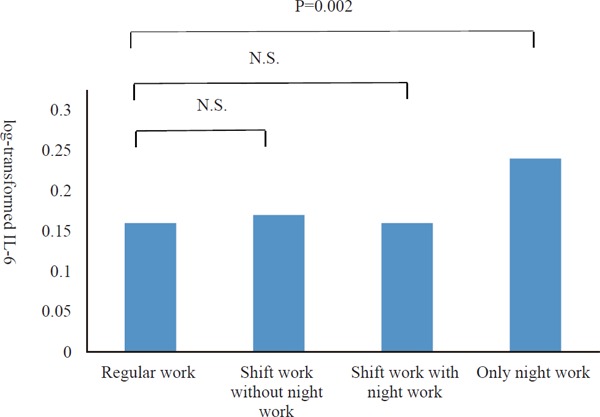
There were 3660 participants who had a regular work schedule; the remaining schedules were shift work without night work for 181 participants, shift work with night work for 1276 participants, and only night work for 142 participants. The unadjusted model showed that only night workers were significantly related to high levels of IL-6 compared with regular workers. Even in the multiple regression analysis, the higher level of IL-6 among only night workers remained significant (β=0.058, P=0.01). On the contrary, hs-CRP was not.
The present study revealed that only night shift work is significantly associated with high levels of IL-6 in Japanese workers. These observations help us understand the mechanism for the association between work schedule and CVD onset.
轮班工作者患心血管疾病(CVD)的风险较高。除了经典的危险因素外,测量到的系统性炎症与 CVD 发病风险相关。然而,工作时间表与炎症细胞因子水平之间的关系仍不清楚。本研究旨在研究日本工人的工作时间表与白细胞介素-6(IL-6)/高敏 C 反应蛋白(hs-CRP)水平之间的关系。
本横断面研究是日本健康、职业和与公平相关的心理社会因素研究(J-HOPE)的一部分。本研究共分析了 5259 名测量炎症细胞因子的人。采用单因素方差分析检验工作时间表对 log 转换的 IL-6/hs-CRP 差异的影响。采用多元回归分析检验对其他可能的 CVD 危险因素进行调整后的差异。
有 3660 名参与者有规律的工作时间表;其余时间表为 181 名无夜班的轮班工作,1276 名有夜班的轮班工作和 142 名只有夜班的轮班工作。未调整模型显示,只有夜班工人与常规工人相比,IL-6 水平显著升高。即使在多元回归分析中,只有夜班工人的 IL-6 水平仍然显著升高(β=0.058,P=0.01)。相反,hs-CRP 则不然。
本研究表明,日本工人中只有夜班工作与高水平的 IL-6 显著相关。这些观察结果有助于我们了解工作时间表与 CVD 发病之间的关联机制。