Silva Bruna S de Alencar, Lira Fábio S, Rossi Fabrício E, Ramos Dionei, Uzeloto Juliana S, Freire Ana P C F, de Lima Fabiano F, Gobbo Luís A, Ramos Ercy M C
Skeletal Muscle Assessment Laboratory, Department of Physical Education, São Paulo State University (UNESP), Presidente Prudente, Brazil.
Exercise and Immunometabolism Research Group, Department of Physical Education, São Paulo State University (UNESP), Presidente Prudente, Brazil.
Front Physiol. 2018 Mar 23;9:262. doi: 10.3389/fphys.2018.00262. eCollection 2018.
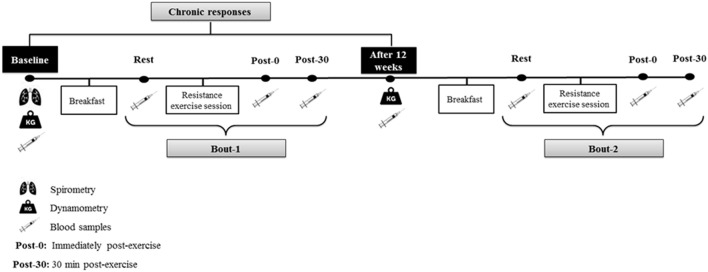
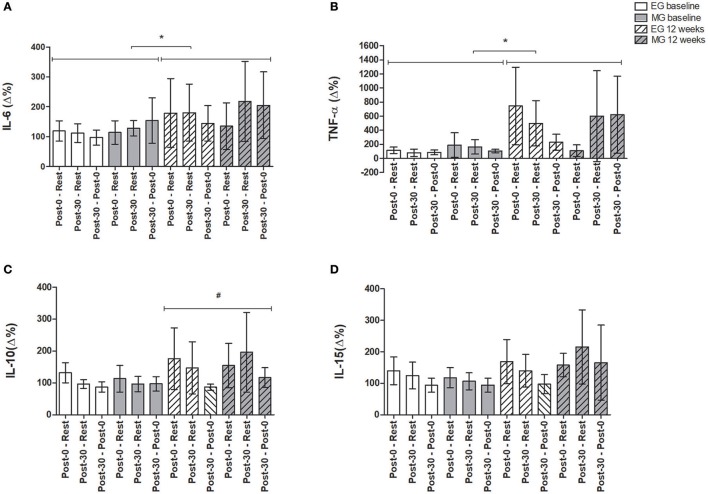
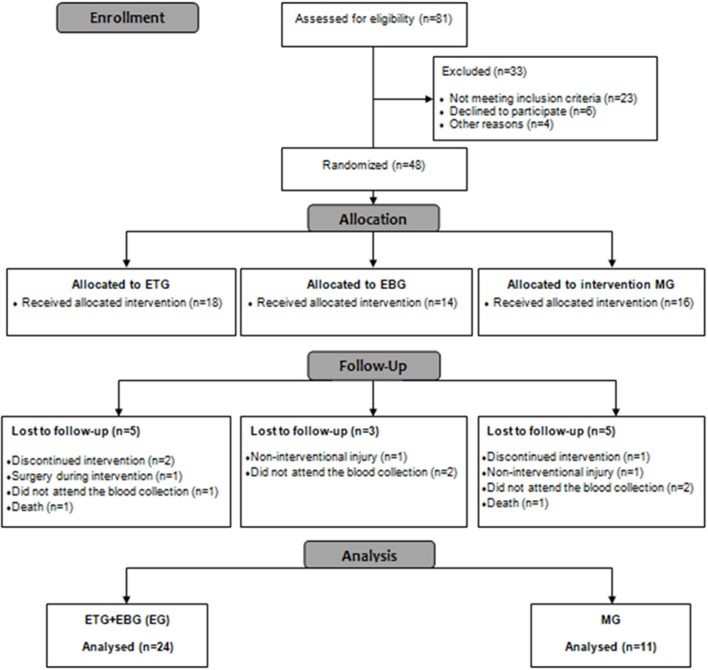
Low-grade inflammation can be present in chronic obstructive pulmonary disease (COPD), which may affect the regulation of muscle protein and body metabolism. Regular exercise show improvement in muscle strength and dyspnea in patients with COPD, however, the response to training on inflammatory and metabolic disorders is unclear. In this study, we compared the effects of resistance training using weight machines and elastic resistance (bands and tubes) on the inflammatory and metabolic responses in patients with COPD. Patients with COPD were randomized into three groups: elastic band group (EBG), elastic tube group (ETG), and weight machines equipment group (MG). EBG and ETG were analyzed together [elastic group (EG)]. The participants were evaluated for pulmonary function (spirometry), peripheral muscle strength (digital dynamometry), IL-6, TNF-α, IL-10, IL-15 (Immunoassay), glucose, triacylglycerol, total cholesterol, HDL-c, and albumin levels (Enzymatic colorimetric). Blood samples were collected to assess the acute and chronic exercise responses after 12 weeks of training protocol. The patient's mean age was 71.53 ± 6.97 years old. FEV (percent predicted) was 50.69 ± 16.67 and 45.40 ± 15.15% for EG and MG, respectively ( = 0.28). All groups increased muscle strength ( < 0.05) with no differences between groups. The acute response to exercise after 12 weeks of training showed improvement of inflammation when compared to baseline. Regarding the chronic effects, it was observed a decrease of all cytokines, except IL-10 ( < 0.05). After 12 weeks of training, the analysis of the metabolic profile presented a reduction in glucose concentration ( < 0.01), with no differences between groups ( = 0.30) and a decrease in triacylglycerol for the EG ( > 0.01). Training with elastic resistances or conventional weight machines showed improvement of inflammation response after 12 weeks of training. Chronically, both training groups showed anti-inflammatory effects, with the EG showing a strong tendency to improve IL-10/TNF-α ratio and IL-10 levels.
RBR-6V9SJJ.
慢性阻塞性肺疾病(COPD)中可能存在低度炎症,这可能会影响肌肉蛋白调节和身体代谢。规律运动可改善COPD患者的肌肉力量和呼吸困难,然而,训练对炎症和代谢紊乱的反应尚不清楚。在本研究中,我们比较了使用重量器械和弹性阻力(弹力带和弹力管)进行抗阻训练对COPD患者炎症和代谢反应的影响。COPD患者被随机分为三组:弹力带组(EBG)、弹力管组(ETG)和重量器械组(MG)。EBG和ETG合并分析[弹性组(EG)]。对参与者进行肺功能(肺活量测定)、外周肌肉力量(数字测力计)、白细胞介素-6(IL-6)、肿瘤坏死因子-α(TNF-α)、白细胞介素-10(IL-10)、白细胞介素-15(IL-15)(免疫测定)、葡萄糖、三酰甘油、总胆固醇、高密度脂蛋白胆固醇(HDL-c)和白蛋白水平(酶比色法)评估。在12周训练方案后采集血样以评估急性和慢性运动反应。患者平均年龄为71.53±6.97岁。EG组和MG组的第一秒用力呼气容积(FEV,预测值百分比)分别为50.69±16.67%和45.40±15.15%(P = 0.28)。所有组肌肉力量均增加(P < 0.05),组间无差异。与基线相比,12周训练后的运动急性反应显示炎症有所改善。关于慢性影响,观察到除IL-10外所有细胞因子均下降(P < 0.05)。12周训练后,代谢谱分析显示葡萄糖浓度降低(P < 0.01),组间无差异(P = 0.30),EG组三酰甘油下降(P > 0.01)。使用弹性阻力或传统重量器械训练12周后炎症反应有所改善。长期来看,两个训练组均显示出抗炎作用,EG组改善IL-10/TNF-α比值和IL-10水平的趋势较强。
RBR-6V9SJJ。