Department of Public Health and Policy, University of Liverpool, Liverpool, United Kingdom.
School of Public Health, Imperial College London, London, United Kingdom.
PLoS Med. 2018 Apr 10;15(4):e1002551. doi: 10.1371/journal.pmed.1002551. eCollection 2018 Apr.
Sodium consumption is a modifiable risk factor for higher blood pressure (BP) and cardiovascular disease (CVD). The US Food and Drug Administration (FDA) has proposed voluntary sodium reduction goals targeting processed and commercially prepared foods. We aimed to quantify the potential health and economic impact of this policy.
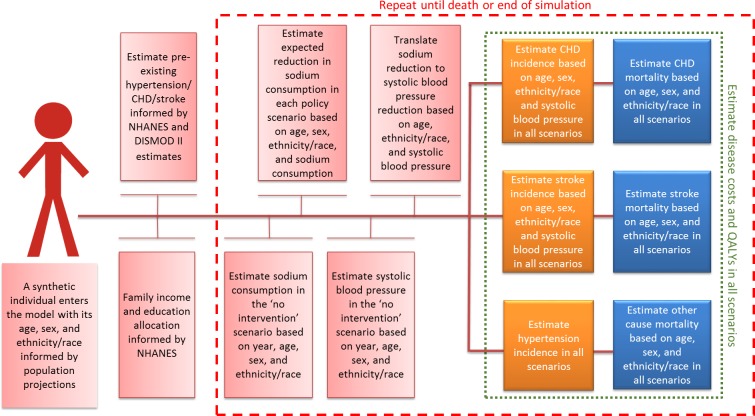
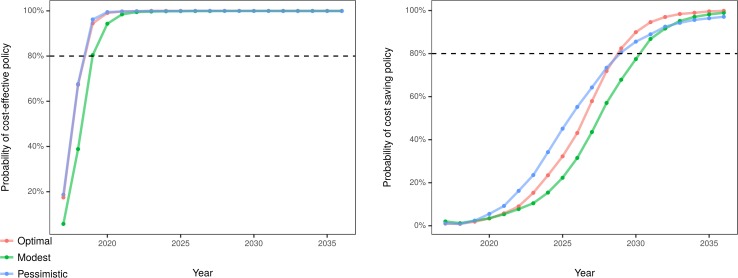
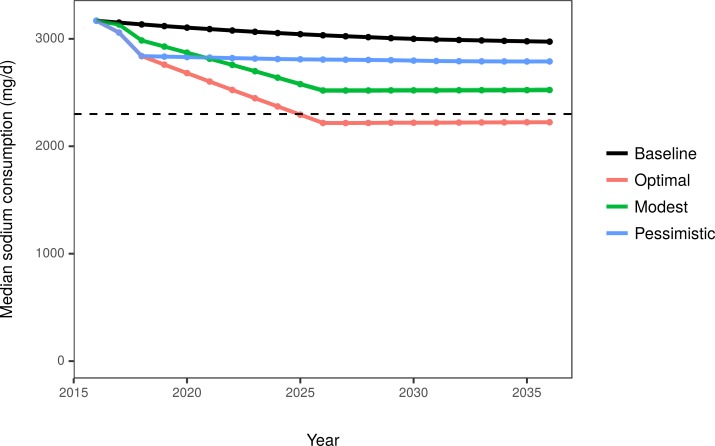
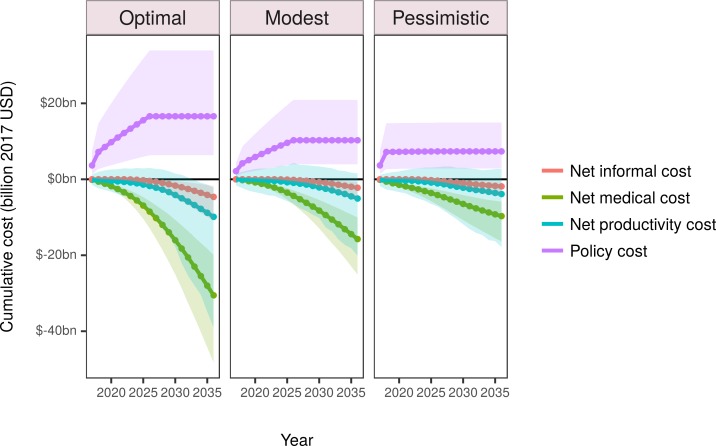
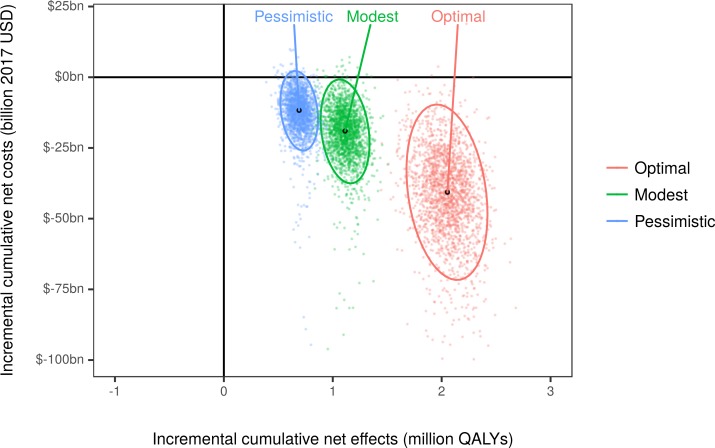
We used a microsimulation approach of a close-to-reality synthetic population (US IMPACT Food Policy Model) to estimate CVD deaths and cases prevented or postponed, quality-adjusted life years (QALYs), and cost-effectiveness from 2017 to 2036 of 3 scenarios: (1) optimal, 100% compliance with 10-year reformulation targets; (2) modest, 50% compliance with 10-year reformulation targets; and (3) pessimistic, 100% compliance with 2-year reformulation targets, but with no further progress. We used the National Health and Nutrition Examination Survey and high-quality meta-analyses to inform model inputs. Costs included government costs to administer and monitor the policy, industry reformulation costs, and CVD-related healthcare, productivity, and informal care costs. Between 2017 and 2036, the optimal reformulation scenario achieving the FDA sodium reduction targets could prevent approximately 450,000 CVD cases (95% uncertainty interval: 240,000 to 740,000), gain approximately 2.1 million discounted QALYs (1.7 million to 2.4 million), and produce discounted cost savings (health savings minus policy costs) of approximately $41 billion ($14 billion to $81 billion). In the modest and pessimistic scenarios, health gains would be 1.1 million and 0.7 million QALYS, with savings of $19 billion and $12 billion, respectively. All the scenarios were estimated with more than 80% probability to be cost-effective (incremental cost/QALY < $100,000) by 2021 and to become cost-saving by 2031. Limitations include evaluating only diseases mediated through BP, while decreasing sodium consumption could have beneficial effects upon other health burdens such as gastric cancer. Further, the effect estimates in the model are based on interventional and prospective observational studies. They are therefore subject to biases and confounding that may have influenced also our model estimates.
Implementing and achieving the FDA sodium reformulation targets could generate substantial health gains and net cost savings.
钠摄入量是导致血压升高(BP)和心血管疾病(CVD)的可改变风险因素。美国食品和药物管理局(FDA)提出了针对加工食品和商业制备食品的自愿减少钠摄入量的目标。我们旨在量化这一政策的潜在健康和经济效益。
我们使用一种接近现实的综合人群的微观模拟方法(美国影响食品政策模型)来估计 2017 年至 2036 年三种情况下的 CVD 死亡人数和预防或推迟的病例数、质量调整生命年(QALYs)以及成本效益:(1)最佳情况,100%遵守 10 年配方改革目标;(2)适度情况,遵守 50%的 10 年配方改革目标;(3)悲观情况,100%遵守 2 年配方改革目标,但没有进一步进展。我们使用国家健康和营养检查调查以及高质量的荟萃分析来为模型输入提供信息。成本包括政府管理和监测政策的成本、行业配方改革成本以及 CVD 相关的医疗保健、生产力和非正式护理成本。在 2017 年至 2036 年期间,实现 FDA 钠减排目标的最佳配方改革方案可预防约 45 万例 CVD 病例(95%置信区间:24 万至 74 万),获得约 210 万 discounted QALYs(170 万至 240 万),并产生约 410 亿美元的贴现成本节约(健康节约减去政策成本)(140 亿美元至 810 亿美元)。在适度和悲观的情况下,健康获益将分别为 110 万和 70 万 discounted QALYs,节约分别为 190 亿美元和 120 亿美元。到 2021 年,所有情景都有超过 80%的概率具有成本效益(增量成本/QALY<100,000 美元),到 2031 年将实现成本节约。限制包括仅评估通过 BP 介导的疾病,而减少钠摄入量可能对其他健康负担(如胃癌)产生有益影响。此外,模型中的效应估计基于干预性和前瞻性观察性研究。因此,它们可能受到影响我们模型估计的偏差和混杂因素的影响。
实施并实现 FDA 钠配方改革目标可带来显著的健康获益和净成本节约。